How to line up a beard neckline
The single edit that decides whether a beard reads as deliberate or as neglect - and the one people cut two inches too high.
By Sawyer V. · Published
We have not tested any of this. Everything below is compiled from published manufacturer specifications, and the arithmetic is printed so you can check it. This page carries affiliate links: if you buy through one we earn a commission at no extra cost to you, and it does not change the order of the picks. Full disclosure.
The short version
Two fingers above your Adam's apple is the lowest point of the line. From there the neckline curves upward in a U to a point just behind the back corner of your jaw on each side. It is not a straight horizontal cut, and it is not the jawline - cutting along the jaw is the mistake that removes the beard's whole silhouette. Fade the two centimeters below the line rather than leaving a hard edge.
| # | Pick | Lasts | Score | Price |
|---|---|---|---|---|
| 1 | Philips Norelco OneBlade 360 Trimming, edging and shaving with one blade | 1,300 shaves* | 7.1/10 | $39.99 - view on Amazon |
| 2 | Panasonic ER-GB80 Precise, repeatable stubble | 1,300 shaves* | 7.3/10 | Check price on Amazon |
| 3 | Wahl Aqua Blade Coarse hair and long gaps between charges | 1,300 shaves* | 7.9/10 | $69.99 - view on Amazon |
Prices last verified September 24, 2026. They move constantly; the figure on Amazon when you click is the real one.
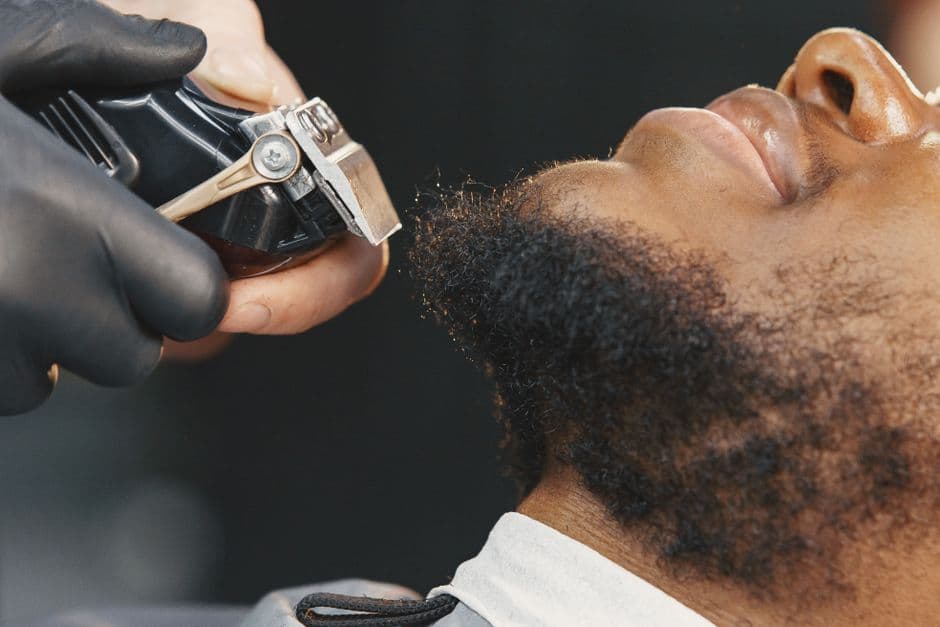
Why this one line does so much work
A beard is judged almost entirely on its edges. Length, softness and product all matter less to how a beard reads than where the hair stops on the neck - because that is the line that signals whether anybody decided anything. A neat beard with no neckline looks unkempt. An untidy beard with a clean one looks intentional.
It is also the edit with the longest recovery time. Everything else on a beard grows back in a week or two. A neckline cut too high is two months.
Where the line actually goes
Two fingers above the Adam's apple, and then a curve. That is the whole rule, and the two halves of it fail in different ways.
- The height. Put your index and middle fingers flat, horizontally, just above your Adam's apple. The top of the upper finger is the lowest point of your neckline. Higher than that and the beard starts to look like it is floating on your jaw.
- The shape. From that center point, the line curves upward to a point just behind the rear corner of the jaw on each side - a shallow U, not a straight horizontal band. A straight cut across a neck is a shelf, and it looks like one.
Making the cut without it creeping
Necklines creep upward because of a predictable loop: you cut one side, notice the other is slightly lower, even it up, notice the first is now lower, and repeat. Three rounds of that is an inch. The fix is procedural.
- Commit to the center first. One small trim at the two-finger mark, before anything else. That is now a fixed reference you work away from rather than a moving one.
- Work outward, one side at a time, back to center between sides. Center to left ear. Back to center. Center to right ear. Never left-then-right-then-left.
- Stop when you have gone round once. The asymmetry you can see today is usually smaller than the correction you would make, which is the entire mechanism of the creep.
The fade below the line
A hard edge is what makes a home neckline look like a home neckline. Below the line, take a guard one or two steps shorter and blend downward for about two centimeters, then a bare edge below that.
| Zone | Setting | What it does |
|---|---|---|
| Above the line | 6 mm (your beard length) | Untouched |
| The line itself | 3 mm | Softens the transition rather than cutting a step |
| 1-2 cm below | 1.5 mm | The blend that makes it read as natural |
| Below that | Bare blade, 0.2-0.5 mm | Clean neck |
This is the reason a trimmer with fine millimeter resolution beats one with numbered combs for neck work: the steps you need here are smaller than the eighth-of-an-inch jumps the numbered scale gives you. The guards guide has the full conversion, and the trimmer roundup ranks on published range and resolution.
Checking it properly
Straight-on in a mirror is the worst possible view of a neckline, because it is the only angle from which asymmetry disappears. Turn your head roughly 45 degrees each way and look at the line where it meets the jaw corner. That is the view other people have of you, and it is where an uneven line announces itself.
Then leave it. If one side is genuinely off, it will still be off tomorrow in daylight, and you will make a smaller correction than you would now.
While you are there: the cheek line
The other edge is easier and gets less attention. Two approaches, both defensible:
- Leave it. Trim only the strays well above the natural line. This suits most people and most beards, and it is what the full trimming guide recommends by default.
- Define it. A straight line from the corner of the mustache to the top of the sideburn. It reads as sharper and it needs redoing every few days, so it is a commitment rather than a one-off.
What determines which suits you is mostly face shape rather than preference - that page works through it.
Every pick, with the working
Each entry shows the published specifications, the axis scores they produce and what you give up. The order is the computed order, not a commercial one, and the arithmetic is open underneath every score.
Our pickTrimming, edging and shaving with one blade
Philips Norelco OneBlade 360
Not a shaver and not a trimmer: a single oscillating blade that trims with a comb, edges without one and takes stubble down close without ever going properly bare. 45 minutes of runtime, five comb lengths from 0.2 to 5 mm, waterproof, and Philips publishes a four-month blade life with an indicator that tells you when it is up.
- Runtime
- 45 min
- Charge time
- Not published
- Length settings
- 5
- Cutting range
- 0.2 - 5 mm
- Head replacement
- Every 4 months
- Waterproof
- Yes
- Made in
- Not published
- Refill
- Proprietary to the maker
- Warranty
- Not published
- Assumed service life
- 1,300 uses
The arithmetic: 260 uses a year x 5 years of assumed service life = 1300 uses.
What it gets right
- Published four-month blade life with a wear indicator on the blade itself
- Five comb settings from 0.2 mm to 5 mm plus bare-blade edging
- 45-minute runtime, 100% waterproof, usable in the shower
- The cheapest entry point to a powered shave here by a wide margin
Flaws
- It will not give you a properly bare shave; that is a design decision, not a fault
- Proprietary blades, replaced on a schedule, which is the real cost of ownership
- 45 minutes of runtime
The working behind the 7.1
- How long it lasts: not scored
- Not scored. This is a durable item, not a consumable, so how long it lasts is an assumption about service life rather than something the pack size tells us.
- Ease of switching: 9.5
- Published 4-month blade life with an indicator, so the one maintenance decision is made for you (++), waterproof and shower-usable (+), five published comb lengths (+), proprietary blades on a schedule (-).
- Refill economics: 4.0
- Only this maker's refill fits, so the ongoing price is set by the maker rather than by a market. This is where the real cost of ownership hides.
- What the maker publishes: 6.0
- 3 of 5 specifications a buyer would expect are published: runtimeMin, waterproof, headReplacementMonths. Not published: chargeMin, cuttingElements. 3 / 5 x 10 = 6.0.
Axes with no published input are dropped and the remaining weights re-normalized, so a product is not punished for a category where an axis does not apply. Specifications compiled 3 September 2026 from Philips Norelco OneBlade 360 published specifications.
2Precise, repeatable stubble
Panasonic ER-GB80
39 length settings from 0.5 to 20 mm across three comb attachments, 45-degree stainless blades, 50 minutes of runtime from a one-hour charge, and it is washable. If you keep a specific stubble length rather than a beard, this is the trimmer that lets you find the exact number and return to it.
- Runtime
- 50 min
- Charge time
- 60 min
- Length settings
- 39
- Cutting range
- 0.5 - 20 mm
- Waterproof
- Yes
- Made in
- Not published
- Refill
- Proprietary to the maker
- Warranty
- Not published
- Assumed service life
- 1,300 uses
The arithmetic: 260 uses a year x 5 years of assumed service life = 1300 uses.
What it gets right
- 39 published length settings from 0.5 mm to 20 mm — the finest increments here
- 45-degree stainless blades, published by Panasonic
- Washable, and usable corded when the battery is flat
- 50 minutes of runtime from a 1-hour charge
Flaws
- 50 minutes is the shortest runtime of the trimmers here
- 39 settings is a lot of dial to turn if you only ever use one
- No foil shaver in the box, so it will not take you to bare skin
The working behind the 7.3
- How long it lasts: not scored
- Not scored. This is a durable item, not a consumable, so how long it lasts is an assumption about service life rather than something the pack size tells us.
- Ease of switching: 8.5
- 39 published settings from 0.5 mm mean a length you like is a number you can write down and repeat (++), washable (+), 50 minutes is the shortest runtime here (-).
- Refill economics: 4.0
- Only this maker's refill fits, so the ongoing price is set by the maker rather than by a market. This is where the real cost of ownership hides.
- What the maker publishes: 8.6
- 6 of 7 specifications a buyer would expect are published: runtimeMin, chargeMin, minLengthMm, maxLengthMm, settings, waterproof. Not published: warrantyLabel. 6 / 7 x 10 = 8.6.
Axes with no published input are dropped and the remaining weights re-normalized, so a product is not punished for a category where an axis does not apply. Specifications compiled 3 September 2026 from Panasonic ER-GB80 published specifications.
3Coarse hair and long gaps between charges
Wahl Aqua Blade
180 minutes of runtime from a 60-minute charge, a published 0.2 to 25 mm cutting range, 16 guide combs, fully waterproof, and a five-year warranty with a lifetime blade warranty behind it. On coarse or dense hair the extra motor headroom and the wider guard range are what you notice.
- Runtime
- 180 min
- Charge time
- 60 min
- Length settings
- 16
- Cutting range
- 0.2 - 25 mm
- Waterproof
- Yes
- Made in
- Not published
- Refill
- Proprietary to the maker
- Warranty
- 5 years, plus lifetime blade warranty
- Assumed service life
- 1,300 uses
The arithmetic: 260 uses a year x 5 years of assumed service life = 1300 uses.
What it gets right
- 180 minutes of published runtime — by a distance the longest here — and 3 minutes from a 1-minute charge
- 0.2 to 25 mm published cutting range, the widest in this ledger
- Fully waterproof and rinseable
- 5-year warranty plus a lifetime blade warranty, published by Wahl
Flaws
- 16 guide combs is a drawer's worth of plastic
- Model numbering across the 9899 family is confusing; variants differ in what is in the box
The working behind the 7.9
- How long it lasts: not scored
- Not scored. This is a durable item, not a consumable, so how long it lasts is an assumption about service life rather than something the pack size tells us.
- Ease of switching: 9.0
- 180 minutes of published runtime and a 1-minute quick charge mean the battery never enters the decision (++), waterproof (+), widest published length range here (+), 16 combs to store (-).
- Refill economics: 4.0
- Only this maker's refill fits, so the ongoing price is set by the maker rather than by a market. This is where the real cost of ownership hides.
- What the maker publishes: 10.0
- 7 of 7 specifications a buyer would expect are published: runtimeMin, chargeMin, minLengthMm, maxLengthMm, settings, waterproof, warrantyLabel. 7 / 7 x 10 = 10.0.
Axes with no published input are dropped and the remaining weights re-normalized, so a product is not punished for a category where an axis does not apply. Specifications compiled 3 September 2026 from Wahl Aqua Blade published specifications.
Prices last verified September 24, 2026. They move constantly; the figure on Amazon when you click is the real one.
Questions people actually ask
Where exactly should a beard neckline be?
Two fingers above the Adam's apple at the lowest point, curving up to just behind the rear corner of the jaw on each side. If you can put three or more fingers between the line and your Adam's apple, it is too high, and that is the most common error in home beard trimming.
Should the neckline follow the jawline?
No, and this is the error worth naming twice. Cutting along the jaw removes the hair that gives a beard its shape from the side, leaves a hard shelf under the chin, and makes a double chin more obvious rather than less. The line goes on the neck, below the jaw.
How do I fix a neckline I cut too high?
You wait. There is no correction - hair grows at roughly half an inch a month, so a neckline cut an inch too high is about two months of growing out. In the meantime, keep the beard slightly longer overall so the proportions read better, and do not trim the neck again until it has caught up.
How often should I redo the neckline?
Every one to two weeks. Necklines blur faster than the beard grows out, because the hair below the line is the shortest and therefore the most visible when it returns. Doing it often also means each edit is small, which is the real protection against creeping upward.
What tool should I use for a neckline?
A trimmer with a bare-blade edge - the Philips OneBlade publishes a 0.2 mm bare-blade setting and Panasonic publishes 0.5 mm as its shortest. Anything with fine millimeter resolution beats numbered guards here, because the fade under the line needs steps smaller than an eighth of an inch. The guards guide covers why.