Philips Norelco 7800 review
Almost nothing in this category tells you when its cutting parts are done. This one does, and checking the figure turned out to matter more than reporting it.
By Sawyer V. · Published
We have not tested any of this. Everything below is compiled from published manufacturer specifications, and the arithmetic is printed so you can check it. This page carries affiliate links: if you buy through one we earn a commission at no extra cost to you, and it does not change the order of the picks. Full disclosure.
The short version
Buy it if you want a rotary shaver that tells you when to replace the heads. Philips states 12 months for the SH71 heads, which is a schedule rather than a guess - and Braun publishes nothing at all for the Series 7 or Series 8. Note the figure, because it is widely reported wrong, including on this site until today: the "two years" attached to these heads is Philips' line about them cutting 9 million hairs in that time, not a replacement interval. The rest is well published - 45 self-sharpening blades at up to 90,000 cutting actions per minute, 360-degree flexing heads, 60 minutes of runtime, a 1-hour full charge and a 5-minute quick charge, fully washable and usable in the shower. Four of its headline claims carry asterisks whose footnotes are not on the page.
| # | Pick | Lasts | Score | Price |
|---|---|---|---|---|
| 1 | Philips Norelco 7800 Rotary heads and a published head interval | 1,300 shaves* | 6.9/10 | $169.96 - view on Amazon |
Prices last verified November 12, 2026. They move constantly; the figure on Amazon when you click is the real one.
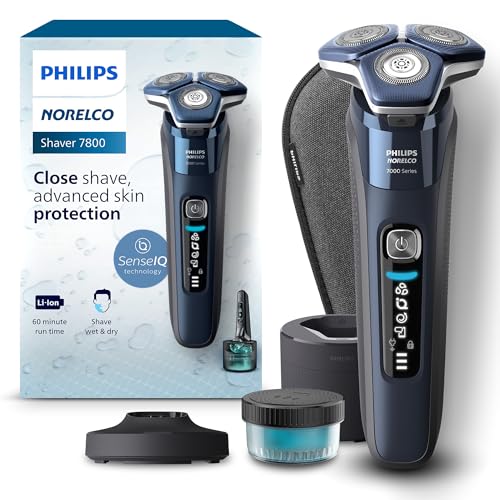
What it is
A mid-range rotary shaver: three circular heads that Philips publishes as flexing through 360 degrees, carrying 45 SteelPrecision blades which Philips states are self-sharpening, made in Europe, and performing up to 90,000 cutting actions per minute. It runs 60 minutes on a charge, takes 1 hour to fill and gives one full shave off a 5-minute top-up. It is waterproof - dry, wet with gel or foam, or in the shower - and the head flips open at a button press for rinsing.
On this site it holds two awards, Best rotary shaver and Best low-maintenance electric shaver, and the second of those is the interesting one - because it was awarded on a figure that turns out to have been wrong.
The figure, and the correction
Until this review, five pages on this site said Philips publishes a two-year head replacement interval for the SH71 heads, and called it the longest published interval in the ledger. Philips' own SH71 page says something different:
The second sentence is a usage statistic deployed as an argument for replacing - not a statement of service life. Read at speed, next to a replacement product, it looks exactly like an interval. That is how it ended up in this ledger as twenty-four months, and it is the sort of error that only surfaces when somebody goes back to the maker rather than to the summary.
The consequence is not small. At 12 months the 7800 is no longer the longest published interval here - Braun states 18 months for the Series 9 PRO+ cassette. Every page that carried the old figure now carries twelve months, and the superlative has moved to Braun where it belongs.
Why it still earns the low-maintenance pick
Because the axis was never really "longest" - it was "stated at all". Lay the category out and the point is obvious.
| Shaver | Published interval | Published by |
|---|---|---|
| Braun Series 9 PRO+ | 18 months (cassette) | Braun |
| Philips Norelco 7800 | 12 months (SH71 heads) | Philips |
| Philips OneBlade 360 | 4 months, with a wear indicator | Philips |
| Braun Series 7 | Not published | - |
| Braun Series 8 | Not published | - |
| Panasonic Arc5 | Not published | - |
| Remington F5 / F4 | Not published | - |
Three products out of seven give you a date. A worn foil or head does not announce itself - it gets gradually less comfortable over a year or more, slowly enough that most people blame their skin, their beard or the weather. Without a stated interval there is no way to tell a tired cutter from a bad week, and the usual outcome is somebody running worn parts for years and concluding that electric shaving does not suit him.
Twelve months is also, bluntly, an easier number to act on than twenty-four. An annual reminder is a habit people keep; a biennial one is a note they lose.
What is published, and what is not
| Specification | What Philips publishes |
|---|---|
| Blades | 45 SteelPrecision, self-sharpening, made in Europe |
| Cutting actions | Up to 90,000 per minute |
| Head movement | 360-degree flexing heads |
| Runtime | Up to 60 minutes |
| Charging | 1 hour full; 5-minute quick charge for one shave |
| Water rating | Waterproof - dry, wet, or in the shower |
| Head interval | 12 months (SH71) |
| Warranty | 2 years, up to 5 on registration |
| Power adapter | Not included - USB-A charging |
| Number of cutting heads | Not published (blade count is) |
| Corded operation | Not published |
| Weight and dimensions | Not published |
Four claims with footnotes we cannot read
Philips' page carries a set of asterisked claims and does not put the footnotes anywhere on it. We are naming them rather than repeating them as specifications, because the difference between a published figure and a qualified marketing claim is the whole point of this site.
- "Closer* shave" - closer than what is not stated on the page.
- Nano SkinGlide coating, "improves gliding on skin by up to 30%***" - the coating itself is published, with up to 250,000 micro-tech beads per square centimeter. The 30 per cent is the part behind the asterisk.
- "After just three shaves, the majority of men achieved a better shaving technique with fewer passes***" - a behavioral outcome, not a specification.
- Quick Clean Pod, "10x more effective than cleaning with water**" - and the pod is an accessory, not something the shave depends on.
None of these is evidence of anything wrong. They are simply not checkable, and a page that treats them as equivalent to the 60-minute runtime would be misleading you about which numbers you can rely on.
The honest limits
- No adapter in the box. Published, USB-A only.
- Philips publishes the blade count but not the number of cutting heads, which means the 45 blades cannot be compared like-for-like with a foil shaver's published cutting elements.
- No corded-operation statement. If the battery dies mid-shave, nothing published tells you whether you can keep going on the cable.
- Rotary suits a few days of growth better than a daily bare shave. That is the design, not a fault - but it is the wrong tool for somebody chasing the closest possible finish every morning.
- Proprietary heads, forever. A twelve-month schedule is a twelve-month purchase, and the running cost of this shaver is SH71 heads for as long as you own it.
What the rotary head is actually doing
Three circular cutters, each spinning behind a perforated guard, mounted on a plate Philips publishes as flexing through 360 degrees. The design exists because a face is not flat: a jawline, a chin and the hollow under a lower lip are compound curves, and a rigid straight foil has to be steered around them in several passes. Heads that pivot independently stay in contact through the curve instead.
That is also why rotary shavers suit slightly longer growth. Hairs lying in different directions get swept into a circular cutter more readily than into a straight slot, which is the mechanism behind the conventional advice that rotary handles two or three days of stubble better and foil wins on a daily bare shave. Philips supports the geometry with published hair-guiding channels molded into the head surface, positioning hair before it reaches the blade.
The figure that sits behind all of it is 90,000 cutting actions per minute across 45 blades. Treat that as a published fact rather than a comparison: Braun does not state an equivalent for its Series 7 or 8, so there is no like-for-like number to set it against, and a count of cutting actions is not interchangeable with the cutting-element counts foil makers publish. The foil-versus-rotary page is the place to work out which of the two shapes your face wants.
The coating, and what is checkable about it
Philips publishes a Nano SkinGlide coating sitting between the heads and the skin, made with up to 250,000 micro-tech beads per square centimeter. The bead density is a specification and an unusually specific one. The benefit attached to it - gliding improved by up to 30 per cent - is asterisked, and the footnote is not on the page, so we are reporting the coating and not the percentage.
Why it matters at all is friction rather than closeness. Most electric-shaver irritation comes from passes, pressure and dragging rather than from the cut itself, which is the argument the irritation page makes at length. A lower-friction head surface is a sensible thing to engineer for. Whether this one delivers a measurable improvement is not something we can tell you, and nor, on the published evidence, can Philips.
What it costs to keep running
This is the part the published interval makes calculable, and almost no other shaver on this site allows it. One SH71 head set per year, for as long as you own the shaver. That is the entire consumable cost - there is no cleaning cartridge unless you buy the pod, no blades to stock, nothing else on a schedule.
Compare that with the silence elsewhere. On a Braun Series 7 or Series 8 you are replacing a cassette at an interval Braun does not state, which means the running cost of those shavers cannot be worked out before you buy one - the price page treats a published interval as one of the few things a premium tier genuinely buys you. Our cost arithmetic only works where a maker publishes a yield or an interval, and this shaver is one of the handful that does.
The honest counterweight: twelve months is a shorter interval than Braun's eighteen, so a published schedule is not automatically a cheaper one. What it is, is a knowable one.
Owning it, in two lines
Rinse the head under a warm tap after each shave and stand it up to dry. Put one calendar reminder in for twelve months. That is the entire maintenance routine, and it is why this shaver leads the low-maintenance page even after losing its superlative.
If the shave starts feeling worse before the year is up, the reminder is not the authority - the face is. The irritation page covers what else changes when a shave degrades, most of which is technique rather than hardware.
Who should buy it
- Anybody who wants a rotary shaver and intends to own it for years without thinking about it. The published interval is the reason.
- Anybody with a contoured face, a strong jawline or curlier growth, where rotary heads have a real geometric advantage over a flat foil.
- Anybody who shaves in the shower. Published waterproof, published shower use, and a head that opens for rinsing without tools.
Who should not
- Anybody chasing the closest daily bare shave on flat planes - that is a foil shaver, and the foil page ranks those.
- Anybody buying purely on the longest published interval, which is Braun's 18 months on the Series 9 PRO+.
- Anybody who wants the simplest possible object rather than the best rotary shave. That is the OneBlade, whose blade carries its own wear indicator.
The verdict
A well-published mid-range rotary that does the thing this category is worst at: it tells you when the cutting parts are finished. Twelve months is not the longest interval here and it is a real one, stated by the maker for the model you are actually buying, which is more than Braun, Panasonic or Remington will do at any price.
The reason this review exists in its current shape is that checking that single figure changed it. We had twenty-four months; Philips says twelve. The product is unchanged and slightly less impressive than this site had been telling you - and still the only rotary here you can put a date in a calendar for.
Every pick, with the working
Each entry shows the published specifications, the axis scores they produce and what you give up. The order is the computed order, not a commercial one, and the arithmetic is open underneath every score.
Our pickRotary heads and a published head interval
Philips Norelco 7800
Forty-five self-sharpening SteelPrecision blades published at up to 90,000 cutting actions per minute, across heads Philips publishes as flexing through 360 degrees, with sixty minutes of runtime, a one-hour full charge and a five-minute quick charge. Philips publishes a head replacement interval of twelve months for the SH71 heads - not the longest in this ledger, but published at all, which most of this category is not. Fully washable, and Philips publishes that it can be used in the shower.
- Runtime
- 60 min
- Charge time
- 60 min
- Head replacement
- Every 12 months
- Waterproof
- Yes
- Made in
- Not published
- Refill
- Proprietary to the maker
- Warranty
- 2 years (up to 5 on registration)
- Assumed service life
- 1,300 uses
The arithmetic: 260 uses a year x 5 years of assumed service life = 1300 uses.
What it gets right
- Published 360-degree flexing heads - the rotary answer to a contoured face
- 45 self-sharpening blades published at up to 90,000 cutting actions per minute, made in Europe
- Published 60-minute runtime with a published 5-minute quick charge
- Published head replacement every 12 months with SH71 - a stated schedule, which most of this category does not give you
- Fully washable, wet and dry, and published as usable in the shower
- 2-year warranty published, extendable to 5 years on registration
Flaws
- The power adapter is not included - USB-A only, which Philips publishes
- Philips' own marketing sits behind four separate asterisks whose footnotes are not on the page
- Philips publishes the blade count but not the number of cutting heads
- No corded-operation statement published
- Rotary shavers suit a few days of growth better than a daily bare shave
The working behind the 6.9
- How long it lasts: not scored
- Not scored. This is a durable item, not a consumable, so how long it lasts is an assumption about service life rather than something the pack size tells us.
- Ease of switching: 8.0
- Published runtime, quick charge and a 2-year head interval (++), washable and shower-safe (+), but proprietary heads (-) and no adapter in the box (-).
- Refill economics: 4.0
- Only this maker's refill fits, so the ongoing price is set by the maker rather than by a market. This is where the real cost of ownership hides.
- What the maker publishes: 8.0
- 4 of 5 specifications a buyer would expect are published: runtimeMin, chargeMin, waterproof, headReplacementMonths. Not published: cuttingElements. 4 / 5 x 10 = 8.0.
Axes with no published input are dropped and the remaining weights re-normalized, so a product is not punished for a category where an axis does not apply. Specifications compiled 3 September 2026 from Philips Norelco 7800 (S7885/85) published runtime, charging, blades and warranty.
Prices last verified November 12, 2026. They move constantly; the figure on Amazon when you click is the real one.
If this is not the one
The alternatives named above, in one place. Each links to its own page, where the published specifications and the scoring are set out in full.
Philips Norelco OneBlade 360
If you want the simplest possible object instead of the best shave. A published 4-month blade life with a wear indicator printed on the blade, so it tells you itself.
Braun Series 7 (360° Flex)
The better shave of the two, and the opposite disclosure: Braun publishes a 360-degree head and AutoSense, and no head replacement interval at all.
Braun Series 9 PRO+
If the published interval is what you are buying on, Braun states 18 months for the Series 9 PRO+ cassette - the longest figure in this ledger.
Prices last verified November 12, 2026. They move constantly; the figure on Amazon when you click is the real one.
Questions people actually ask
How often do the heads actually need replacing?
Philips says 12 months. Its SH71 page puts it plainly - "change heads every 12 months for like-new peak performance" - and that is the figure to budget against. Treat it as an outer limit rather than a target: a head that tugs is done whatever the calendar says. The head replacement guide covers the mechanics, which on this shaver are a retaining-ring job rather than a cassette swap.
Where does the 'two years' figure come from, then?
From a different sentence on the same Philips page: "within two years, your shaver heads cut 9 million hairs on your face." That is a usage statistic used to argue for replacement, not a statement of how long the heads last. Read quickly it looks like an interval, which is how it ends up repeated as one - this site had it wrong in five places until this review, and those are now corrected.
Is 12 months good or bad for this category?
Middling on length and excellent on existence. Braun states 18 months for the Series 9 PRO+ cassette, which is longer. But Braun states nothing for the Series 7 or the Series 8, Remington states nothing for either of its foil shavers, and Panasonic states nothing for the Arc5 - the foil lifespan page is about exactly that silence. A published schedule you can diarize beats a longer one nobody will give you.
Rotary or foil for my face?
Rotary suits contoured faces, curlier growth and a few days of stubble; foil suits flat planes, fine-to-medium hair and a daily bare shave. The foil-versus-rotary page works through it properly. It is a face question rather than a quality question, and getting it wrong is the most common reason somebody decides electric shaving "does not work" for them.
Does the missing power adapter matter?
It is worth knowing before you order. Philips publishes that the shaver charges over USB-A and that no wall adapter is in the box, with a supply unit available through Philips support if you want one. Most people have a spare USB brick; if you do not, that is a second order rather than a defect.
Is the Quick Clean Pod necessary?
No, and that is the point of this shaver. The head flips open at the touch of a button and rinses under a tap, which is the whole maintenance routine on a fully waterproof tool. Philips publishes that the pod is "10x more effective than cleaning with water" behind an asterisk whose footnote is not on the page - the cleaning station page covers why an automated cleaner mostly buys convenience and a second proprietary consumable.
What about the app and the motion sensor?
Philips publishes a Motion Control sensor that tracks how you shave, a density sensor it says reads hair density 250 times per second and adapts power, and a GroomTribe app for guidance. The claim that "after just three shaves, the majority of men achieved a better shaving technique with fewer passes" carries an asterisk we cannot follow. The sensors are real published features; the behavioral outcome is a marketing claim, and this page keeps those two things apart.
How does it compare with the Braun Series 8?
They disclose in opposite directions, which is why the head-to-head exists. Braun publishes its box contents item by item and a warranty of up to five years, and no head interval. Philips publishes the head interval and a comparable warranty on registration, and no box list. Pick the disclosure you care about.