How to shave with a safety razor
Seven steps. The two that matter are the angle and the pressure, and almost every first-month problem is one of them rather than the razor.
By Sawyer V. · Published
We have not tested any of this. Everything below is compiled from published manufacturer specifications, and the arithmetic is printed so you can check it. This page carries affiliate links: if you buy through one we earn a commission at no extra cost to you, and it does not change the order of the picks. Full disclosure.
The seven steps
- Shave after a shower, or after two minutes of hot water. Warm water swells the hair and softens it. A dry face is the single most common reason a first shave goes badly, and no razor or blade compensates for it.
- Build a proper lather and work it in. Load a wet brush from the soap, then work it into the beard in circles for thirty seconds. You are lifting the hair off the face, not painting the face. The lather should be glossy rather than fluffy.
- Find the angle at about thirty degrees. Lay the head flat against your cheek so the handle points straight out, then tip the handle down until the blade just engages. That is your angle. Hold it there rather than chasing it.
- First pass with the grain, no pressure at all. Rest the razor on the skin and draw it in short strokes in the direction the hair grows. Your hand only guides. If you can feel yourself pressing, you are pressing.
- Re-lather and take a second pass across the grain. Never work on skin that is not lathered. The second pass goes across the direction of growth, not against it, and it removes most of what the first pass left.
- Third pass against the grain, only if you want it. This is the pass that produces the smoothest result and the most irritation. Skip it entirely for the first fortnight, and skip it permanently on your neck if you get ingrown hairs.
- Rinse cool, then use an alcohol-free balm. Cool water closes things down and rinses the soap off. A balm puts moisture back into skin that has just had its top layer partly removed. An alcohol splash does the opposite.
| # | Pick | Lasts | Score | Price |
|---|---|---|---|---|
| 1 | Merkur 34C HD One razor, no research | 5,200 shaves* | 8.9/10 | $60.00 - view on Amazon |
| 2 | Astra Superior Platinum The blade to start on | ~500 shaves | 9.6/10 | $11.99 - view on Amazon |
| 3 | Proraso Green shaving soap The safe first soap | ~100 lathers | 7.7/10 | $10.00 - view on Amazon |
| 4 | Nivea Men Sensitive Post Shave Balm Every face, on day one | ~50 uses | 8.4/10 | $7.98 - view on Amazon |
Prices last verified October 19, 2026. They move constantly; the figure on Amazon when you click is the real one.
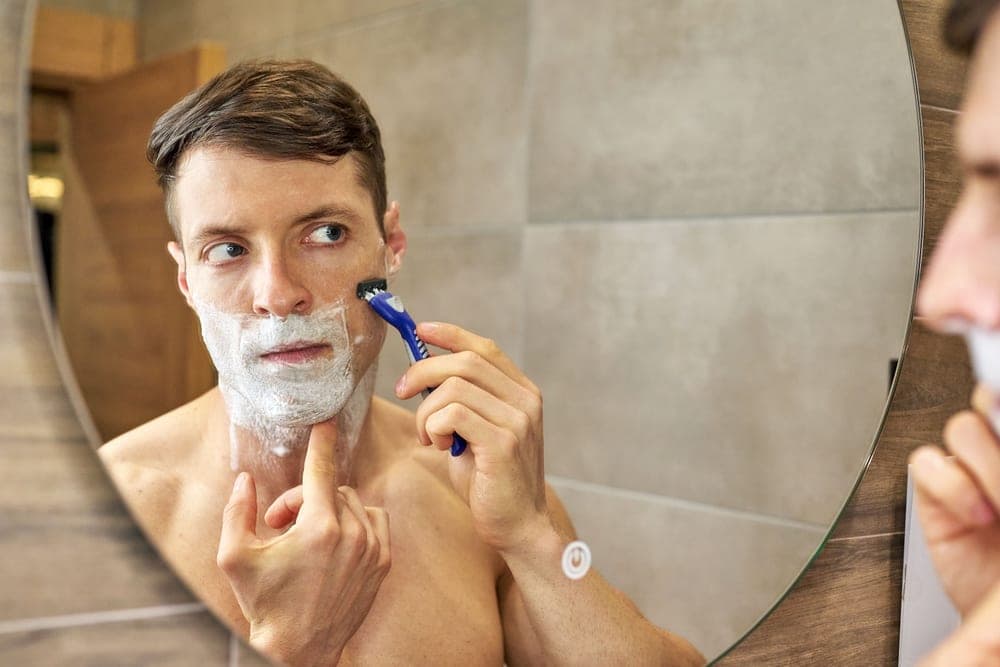
The two steps that actually matter
Steps three and four. Everything else on the list above is either preparation or aftercare, and while all of it helps, none of it is what goes wrong. What goes wrong is the angle and the pressure, in that order of frequency.
The angle
A cartridge razor has no angle to find - the pivoting head sets it for you, which is exactly what you are paying for. A safety razor has a fixed head, so the angle between the blade and your skin is entirely up to your wrist.
Roughly thirty degrees is the target, and the reliable way to find it is not to measure but to start from flat: put the top cap of the razor against your cheek so the handle points straight out from your face, then tip the handle downwards until the blade just begins to engage. Hold it there for the whole stroke. The most common error is a wandering angle rather than a wrong one, because a wandering angle finds the wrong one eventually.
This is also the argument behind the Henson AL13, which fixes the blade at a published thirty degrees so the geometry is decided by the razor rather than the wrist. It is a genuinely different design philosophy, and it works better once you already know what the angle should feel like.
The pressure
None. The razor weighs 60 to 120 grams and that is the force it needs. Your hand is a guide rail, not a press.
This is the habit a cartridge razor teaches, and it is the reason almost every complaint about razor burn in a first month is a technique problem rather than an equipment one. It also explains why we recommend heavier razors to beginners: a heavier razor needs less help and so tolerates a hand that is still helping.
The neck, specifically
The neck is where most people get into trouble, for three reasons that all arrive at once. Hair grows in inconsistent directions there, often sideways or upward. The skin is looser, so it moves under the blade. And it is the area you can see least well.
- Map the grain once. Leave a day of growth and run a finger across your neck in several directions. Write down what you find; it will not change.
- Stretch the skin with your free hand. Pull it taut so the blade meets a flat surface rather than a moving one. This is the single largest improvement available after not pressing.
- Skip the against-the-grain pass here. Permanently, if you get ingrown hairs - the razor bumps guide explains why a less close shave is the treatment rather than a compromise.
What a good lather looks like
Glossy and dense, not fluffy and white. Fluffy means too much air and not enough water, and it will collapse halfway through a pass leaving the blade dragging on bare skin. Add water a few drops at a time and keep working the brush until the lather stops looking like foam and starts looking like wet paint.
Getting there is a matter of soap, brush and water in roughly that order of importance. The soap roundup and the brush roundup cover the equipment; practically, if your lather is thin, the answer is almost always more soap and more brush time rather than a different product.
Afterwards
Rinse with cool water and use an alcohol-free balm. That is the whole of it. The traditional alcohol splash goes onto skin that has just had its outer layer partly removed, and the sting people take as evidence it is working is exactly the problem - the aftershave roundup covers the sequence properly.
And rinse the razor. Soap left in a two-piece head is what turns a twenty-year razor into a five-year one, and it takes ten seconds.
Every pick, with the working
Each entry shows the published specifications, the axis scores they produce and what you give up. The order is the computed order, not a commercial one, and the arithmetic is open underneath every score.
Our pickOne razor, no research
Merkur 34C HD
Buy this one if you want to stop reading and start shaving. It is 68 grams of chrome-plated brass on a short knurled handle, which is heavy enough that you naturally stop pressing, and the head is a plain closed comb with nothing to set, adjust or get wrong. It has been in production in Solingen for decades, so parts, advice and blades are everywhere.
- Weight
- 68 g
- Length
- 80 mm
- Material
- Chrome-plated brass
- Head
- Closed comb, two-piece
- Blade gap
- Not published
- Blades in the box
- 0
- Made in
- Germany
- Refill
- Universal standard
- Warranty
- Not published
- Assumed service life
- 5,200 uses
The arithmetic: 260 shaves a year x 20 years of assumed service life = 5200 shaves.
What it gets right
- 68 g in a 80 mm body: the weight does the work, which is exactly the habit a cartridge user has to unlearn
- Closed comb with no adjustment, so there is one variable fewer on your first month
- Two-piece construction; the head unscrews as a unit and there is nothing to lose in the sink
- Takes any standard double-edge blade, so the refill is a commodity
Flaws
- The 80 mm handle is short for large hands, and Merkur's own longer handles are a separate purchase
- No blade in the box, so the first order needs a blade pack alongside it
- Chrome over brass will show wear at the edges over years in a way stainless will not
The working behind the 8.9
- How long it lasts: not scored
- Not scored. This is a durable item, not a consumable, so how long it lasts is an assumption about service life rather than something the pack size tells us.
- Ease of switching: 8.5
- Closed comb (+), no adjustment to set (+), 68 g published weight in the range where the razor's own mass supplies the pressure (+), no blade included so the first order is two items (-).
- Refill economics: 10.0
- The refill is a commodity standard that dozens of factories make, so the price is set by competition and no single maker can raise it.
- What the maker publishes: 8.6
- 6 of 7 specifications a buyer would expect are published: weightG, lengthMm, material, madeIn, headType, bladesIncluded. Not published: bladeGapNote. 6 / 7 x 10 = 8.6.
Axes with no published input are dropped and the remaining weights re-normalized, so a product is not punished for a category where an axis does not apply. Specifications compiled 3 September 2026 from Merkur 34C HD listed specifications (Fendrihan).
2The blade to start on
Astra Superior Platinum
Platinum-coated stainless, made in Russia, sold in hundreds. Astra is the blade almost every wet shaver eventually recommends to a beginner because it is forgiving enough to survive bad technique and cheap enough that throwing one away early costs nothing. Start here, and only move if your face tells you to.
- Material
- Platinum-coated stainless steel
- Blades per pack
- 100
- Made in
- Russia
- Refill
- Universal standard
- Warranty
- Not applicable
- How long it lasts
- 500 uses
The arithmetic: 100 blades x 5 shaves per blade (assumed) = 500 shaves.
What it gets right
- Sold in 100-blade boxes of twenty five-packs, individually wax-wrapped
- Platinum-coated stainless, made by Gillette's Russian operation
- Forgiving rather than aggressive, which is what a new hand needs
- Fits every standard double-edge razor in this ledger
Flaws
- Not the sharpest blade available, which a very coarse beard will notice
- Astra publishes no edge geometry, so 'forgiving' is a description, not a figure
The working behind the 9.6
- How long it lasts: 9.6
- 100 blades x 5 shaves per blade (assumed) = 500 shaves. At five shaves a week, that is about 23.1 months. A 24-month supply scores 10 in this category, so 23.1 / 24 x 10 = 9.6.
- Ease of switching: 9.0
- Widely described as a forgiving rather than a keen edge (+), sold in 100s so a discarded blade costs almost nothing (+), no published edge geometry to verify the claim (-).
- Refill economics: 10.0
- The refill is a commodity standard that dozens of factories make, so the price is set by competition and no single maker can raise it.
- What the maker publishes: 10.0
- 3 of 3 specifications a buyer would expect are published: unitsPerPack, material, madeIn. 3 / 3 x 10 = 10.0.
Axes with no published input are dropped and the remaining weights re-normalized, so a product is not punished for a category where an axis does not apply. Specifications compiled 3 September 2026 from Astra Superior Platinum listed specifications.
3The safe first soap
Proraso Green shaving soap
150 grams of eucalyptus-and-menthol soap in a bowl, made in Italy, free of parabens, silicones and preservatives. It lathers easily enough that a first attempt with a new brush still produces something usable, which is the only quality that matters in a first soap. The menthol is loud; if you dislike it, buy the white tub instead.
- Net weight
- 150 g
- Fragrance
- Fragranced
- Made in
- Italy
- Refill
- Nothing to refill
- Warranty
- Not applicable
- How long it lasts
- 100 uses
Published key ingredients: Stearic acid, Coconut oil, Glycerin, Menthol, Eucalyptus globulus leaf oil.
The arithmetic: 150 g net weight / 1.5 g per lather (assumed) = about 100 lathers.
What it gets right
- 150 g published net weight in a reusable bowl
- Lathers readily, which forgives a beginner's brush technique
- Published ingredient list; no parabens, silicones or preservatives
- Sold in most places that sell any wet shaving at all
Flaws
- The menthol and eucalyptus is a strong opinion for a product you use every day
- Contains fragrance and geraniol, so not the choice for a genuinely reactive face
The working behind the 7.7
- How long it lasts: 3.8
- 150 g net weight / 1.5 g per lather (assumed) = about 100 lathers. At five shaves a week, that is about 4.6 months. A 12-month supply scores 10 in this category, so 4.6 / 12 x 10 = 3.8.
- Ease of switching: 9.0
- Lathers with very little technique (+), 150 g published net weight in a bowl you can load straight from (+), but a fragranced, mentholated formula is a strong choice to impose on a face you have just started shaving differently (-).
- Refill economics: 8.0
- Nothing to refill. The only future cost is replacing the item itself.
- What the maker publishes: 10.0
- 4 of 4 specifications a buyer would expect are published: netWeightG, madeIn, keyIngredients, fragranceFree. 4 / 4 x 10 = 10.0.
Axes with no published input are dropped and the remaining weights re-normalized, so a product is not punished for a category where an axis does not apply. Specifications compiled 3 September 2026 from Proraso Green shaving soap published specifications.
4Every face, on day one
Nivea Men Sensitive Post Shave Balm
100 ml, alcohol-free, with chamomile extract, witch hazel, vitamin E and pro-vitamin B5 on a fully published ingredient list. The single most useful change most men can make to their shave is to stop putting alcohol on a freshly abraded face, and this is the cheapest way to do it.
- Volume
- 100 ml
- Fragrance
- Fragranced
- Refill
- Nothing to refill
- Warranty
- Not applicable
- How long it lasts
- 50 uses
Published key ingredients: Chamomile flower extract, Witch hazel extract, Tocopheryl acetate (vitamin E), Panthenol.
The arithmetic: 100 ml / 2 ml per application (assumed) = about 50 applications.
What it gets right
- Alcohol-free — the one property that actually matters immediately after a blade
- 100 ml with a complete published ingredient list
- Chamomile, witch hazel, vitamin E and pro-vitamin B5
- Sold everywhere, at a price that makes it a default rather than a decision
Flaws
- Contains fragrance, so not for a genuinely fragrance-intolerant face
- Light enough that dry skin will want a moisturizer over the top in winter
The working behind the 8.4
- How long it lasts: 5.8
- 100 ml / 2 ml per application (assumed) = about 50 applications. At five shaves a week, that is about 2.3 months. A 4-month supply scores 10 in this category, so 2.3 / 4 x 10 = 5.8.
- Ease of switching: 9.5
- Alcohol-free, which is the property that decides whether a post-shave helps or hurts (++), 100 ml with a published ingredient list (+), contains fragrance (-).
- Refill economics: 8.0
- Nothing to refill. The only future cost is replacing the item itself.
- What the maker publishes: 10.0
- 3 of 3 specifications a buyer would expect are published: volumeMl, keyIngredients, fragranceFree. 3 / 3 x 10 = 10.0.
Axes with no published input are dropped and the remaining weights re-normalized, so a product is not punished for a category where an axis does not apply. Specifications compiled 3 September 2026 from Nivea Men Sensitive Post Shave Balm published ingredients.
Prices last verified October 19, 2026. They move constantly; the figure on Amazon when you click is the real one.
Questions people actually ask
What angle should I hold a safety razor at?
About thirty degrees between the blade and your skin. The way to find it without measuring: lay the head flat against your cheek so the handle sticks straight out, then tip the handle down until the blade just starts to engage. That is the angle, and holding it steady matters far more than getting it exactly right.
How much pressure should I use?
None. The weight of the razor is the pressure, which is why the razors we recommend for beginners sit between 60 and 100 grams. If you are consciously pushing, you are doing the thing that causes razor burn, and no blade or soap will fix it.
Which direction does my hair grow?
It varies across your face and it is worth finding out once. Leave the growth a day, then run a finger over each area in different directions. The direction that feels smooth is with the grain; the direction that feels rough is against. Most necks grow sideways or upwards, which is why necks cause most of the trouble.
How long should a safety razor shave take?
Ten to fifteen minutes for three passes when you are learning, settling to five or six. If you are trying to do it in two, you will press and you will go too fast, and those are the two things that hurt.
Should I stretch the skin?
Yes, on the awkward areas - the neck, the jawline, under the nose. Use your free hand to pull the skin taut so the blade meets a flat surface. It is the single most effective technique improvement after not pressing.