Nivea Men Sensitive Post Shave Balm review
A supermarket balm that beats every expensive aftershave on this site, for one reason: the thing that makes traditional aftershave sting is not in it.
By Sawyer V. · Published
We have not tested any of this. Everything below is compiled from published manufacturer specifications, and the arithmetic is printed so you can check it. This page carries affiliate links: if you buy through one we earn a commission at no extra cost to you, and it does not change the order of the picks. Full disclosure.
The short version
Buy it, almost regardless of who you are. The single most useful change most men can make after shaving is to stop putting ethyl alcohol on a freshly abraded face, and this is the cheapest way to do it. Nivea publishes a 15-item ingredient list and an explicit exclusion - “Does not include: Alcohol (Ethyl Alcohol)” - which is a more precise claim than the vague “alcohol-free” most of this category prints. Buy something else if fragrance is your specific trigger: fragrance is on the list, and no amount of chamomile offsets that for a face that reacts to it. It is also light, so dry skin in winter will want a moisturizer over the top rather than instead.
| # | Pick | Lasts | Score | Price |
|---|---|---|---|---|
| 1 | Nivea Men Sensitive Post Shave Balm Every face, on day one | ~50 uses | 8.4/10 | $8.35 - view on Amazon |
Prices last verified October 22, 2026. They move constantly; the figure on Amazon when you click is the real one.
What it is
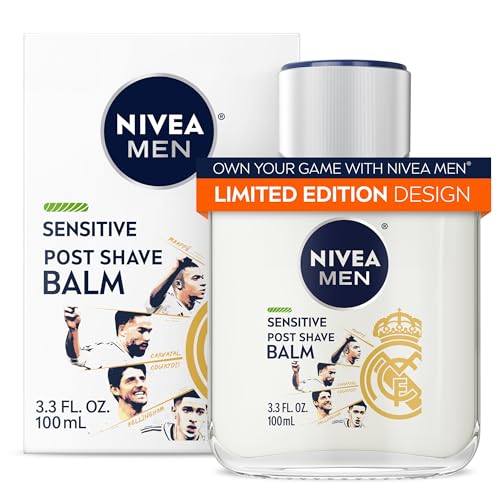
A 100 ml bottle of light, non-greasy post-shave lotion, sold in every supermarket and pharmacy in the country. It is the cheapest product that holds an award on this site, and it holds two of them: best aftershave, and best aftershave for sensitive skin.
| Nivea Men Sensitive Post Shave Balm | |
|---|---|
| Size | 100 ml / 3.3 fl oz |
| Ingredients published | 15, in order |
| Named exclusion | Alcohol (ethyl alcohol) |
| Also formulated without | Parabens, drying alcohols |
| Named actives | Chamomile extract, vitamin E, pro-vitamin B5 |
| Fragrance | Present, last on the list |
| Testing claim | Dermatologically tested on men with sensitive skin |
| Published concentrations | None |
The product is the thing it leaves out
Almost every product review is an argument about what has been added. This one is not. The reason this balm outranks aftershaves costing five times as much is a single absence, and Nivea states it as an absence: the page carries a Does not include line, and the thing it names is alcohol - ethyl alcohol, specifically.
That specificity is worth more than it looks. “Alcohol-free” is a slippery phrase on a cosmetic label, because plenty of ingredients ending in -alcohol are emollients rather than solvents. Cetearyl alcohol and stearyl alcohol are waxy fatty alcohols that soften skin; they have nothing in common with ethanol except a suffix. By naming ethyl alcohol, Nivea is excluding the one that actually matters rather than leaning on the ambiguity.
Why it matters on a shaved face: a razor does not only cut hair, it takes the top off the stratum corneum. Ethanol on that surface is a solvent on a barrier that is already compromised, which is the sting people have been taught to read as proof that something is working. It is not disinfecting anything useful. It is the reason the traditional splash is the named skip on the sensitive-skin roundup.
Reading the list in order
Fifteen ingredients, published in order: water, glycerin, isopropyl palmitate, chamomile flower extract, panthenol, tocopheryl acetate, tapioca starch, triceteareth-4 phosphate, maltodextrin, pantolactone, sodium hydroxide, phenoxyethanol, piroctone olamine, citric acid and fragrance.
The honest reading is that the marketing and the formula emphasize different things. Nivea leads on chamomile, vitamin E and pro-vitamin B5 - and those are genuinely present, at positions four, six and five. But the two ingredients doing most of the actual work are second and third: glycerin, a humectant that pulls water into the stratum corneum, and isopropyl palmitate, an emollient that gives the lotion its slip and its fast, non-greasy finish.
That is not a criticism. Glycerin is one of the best-evidenced moisturizing ingredients there is, and a cheap, well-built humectant lotion is exactly the right thing to put on a shaved face. It is simply worth knowing that you are buying competent basic moisturization plus the absence of alcohol, not a botanical treatment.
Three places it runs out of road
- Fragrance is on the list. Last, so it is a small percentage, but present. Fragrance is the most common contact allergen in grooming, and if it is your specific trigger then this balm will keep causing the thing you bought it to fix. The sensitive-skin award it holds is about alcohol, which is the bigger and more common variable - not a claim that it suits every reactive face.
- It is light. Fast-absorbing and non-greasy is the selling point and also the limit. On dry skin in winter it will disappear and leave you wanting something more occlusive. The fix is to layer, not to switch.
- No ceramides, and no published concentrations. This restores water; it does not rebuild barrier lipids. And like almost everything in this category, not one ingredient carries a percentage, so the order of the list is the only evidence you have.
The claim we are setting aside
Nivea states the balm “fights the five signs of shave irritation: burning, micro cuts, dryness, tightness and stubble itch.” Two of those - burning and tightness - follow directly from not stripping the barrier, and dryness follows from the glycerin. The other two do not. Nothing in a balm closes micro cuts, and stubble itch is the mechanical sensation of blunt-cut hair growing back through skin.
There is no published trial behind the five-signs claim, so we are not treating it as evidence either way. It is a marketing line on a product that does not need one.
Using it
- Apply to a damp face, not a dry one. Glycerin is a humectant; it works by holding water against the skin, so give it water to hold. Pat the face, do not dry it fully.
- A dime-sized amount covers a full face and neck. More does not absorb faster.
- Layer it in winter. Balm first, moisturizer over the top once it has absorbed, if your skin is dry.
- A 100 ml bottle lasts months at daily use, which is what makes the per-shave cost effectively nothing.
What it actually costs to use
On this site's stated assumption of 2 ml per application - the same figure used for every balm, cleanser and lotion in the ledger - a 100 ml bottle is about 50 applications. At five shaves a week that is roughly ten weeks a bottle, or about five bottles a year.
That assumption is ours rather than Nivea's, and it is deliberately generous; most people use less on a face than on a body. But even at the generous figure, the per-shave cost of this balm rounds to nothing against the blade, and it is a rounding error against the razor. The calculator will run the arithmetic with your own numbers and the live price.
This is the part that makes the recommendation easy. Where an expensive aftershave has to justify itself against a cheaper one that does the same job better, this balm has no such problem: the thing it is competing against costs more and damages the barrier it is sold to soothe. There is no trade to weigh.
One caveat on buying it: this product is sold in several formats and a couple of near-identical names - a cooling variant among them - and the bottles look alike on a shelf. Check that the one you are picking up is the sensitive post-shave balm rather than a scented splash from the same range.
Who should buy it
- Anyone currently using a traditional alcohol splash. This is the single highest-value change available in a shaving routine, and it costs less than the thing it replaces.
- Anyone starting out. A first wet-shaving setup has enough variables in it without an expensive aftershave being one of them.
- Anyone whose face burns after shaving and who has not yet worked out why. Remove the alcohol first; it is the likeliest cause and the cheapest to test.
Who should not
- Anyone who knows fragrance is their trigger. Go unscented. The balm has no fragrance-free variant.
- Anyone with genuinely dry skin expecting this to be enough alone. It is a layer, not a whole routine.
- Anyone buying it for razor bumps. Wrong mechanism, wrong product.
- Anyone who wants the ritual. If the sting and the scent of a traditional splash are the point for you, that is a legitimate thing to want - just buy it knowing what it does to your barrier.
The verdict
The best-value product on this site, and the clearest example of its central argument: the most important specification is often a negative, and it usually costs nothing. Fifteen published ingredients, a named exclusion rather than a vague claim, and competent humectant moisturization underneath the botanicals the marketing leads with.
It is not sophisticated and it does not need to be. The expensive aftershaves it beats are not losing on formulation quality - they are losing because they contain a solvent that should not go on a face that has just been shaved. The razor burn guide puts this in the sequence where it belongs: technique first, then the blade, then what goes on afterwards. Buy this last and buy it once; the gains ahead of it in that sequence are larger, and the money you would have spent on a designer splash is better spent on blades you change often enough.
Every pick, with the working
Each entry shows the published specifications, the axis scores they produce and what you give up. The order is the computed order, not a commercial one, and the arithmetic is open underneath every score.
Our pickEvery face, on day one
Nivea Men Sensitive Post Shave Balm
100 ml, alcohol-free, with chamomile extract, vitamin E and pro-vitamin B5 on a fully published fifteen-item ingredient list. The single most useful change most men can make to their shave is to stop putting alcohol on a freshly abraded face, and this is the cheapest way to do it.
- Volume
- 100 ml
- Fragrance
- Fragranced
- Refill
- Nothing to refill
- Warranty
- Not applicable
- How long it lasts
- 50 uses
Published key ingredients: Chamomile flower extract, Tocopheryl acetate (vitamin E), Panthenol (pro-vitamin B5), Glycerin.
The arithmetic: 100 ml / 2 ml per application (assumed) = about 50 applications.
What it gets right
- Alcohol-free — the one property that actually matters immediately after a blade
- 100 ml with a complete published ingredient list
- Chamomile, vitamin E and pro-vitamin B5, the three actives Nivea names
- Sold everywhere, at a price that makes it a default rather than a decision
Flaws
- Contains fragrance, so not for a genuinely fragrance-intolerant face
- Light enough that dry skin will want a moisturizer over the top in winter
The working behind the 8.4
- How long it lasts: 5.8
- 100 ml / 2 ml per application (assumed) = about 50 applications. At five shaves a week, that is about 2.3 months. A 4-month supply scores 10 in this category, so 2.3 / 4 x 10 = 5.8.
- Ease of switching: 9.5
- Alcohol-free, which is the property that decides whether a post-shave helps or hurts (++), 100 ml with a published ingredient list (+), contains fragrance (-).
- Refill economics: 8.0
- Nothing to refill. The only future cost is replacing the item itself.
- What the maker publishes: 10.0
- 3 of 3 specifications a buyer would expect are published: volumeMl, keyIngredients, fragranceFree. 3 / 3 x 10 = 10.0.
Axes with no published input are dropped and the remaining weights re-normalized, so a product is not punished for a category where an axis does not apply. Specifications compiled 3 September 2026 from Nivea Men Sensitive Post Shave Balm published ingredient list and alcohol exclusion.
Prices last verified October 22, 2026. They move constantly; the figure on Amazon when you click is the real one.
If this is not the one
The alternatives named above, in one place. Each links to its own page, where the published specifications and the scoring are set out in full.
Thayers Alcohol-Free Witch Hazel Toner
If what you actually miss is the tightening astringent feeling rather than the sting, this does that without alcohol - and it genuinely contains witch hazel, which the Nivea does not.
CeraVe PM Facial Moisturizing Lotion
For dry skin in winter, when the balm absorbs and leaves you wanting more. Ceramides and niacinamide, published, over the top of the balm rather than instead of it.
Proraso After Shave Lotion (Refreshing)
The traditional splash, named here as the thing this balm exists to replace. Buy it only if you want the ritual and the sting and know what they cost you.
Prices last verified October 22, 2026. They move constantly; the figure on Amazon when you click is the real one.
Questions people actually ask
Why does an $8 supermarket balm win over expensive aftershave?
Because the thing that decides whether a post-shave product helps or hurts is a negative, not a feature. Traditional aftershave leads with denatured alcohol, which strips a barrier that a blade has just damaged. This balm leaves it out. Nothing you can add to a formula compensates for putting alcohol on abraded skin, which is why price has very little to do with the ranking on the aftershave roundup.
Is it actually alcohol-free?
Nivea's own wording is more precise than most: it publishes a “Does not include” line naming ethyl alcohol specifically, and describes the product as formulated without parabens and drying alcohols. That precision matters, because “alcohol” on an ingredient list can mean a fatty alcohol like cetearyl alcohol, which is an emollient and not drying at all. The alcohol that stings is ethanol or denatured alcohol, and that is the one Nivea names.
Does it contain witch hazel?
No. Nivea's published list has no witch hazel in it - the named actives are chamomile extract, vitamin E and pro-vitamin B5. If the astringent, tightened feeling is what you are after, that comes from witch hazel and you need a separate toner for it.
Can I use it as a moisturizer?
For normal skin, yes - it is a light humectant lotion and there is nothing shave-specific in it that would stop you. For dry skin it is not enough on its own, and it has no ceramides to rebuild barrier lipids. The balm-against-moisturizer comparison works through where the two categories actually diverge.
Will it help with razor bumps?
Not directly. Razor bumps are ingrown hairs, a mechanical problem caused by how close the hair is cut and which direction it is growing - no balm reaches that. The razor bumps guide covers what does. What this balm addresses is the other thing people call irritation: the immediate burning and tightness of a stripped barrier.
Is the scented version a problem?
Only if fragrance is your trigger, and most people do not know whether it is. The practical test is to eliminate one variable at a time: if your face still reacts on an alcohol-free balm, fragrance is the next thing to remove, not the balm itself.