The best beard brush and comb
These are distribution tools, not styling tools. And the one thing that decides whether a comb helps or harms is how it was manufactured.
By Sawyer V. · Published
We have not tested any of this. Everything below is compiled from published manufacturer specifications, and the arithmetic is printed so you can check it. This page carries affiliate links: if you buy through one we earn a commission at no extra cost to you, and it does not change the order of the picks. Full disclosure.
The short answer
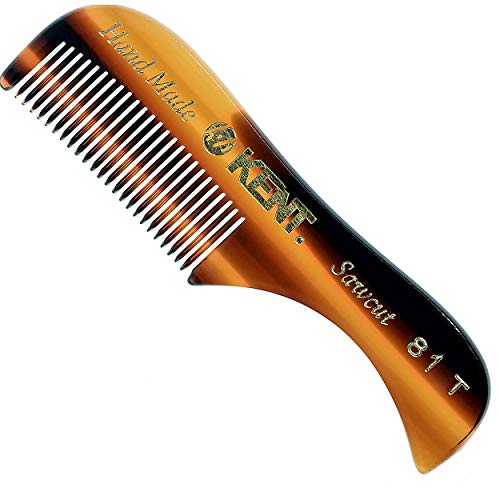
Buy the comb first. A sawcut comb - cut from sheet and hand-sanded, with no molding seam along the teeth - does not split hair the way a cheap molded one does, and split ends are most of what beard scratchiness actually is. The Kent 81T is 73 mm and pocket-sized. Add a boar-bristle brush once the beard is long enough that oil needs dragging along it.
| # | Pick | Lasts | Score | Price |
|---|---|---|---|---|
| 1 | Kent 81T Beard and Mustache Comb Not tearing hair while you tidy | 1,300 shaves* | 9.2/10 | $6.00 - view on Amazon |
| 2 | Kent Beard Brush Distributing oil through a real beard | 1,300 shaves* | 8.8/10 | $44.00 - view on Amazon |
| 3 | Semogue 830 Boar in a smaller knot | 1,300 shaves* | 7.8/10 | $24.55 - view on Amazon |
Prices last verified October 19, 2026. They move constantly; the figure on Amazon when you click is the real one.
What these tools actually do
Neither is a styling tool on a beard under a few inches. Both are distribution tools, and the thing they distribute is oil - the sebum your skin already makes, plus anything you apply.
That is the mechanism, and it explains why combing matters even on a short beard: oil is produced at the root and needed along the length, and nothing moves it there on its own. It also explains why the tool that touches skin is the one worth having first.
Why the comb comes first
It works at every beard length, it reaches skin, it costs less, and it fits in a pocket. The Kent 81T is 73 mm of sawcut cellulose acetate, hand-sanded in England - which is a boring specification that happens to be the only one that matters here.
Its honest limits: 73 mm is too short to be useful on the full length of a long beard, Kent publishes no tooth spacing, and it costs several times a drugstore comb that looks identical in a photograph. The last of those is the point rather than a drawback - the visual similarity is exactly why people buy the molded one.
When a brush earns its place
Around an inch of beard, when oil applied at the roots stops reaching the ends. A brush drags it along the length in a way a comb only partly does, and boar bristle is stiff enough to reach through to skin, which is where beard itch lives.
Kent's beard brush is boar bristle cut and shaped for coarse facial hair on a hand-carved wooden handle. What Kent does not publish is bristle length or density, so it cannot be compared numerically to anything - which is what keeps its disclosure score down despite the construction being sound.
The confusion this page exists to prevent
Boar bristle appears in two completely different products on this site and they are not interchangeable. That is why the Semogue is on this page as the named skip.
- A shaving brush holds water and lather. It has a long loft relative to its knot, soft split tips, and it is designed to release what it holds onto your face. That roundup is here.
- A beard brush has short, stiff bristles set in a flat pad, designed to pull through hair and reach skin. It holds nothing.
Using a shaving brush on a beard does very little; using a beard brush to build lather does nothing at all. They are the same material doing opposite jobs.
Using them
Damp, not dry. Dry combing a coarse beard snaps hairs and produces the split ends you are trying to prevent. After a shower, towel-dried, is the right moment.
Oil first, then comb through. Work the oil into the skin with fingertips, then use the comb to move it along the hair. Doing it the other way round leaves the skin - where the itch is - untouched. The oil roundup covers what to use and why the first bottle should be unscented.
Comb before you trim. Every hair standing at its full length is the only state in which a trim is even. That is step one of the trimming guide and it is the step people skip.
Care, which is minimal
Rinse the comb occasionally with soap and water - it collects sebum and product. Pick the hair out of the brush and let it dry bristles-down. Neither needs conditioning, oiling or anything the internet suggests.
Both are one-off purchases on our assumed five-year service life, and neither has a consumable. In a section where every trimmer runs on a proprietary blade, that is worth noticing - the cost calculator is where the difference between a tool with a refill and a tool without one stops being abstract.
Every pick, with the working
Each entry shows the published specifications, the axis scores they produce and what you give up. The order is the computed order, not a commercial one, and the arithmetic is open underneath every score.
Our pickNot tearing hair while you tidy
Kent 81T Beard and Mustache Comb
73 mm, sawcut from cellulose acetate and hand-sanded in England. Sawcut matters more than it sounds: a molded comb has a seam along every tooth that catches and splits hair, and a sawcut one does not. On a beard, split ends are most of what scratchiness actually is.
- Length
- 73 mm
- Material
- Sawcut cellulose acetate
- Made in
- England
- Refill
- Nothing to refill
- Warranty
- Not published
- Assumed service life
- 1,300 uses
The arithmetic: 260 shaves a year x 5 years of assumed service life = 1300 shaves.
What it gets right
- Sawcut and hand-sanded, so there is no molding seam to split hair
- 73 mm - pocket-sized, which is the size you will actually carry
- Cellulose acetate rather than injection-molded plastic
- Made in England by a firm that has done nothing else for two centuries
Flaws
- Costs several times an ordinary drugstore comb that looks identical
- 73 mm is too small to be useful on a long beard's full length
- Kent publishes tooth spacing nowhere
The working behind the 9.2
- How long it lasts: not scored
- Not scored. This is a durable item, not a consumable, so how long it lasts is an assumption about service life rather than something the pack size tells us.
- Ease of switching: 9.5
- Sawcut teeth with no molding seam is a real, checkable construction difference that prevents split ends (++), pocket-sized (+), but tooth spacing is unpublished and it costs many times a visually identical drugstore comb (-).
- Refill economics: 8.0
- Nothing to refill. The only future cost is replacing the item itself.
- What the maker publishes: 10.0
- 2 of 2 specifications a buyer would expect are published: material, madeIn. 2 / 2 x 10 = 10.0.
Axes with no published input are dropped and the remaining weights re-normalized, so a product is not punished for a category where an axis does not apply. Specifications compiled 3 September 2026 from Kent handmade sawcut comb published construction.
2Distributing oil through a real beard
Kent Beard Brush
Hand-carved wood handle with specially cut and shaped boar bristle, from a firm that has made brushes in England since the eighteenth century. A beard brush is a distribution tool rather than a styling one: it drags the oil your skin makes from the roots out along the length, which is the job nothing else does.
- Material
- Boar bristle, hand-carved wood handle
- Made in
- England
- Refill
- Nothing to refill
- Warranty
- Not published
- Assumed service life
- 1,300 uses
The arithmetic: 260 shaves a year x 5 years of assumed service life = 1300 shaves.
What it gets right
- Boar bristle cut and shaped for coarse facial hair rather than borrowed from a hairbrush
- Hand-carved wood handle; no plastic to crack
- Stiff enough to reach skin, which is where beard itch lives
- Distributes oil along the hair, which is what actually softens a beard
Flaws
- Kent publishes very little beyond material and construction - no bristle length or density
- Boar bristle is an animal product
- A brush does nothing for a beard under about half an inch
The working behind the 8.8
- How long it lasts: not scored
- Not scored. This is a durable item, not a consumable, so how long it lasts is an assumption about service life rather than something the pack size tells us.
- Ease of switching: 8.5
- Stiff boar bristle reaches skin, which is the job (+), no plastic to fail (+), but Kent publishes no bristle length or density, so it cannot be compared numerically to anything (-).
- Refill economics: 8.0
- Nothing to refill. The only future cost is replacing the item itself.
- What the maker publishes: 10.0
- 2 of 2 specifications a buyer would expect are published: material, madeIn. 2 / 2 x 10 = 10.0.
Axes with no published input are dropped and the remaining weights re-normalized, so a product is not punished for a category where an axis does not apply. Specifications compiled 3 September 2026 from Kent beard brush published construction.
3Boar in a smaller knot
Semogue 830
Skip this one. This is a shaving brush, not a beard brush, and it is on this page to prevent a specific confusion. Boar bristle appears in both categories and they are not interchangeable: a shaving brush is soft-tipped and loft-heavy for holding lather, and it has no backbone for pulling through hair. Buy it for lather, not for a beard.
22 mm knot, 55 mm loft, 103 mm tall, 65 grams, acrylic handle, made in Portugal. It is the Omega's argument in a smaller, tidier package: same premium boar behavior, less brush, better suited to a face rather than a bowl.
- Weight
- 65 g
- Length
- 103 mm
- Material
- Premium boar bristle, acrylic handle
- Made in
- Portugal
- Refill
- Nothing to refill
- Warranty
- Not published
- Assumed service life
- 1,300 uses
The arithmetic: 260 shaves a year x 5 years of assumed service life = 1300 shaves.
What it gets right
- Published 22 mm knot and 55 mm loft — a genuinely face-sized brush
- Premium boar, made in Portugal by a family firm that has done nothing else for decades
- 103 mm tall and 65 g; it feels like a tool rather than an ornament
Flaws
- Same break-in period and initial odor as any boar brush
- Smaller knot holds less lather, so a three-pass shave is closer to the limit
The working behind the 7.8
- How long it lasts: not scored
- Not scored. This is a durable item, not a consumable, so how long it lasts is an assumption about service life rather than something the pack size tells us.
- Ease of switching: 6.5
- Published knot, loft, height and weight — the most completely specified brush here (+). Break-in and odor apply as with any boar (--).
- Refill economics: 8.0
- Nothing to refill. The only future cost is replacing the item itself.
- What the maker publishes: 10.0
- 3 of 3 specifications a buyer would expect are published: lengthMm, material, madeIn. 3 / 3 x 10 = 10.0.
Axes with no published input are dropped and the remaining weights re-normalized, so a product is not punished for a category where an axis does not apply. Specifications compiled 3 September 2026 from Semogue 830 published specifications (Maggard Razors).
Prices last verified October 19, 2026. They move constantly; the figure on Amazon when you click is the real one.
Questions people actually ask
What is the difference between a sawcut and a molded comb?
A molded comb is injection-molded, which leaves a fine seam running along every tooth where the two halves of the mold met. That seam catches and splits hair. A sawcut comb is cut from sheet material and hand-sanded, so the teeth are smooth. It is invisible at arm 's length and it is the whole difference.
Brush or comb - which do I need?
Comb first, for any beard. A brush earns its place once the beard is long enough that oil applied at the roots does not reach the ends on its own - roughly an inch. Below that a comb does everything a brush would.
Should I brush my beard wet or dry?
Damp, not soaking and not bone dry. Dry combing a coarse beard breaks hairs and creates exactly the split ends you are trying to remove. Damp hair has more give.
Does brushing help a beard grow?
No, and no product or tool on this site makes that claim. What brushing does is distribute sebum and applied oil along the hair, which makes an existing beard softer and more even. Growth is not something a brush affects.
Can I use a hairbrush on my beard?
A hairbrush is usually too soft and too widely spaced to reach through beard hair to skin, which is where the useful work happens. It will not damage anything; it just does less.