The best antiperspirants for heavy sweating
One of the few grooming categories where the active and its concentration are printed on a regulated label. Which means for once you can actually compare.
By Sawyer V. · Published
We have not tested any of this. Everything below is compiled from published manufacturer specifications, and the arithmetic is printed so you can check it. This page carries affiliate links: if you buy through one we earn a commission at no extra cost to you, and it does not change the order of the picks. Full disclosure.
The short answer
Start with the Dove antiperspirant: aluminum chlorohydrate at a published 20.2 per cent on a drug-facts label. That is a genuinely strong everyday antiperspirant and it resolves most complaints. Move to Certain Dri only if it has actually failed - 12 per cent aluminum chloride is a different and stronger salt, applied at bedtime, and it is the most irritating one in common use. And if the problem is smell rather than wetness, none of this is the answer.
| # | Pick | Lasts | Score | Price |
|---|---|---|---|---|
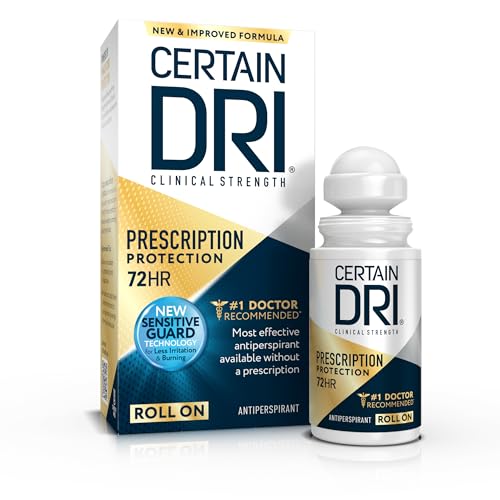
| 1 | Certain Dri Prescription Strength Clinical The strongest published active you can buy over the counter | Not published | 6.9/10 | $8.79 - view on Amazon |
| 2 | Dove Men+Care Clean Comfort Antiperspirant Actually reducing sweat | ~150 uses | 9.4/10 | $24.00 - view on Amazon |
| 3 | Vanicream Aluminum-Free Deodorant Skin that reacts to everything else | ~110 uses | 9.4/10 | Check price on Amazon |
Prices last verified September 24, 2026. They move constantly; the figure on Amazon when you click is the real one.
One of the few categories with real numbers
Antiperspirants are regulated as over-the-counter drugs in the United States, which means the active and its concentration are on a drug-facts label filed publicly. That is unusual and it is why this page can compare things properly rather than describing adjectives.
| Product | Active | Published concentration | Addresses |
|---|---|---|---|
| Certain Dri Clinical | Aluminum chloride | 12% | Wetness |
| Dove Men+Care | Aluminum chlorohydrate | 20.2% | Wetness |
| Vanicream | Triethyl citrate (no aluminum) | Not published | Odor only |
Start with the everyday one
Dove's 20.2 per cent aluminum chlorohydrate is a genuinely strong everyday antiperspirant, published on a regulated label, and it resolves the large majority of heavy-sweating complaints on its own.
The reason to start here rather than at the strongest available is not caution for its own sake. It is that clinical-strength aluminum chloride is meaningfully more irritating, and an irritated underarm is a worse outcome than a slightly damp one. Escalate only if this has actually failed while being used correctly - which for most people means at night, which most people do not do.
When to escalate, and how to use it
Certain Dri publishes 12 per cent aluminum chloride and publishes the directions alongside it: apply at bedtime. That instruction is the product, not a suggestion.
- At night, on completely dry skin. Dry means dry - not towelled, but properly dry, ideally some minutes after a shower. Damp skin plus aluminum chloride is where the stinging comes from.
- Start on alternate nights. Build up rather than going straight to nightly.
- Wash it off in the morning. The plugs are already formed; leaving the product on all day adds irritation without adding effect.
- Never on freshly shaved skin. This is the single most common way people have a bad experience with it. Shave in the morning, apply at night, or leave a day.
If the problem is smell rather than wetness
Then none of the above is the right product, and this is worth checking before escalating. Sweat itself is close to odorless - the smell is bacteria metabolizing it. An antiperspirant reduces the substrate; a deodorant addresses the bacteria.
Vanicream is on this page as the third option for exactly that case: five published ingredients, no aluminum, triethyl citrate as the working ingredient, which suppresses the enzymes bacteria use to break sweat down. It does nothing about wetness and does not claim to.
The odor page ranks the five causes, and product is fifth on that list behind washing properly, changing clothes, drying before dressing and fabric choice.
Three things that are not the product
- Fabric. Cotton holds sweat against skin; technical synthetics move it away. The same variable that drives chafing drives how wet you feel.
- Dry completely before dressing. Getting dressed damp traps moisture for the rest of the day, and no antiperspirant compensates for that.
- Trim, if the hair is dense. Underarm hair holds moisture against skin. Trimming rather than shaving avoids the ingrown problem in an area with constant friction.
And the honest boundary: sweating that happens without heat or exertion, or that interferes with your daily life despite a clinical-strength product used as directed, is a recognized medical condition with real treatments. That is a doctor's conversation, not a shelf one.
Every pick, with the working
Each entry shows the published specifications, the axis scores they produce and what you give up. The order is the computed order, not a commercial one, and the arithmetic is open underneath every score.
Our pickThe strongest published active you can buy over the counter
Certain Dri Prescription Strength Clinical
Skip this one. It is the strongest published active you can buy without a prescription and it is a treatment rather than a toiletry. Aluminum chloride is the most irritating antiperspirant salt in common use, and reaching for it when a 20.2 per cent chlorohydrate stick would have done is how people end up with a rash and conclude that antiperspirants do not suit them. Buy it if an ordinary antiperspirant has genuinely failed - not before.
Aluminum chloride at a published 12 per cent on an FDA drug-facts label. Aluminum chloride is a different and stronger salt than the chlorohydrate in ordinary antiperspirants, which is why this is the one doctors point at for genuine excessive sweating - and why it is applied at bedtime rather than in the morning.
- Volume
- 35.5 ml
- Fragrance
- Fragrance-free
- Made in
- United States
- Refill
- Nothing to refill
- Warranty
- Not applicable
- How long it lasts
- Not published
Published key ingredients: Aluminum chloride 12%.
What it gets right
- Published 12 per cent aluminum chloride on a regulated drug-facts label
- A genuinely different active from the chlorohydrate used in everyday antiperspirants
- Published directions: apply at bedtime, which is when the ducts are least active
- Published protection window rather than a vague claim
Flaws
- Aluminum chloride is the most irritating antiperspirant salt in common use
- It must go on completely dry skin or it stings badly
- Not a deodorant: it addresses wetness and does comparatively little about smell
The working behind the 6.9
- How long it lasts: not scored
- Not scored. This is a durable item, not a consumable, so how long it lasts is an assumption about service life rather than something the pack size tells us.
- Ease of switching: 6.5
- A regulated active at a published 12 per cent with published directions (++), a genuinely stronger salt than everyday antiperspirants (+), but the most irritating salt in common use (--) and it must go on bone-dry skin (-).
- Refill economics: 8.0
- Nothing to refill. The only future cost is replacing the item itself.
- What the maker publishes: 6.7
- 2 of 3 specifications a buyer would expect are published: keyIngredients, fragranceFree. Not published: netWeightG. 2 / 3 x 10 = 6.7.
Axes with no published input are dropped and the remaining weights re-normalized, so a product is not punished for a category where an axis does not apply. Specifications compiled 3 September 2026 from Certain Dri published aluminum chloride 12% drug facts (DailyMed).
2Actually reducing sweat
Dove Men+Care Clean Comfort Antiperspirant
Aluminum chlorohydrate at a published 20.2 per cent in the dry-spray formula - a regulated figure printed on a drug-facts label, not a claim. This is an antiperspirant rather than a deodorant: it reduces sweat rather than masking the smell of it, and those are different products sold under one word.
- Net weight
- 76 g
- Fragrance
- Fragranced
- Refill
- Nothing to refill
- Warranty
- Not applicable
- How long it lasts
- 150 uses
Published key ingredients: Aluminum chlorohydrate 20.2% (dry spray).
The arithmetic: 76 g / 0.5 g per application (assumed) = about 150 applications.
What it gets right
- Published active concentration: aluminum chlorohydrate 20.2% on a drug-facts label
- Reduces sweat rather than only addressing odor - a different mechanism entirely
- Sold everywhere, in every format
- 72-hour protection claim is on the regulated label rather than the marketing
Flaws
- If you want to avoid aluminum salts, this is the entire category to avoid
- Fragranced
- Stick and spray formats use different aluminum compounds, so the published figure is format-specific
The working behind the 9.4
- How long it lasts: 10.0
- 76 g / 0.5 g per application (assumed) = about 150 applications. At five shaves a week, that is about 6.9 months. A 3-month supply scores 10 in this category, so 6.9 / 3 x 10 = 10.0.
- Ease of switching: 9.5
- A published, regulated active percentage - the single most checkable number in this whole category (++), universal availability (+), fragranced and aluminum-based, which rules it out for a specific group (-).
- Refill economics: 8.0
- Nothing to refill. The only future cost is replacing the item itself.
- What the maker publishes: 10.0
- 3 of 3 specifications a buyer would expect are published: netWeightG, keyIngredients, fragranceFree. 3 / 3 x 10 = 10.0.
Axes with no published input are dropped and the remaining weights re-normalized, so a product is not punished for a category where an axis does not apply. Specifications compiled 3 September 2026 from Dove Men+Care Clean Comfort published drug facts (DailyMed).
3Skin that reacts to everything else
Vanicream Aluminum-Free Deodorant
Five ingredients: purified water, triethyl citrate, sodium polyacrylate, undecylenoyl glycine and sodium hydroxide. No aluminum, no fragrance, no alcohol, no baking soda, no botanical extracts. If deodorant is what makes your underarms itch, this is the shortest list available and the sensible thing to test with.
- Net weight
- 57 g
- Fragrance
- Fragrance-free
- Refill
- Nothing to refill
- Warranty
- Not applicable
- How long it lasts
- 110 uses
Published key ingredients: Purified water, Triethyl citrate, Sodium polyacrylate, Undecylenoyl glycine.
The arithmetic: 57 g / 0.5 g per application (assumed) = about 110 applications.
What it gets right
- Five published ingredients - by a distance the shortest list in this entire product ledger
- No fragrance, alcohol, aluminum, baking soda or botanical extracts
- Triethyl citrate works by suppressing the enzymes that make sweat smell, not by masking
- Water-based gel rather than a waxy stick
Flaws
- Not an antiperspirant - it does nothing about wetness
- 57 g, the smallest here
- Unscented means unscented; there is no version that smells of anything
The working behind the 9.4
- How long it lasts: 10.0
- 57 g / 0.5 g per application (assumed) = about 110 applications. At five shaves a week, that is about 5.1 months. A 3-month supply scores 10 in this category, so 5.1 / 3 x 10 = 10.0.
- Ease of switching: 9.5
- A five-ingredient, fragrance-free, baking-soda-free formula is about as few variables as a deodorant can present (++), water-based gel (+), but it is not an antiperspirant and the tube is the smallest here (-).
- Refill economics: 8.0
- Nothing to refill. The only future cost is replacing the item itself.
- What the maker publishes: 10.0
- 3 of 3 specifications a buyer would expect are published: netWeightG, keyIngredients, fragranceFree. 3 / 3 x 10 = 10.0.
Axes with no published input are dropped and the remaining weights re-normalized, so a product is not punished for a category where an axis does not apply. Specifications compiled 3 September 2026 from Vanicream Aluminum-Free Deodorant published ingredients.
Prices last verified September 24, 2026. They move constantly; the figure on Amazon when you click is the real one.
Questions people actually ask
What is the strongest antiperspirant you can buy over the counter?
Aluminum chloride, which Certain Dri publishes at 12 per cent on its drug-facts label. It is a different salt from the aluminum chlorohydrate or zirconium compounds in everyday antiperspirants - so a lower percentage of a stronger salt, which is why the numbers cannot be compared directly.
Why apply antiperspirant at night?
Because the active works by forming plugs in the sweat ducts, and it needs time on relatively dry skin to do it. Overnight the ducts are least active, so more of the salt gets where it needs to be. Applying to a wet underarm in the morning washes most of it straight off.
Is a deodorant the same thing?
No, and the two words are used interchangeably in shops. An antiperspirant reduces sweat using an aluminum salt at a regulated concentration. A deodorant addresses smell and does nothing about wetness. That comparison covers the difference properly.
Why does aluminum chloride sting?
It is more acidic in solution than the chlorohydrate salts and it reacts more aggressively with skin. That is the same property that makes it effective. Applying to bone-dry skin, at night, on non-consecutive nights at first, is how the label directs you to manage it.
When is heavy sweating a medical question?
When it interferes with daily life, happens without heat or exertion, or does not respond to a published clinical-strength product used as directed. There are real diagnoses and real treatments for that, and nothing on this site is medical advice.