The best electric shavers for coarse hair
Dense, coarse growth is the one case where the motor figure stops being a spec-sheet number and starts being the difference.
By Sawyer V. · Published · Last updated
We have not tested any of this. Everything below is compiled from published manufacturer specifications, and the arithmetic is printed so you can check it. This page carries affiliate links: if you buy through one we earn a commission at no extra cost to you, and it does not change the order of the picks. Full disclosure.
The short answer
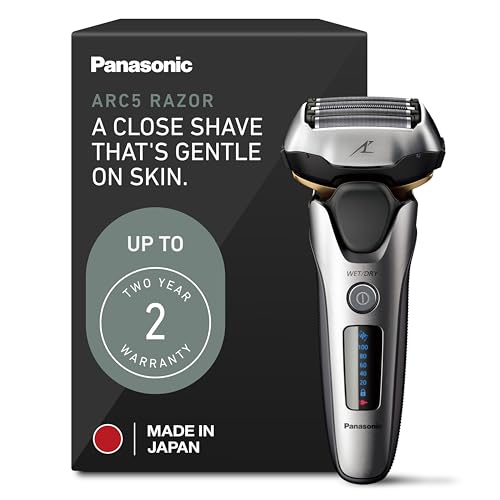
Buy the Panasonic Arc5. It publishes a 14,000 CPM linear motor across five blades - and on coarse hair the motor is the figure that matters, because a faster cutter shears a thick hair rather than pushing it over. Buy the Braun Series 9 PRO+ if you want the published maintenance schedule instead: about 18 months for the foil and cutter, which is the disclosure almost nobody else in the category offers.
| # | Pick | Lasts | Score | Price |
|---|---|---|---|---|
| 1 | Panasonic Arc5 ES-LV67 Speed on a dense beard | 1,300 shaves* | 7.2/10 | $199.97 - view on Amazon |
| 2 | Braun Series 9 PRO+ The closest electric shave | 1,300 shaves* | 7.4/10 | $429.64 - view on Amazon |
| 3 | Philips Norelco 9000 Prestige Contoured faces and coarse, curly hair | 1,300 shaves* | 6.9/10 | $149.99 - view on Amazon |
Prices last verified September 24, 2026. They move constantly; the figure on Amazon when you click is the real one.
What coarse hair changes
A thick hair resists being cut. That single fact reorders which specifications matter, because a shaver that handles fine growth adequately can bend a coarse hair over and push it past rather than shearing it - which you experience as a shaver that needs four passes and leaves your neck sore.
- Motor speed goes from irrelevant to decisive. More strokes per second means each hair is met more often per unit of travel, and a hair that is met more often is cut rather than deflected.
- Cutting elements matter for a second reason. Not just coverage - each element is a chance to catch a hair the previous one bent over.
- Head clogging arrives faster. More hair volume per shave means the head packs sooner, and a packed head is the most common cause of the pulling people blame on a worn blade.
| Panasonic Arc5 | Braun Series 9 PRO+ | Philips S9000 | |
|---|---|---|---|
| Type | Foil | Foil | Rotary |
| Motor speed | 14,000 CPM, published | Not published | Not published |
| Cutting elements | 5 | 5 (4 + 1 trimmer) | 3 rotary heads |
| Head interval | Not published | About 18 months, published | Not published |
| Wet/dry | Yes | Yes | Yes |
Why the motor figure wins this page
Panasonic publishes 14,000 cuts per minute from a linear motor, and claims up to 70,000 cross-cuts a minute across five blades. Whatever weight you give the second figure, the first is a real, comparable specification - and it is the one specification that directly addresses the problem this page is about.
It is also, notably, one of only three published motor figures anywhere in this ledger. The others are on a clipper and a nose trimmer. In a category where every box leads with blade counts, publishing the number that actually predicts performance on dense growth is worth the ranking on its own.
The honest mark against it: Panasonic publishes no head replacement interval. So you get the performance figure and not the ownership figure, which is the reverse of the Braun.
The trade with the Braun
Braun does not publish a motor speed. What it publishes is a foil and cutter replacement interval of about 18 months, which is the single most useful ownership figure in this category and which almost nobody else provides - only two makers in this ledger do at all.
On coarse hair that matters more than usual, because coarse hair wears a head faster. A published interval on a shaver that will be worked hard is a genuine argument, and it is why this is second rather than third despite the missing motor figure.
Why the rotary is the skip here specifically
This is not a general criticism - rotary heads follow the contours of a jaw and a neck better than a flat foil does, and that is a real advantage for a lot of faces.
On coarse dense growth it is the wrong strength. Rotary heads cut in circles at lower rotational speeds than a linear foil motor oscillates, which is the opposite of what a thick hair needs. And Philips publishes neither a motor figure nor a head interval, so on the two axes that decide this page there is nothing to compare.
Technique matters more here than elsewhere
- Trim first if it is more than two or three days. A shaver is a stubble tool. This single habit fixes most complaints about shavers on thick beards.
- Shave dry, and shave before the shower. Water softens hair, and a soft coarse hair bends away from the foil rather than standing into it - which is why electric technique inverts blade technique.
- Clean the head every single time. Coarse hair packs a head faster than anything else, and a packed head is what pulls.
- Do not press. The instinct on thick growth is to push harder. It does not cut more hair and it is the direct cause of the irritation - which that guide ranks first.
Every pick, with the working
Each entry shows the published specifications, the axis scores they produce and what you give up. The order is the computed order, not a commercial one, and the arithmetic is open underneath every score.
Our pickSpeed on a dense beard
Panasonic Arc5 ES-LV67
A 14,000 CPM linear motor producing up to 70,000 cross-cuts a minute across five blades, a head that flexes in 16 directions, and a beard sensor taking 220 readings a second. It is the fastest shaver here on dense growth. The trade is 45 minutes of runtime, the shortest of the three.
- Runtime
- 45 min
- Charge time
- 60 min
- Cutting elements
- 5
- Waterproof
- Yes
- Made in
- Not published
- Refill
- Proprietary to the maker
- Warranty
- Not published
- Assumed service life
- 1,300 uses
The arithmetic: 260 uses a year x 5 years of assumed service life = 1300 uses.
What it gets right
- Published 14,000 CPM linear motor and up to 70,000 cross-cuts per minute
- Five blades and a 16-direction flexing head
- Beard sensor with a published 220 detections per second and 14 power adjustments per second
- 3-minute quick charge for one shave; wet and dry
Flaws
- 45 minutes of runtime, the shortest of the shavers here
- Proprietary foil and cutter assemblies
- Louder than the Braun units, which is a real daily consideration
The working behind the 7.2
- How long it lasts: not scored
- Not scored. This is a durable item, not a consumable, so how long it lasts is an assumption about service life rather than something the pack size tells us.
- Ease of switching: 8.5
- The most completely specified shaver here — motor speed, cross-cut rate, sensor rate and head articulation are all published figures (++). 45-minute runtime is the shortest of the three (-).
- Refill economics: 4.0
- Only this maker's refill fits, so the ongoing price is set by the maker rather than by a market. This is where the real cost of ownership hides.
- What the maker publishes: 8.0
- 4 of 5 specifications a buyer would expect are published: runtimeMin, chargeMin, cuttingElements, waterproof. Not published: headReplacementMonths. 4 / 5 x 10 = 8.0.
Axes with no published input are dropped and the remaining weights re-normalized, so a product is not punished for a category where an axis does not apply. Specifications compiled 3 September 2026 from Panasonic Arc5 ES-LV67-K published specifications.
2The closest electric shave
Braun Series 9 PRO+
Five synchronized shaving elements — two gliding foils, a SkinGuard, a Direct & Cut blade and a Lift & Cut blade — plus a titanium-coated ProLift blade, 60 minutes of runtime, a five-minute charge for one shave, and it is fully waterproof. If the requirement is 'as close as an electric gets', this is the answer and there is not much argument about it.
- Runtime
- 60 min
- Charge time
- Not published
- Cutting elements
- 5
- Head replacement
- Every 18 months
- Waterproof
- Yes
- Made in
- Not published
- Refill
- Proprietary to the maker
- Warranty
- Not published
- Assumed service life
- 1,300 uses
The arithmetic: 260 uses a year x 5 years of assumed service life = 1300 uses.
What it gets right
- Five published cutting elements, each with a stated job, plus the ProLift blade
- 60-minute Li-Ion runtime, the longest of the shavers here
- 5-minute quick charge for a full shave
- 100% waterproof; usable wet with lather
Flaws
- Replacement head cassettes are proprietary and are the real long-run cost
- Braun's published 18-month replacement interval is guidance on its parts pages rather than a figure on the product specification, so it is easy to miss before you buy
- The most expensive way to remove hair in this ledger
The working behind the 7.4
- How long it lasts: not scored
- Not scored. This is a durable item, not a consumable, so how long it lasts is an assumption about service life rather than something the pack size tells us.
- Ease of switching: 9.0
- Wet-and-dry with 60 minutes of runtime and a 5-minute quick charge; nothing about daily use requires a decision (++). Braun publishes an 18-month foil-and-cutter replacement interval, which at least makes the running cost plannable (+), but the cassettes are proprietary so the price of it is Braun's to set (-).
- Refill economics: 4.0
- Only this maker's refill fits, so the ongoing price is set by the maker rather than by a market. This is where the real cost of ownership hides.
- What the maker publishes: 8.0
- 4 of 5 specifications a buyer would expect are published: runtimeMin, cuttingElements, waterproof, headReplacementMonths. Not published: chargeMin. 4 / 5 x 10 = 8.0.
Axes with no published input are dropped and the remaining weights re-normalized, so a product is not punished for a category where an axis does not apply. Specifications compiled 3 September 2026 from Braun Series 9 PRO+ published specifications.
3Contoured faces and coarse, curly hair
Philips Norelco 9000 Prestige
Skip this one. Rotary heads follow contours better than any foil and that is a genuine advantage on a jaw. On coarse, dense growth it is the wrong strength: rotary cuts in circles at lower speeds, and this is precisely the case where a fast linear motor earns its money. Philips also publishes no motor figure, so on the one axis that decides this page it cannot be compared at all.
The rotary flagship. Three circular heads that cut in circles rather than straight lines, 60 minutes of published runtime, wet and dry, with a Qi charging pad. If your face is contoured or your hair is curly and grows in several directions at once, a rotary handles that better than any foil does.
- Runtime
- 60 min
- Charge time
- 180 min
- Cutting elements
- 3
- Head replacement
- Not published
- Waterproof
- Yes
- Made in
- Not published
- Refill
- Proprietary to the maker
- Warranty
- Not published
- Assumed service life
- 1,300 uses
The arithmetic: 260 uses a year x 5 years of assumed service life = 1300 uses.
What it gets right
- Rotary heads follow contours in a way a flat foil cannot
- Published 60-minute runtime with an 18-minute quick charge
- Wet and dry, with a Qi charging pad rather than a socket
- Cuts hair growing in mixed directions, which is where foils struggle
Flaws
- Three-hour full charge on the Qi pad is the slowest here
- Rotary shavers suit every-few-days growth better than daily shaving
- Philips does not publish a head replacement interval for this line
The working behind the 6.9
- How long it lasts: not scored
- Not scored. This is a durable item, not a consumable, so how long it lasts is an assumption about service life rather than something the pack size tells us.
- Ease of switching: 8.0
- 60 minutes of published runtime and an 18-minute quick charge (+), wet and dry (+), rotary heads handle mixed growth directions without technique (+), but a three-hour full charge and no published head replacement interval both count against it (--).
- Refill economics: 4.0
- Only this maker's refill fits, so the ongoing price is set by the maker rather than by a market. This is where the real cost of ownership hides.
- What the maker publishes: 8.0
- 4 of 5 specifications a buyer would expect are published: runtimeMin, chargeMin, cuttingElements, waterproof. Not published: headReplacementMonths. 4 / 5 x 10 = 8.0.
Axes with no published input are dropped and the remaining weights re-normalized, so a product is not punished for a category where an axis does not apply. Specifications compiled 3 September 2026 from Philips Norelco S9000 Prestige published specifications.
Prices last verified September 24, 2026. They move constantly; the figure on Amazon when you click is the real one.
Questions people actually ask
Does motor speed actually matter?
On coarse hair, yes - it is the one case where it stops being a spec-sheet number. A faster cutter meets each hair with more strokes per second, which means shearing it cleanly rather than bending it and catching it on a second pass. On fine hair the difference is much harder to notice.
Foil or rotary for thick hair?
Foil, generally. Foil shavers run faster linear motors and cut in straight lines, which suits dense uniform growth. Rotary follows contours better, which matters more on an irregular jaw than on a thick beard. The comparison covers the trade properly.
Should I trim before shaving if my beard is thick?
If there is more than two or three days of growth, yes. An electric shaver is a stubble tool - on longer hair it packs and stalls, exactly like a closed comb razor clogging. A trimmer at1 mm first turns a difficult shave into an ordinary one.
Why does my shaver pull on coarse hair?
Three causes in order: the head is past its interval, the head is clogged, or you are pressing. Coarse hair loads a head faster than fine hair does, so both of the first two arrive sooner - clean it before concluding it is worn.
Do more cutting elements help?
Somewhat - five blades cover more hair per stroke than three, which means fewer passes over the same skin and less irritation. It is a smaller effect than motor speed on coarse hair, and it is the figure makers lead with because it is the easiest to print.