How to cut a crew cut
The most forgiving haircut you can do on yourself, because the guard makes every length decision and the shape is a gradient rather than a line.
By Sawyer V. · Published
We have not tested any of this. Everything below is compiled from published manufacturer specifications, and the arithmetic is printed so you can check it. This page carries affiliate links: if you buy through one we earn a commission at no extra cost to you, and it does not change the order of the picks. Full disclosure.
The short version
Three guards, two apart, longest on top and shortest at the sides - then blend the two boundaries with the taper lever. Cut the top first so the sides have something to blend up to. The detail that makes it read as a crew cut rather than a buzz is the graduation: the top should be a fraction longer at the front than at the crown, which is one extra pass with the next guard down.
| # | Pick | Lasts | Score | Price |
|---|---|---|---|---|
| 1 | Wahl Elite Pro (79602) The widest published guard range | 1,300 shaves* | 5.6/10 | $69.99 - view on Amazon |
| 2 | Wahl 5 Star Magic Clip (8148) Fading and blending at home | 1,300 shaves* | 5.9/10 | $139.99 - view on Amazon |
| 3 | Equinox Razor Edge 6.5 in Hair Shears Scissor-over-comb, and everything clippers cannot do | 2,600 shaves* | 6.5/10 | $8.90 - view on Amazon |
Prices last verified September 24, 2026. They move constantly; the figure on Amazon when you click is the real one.
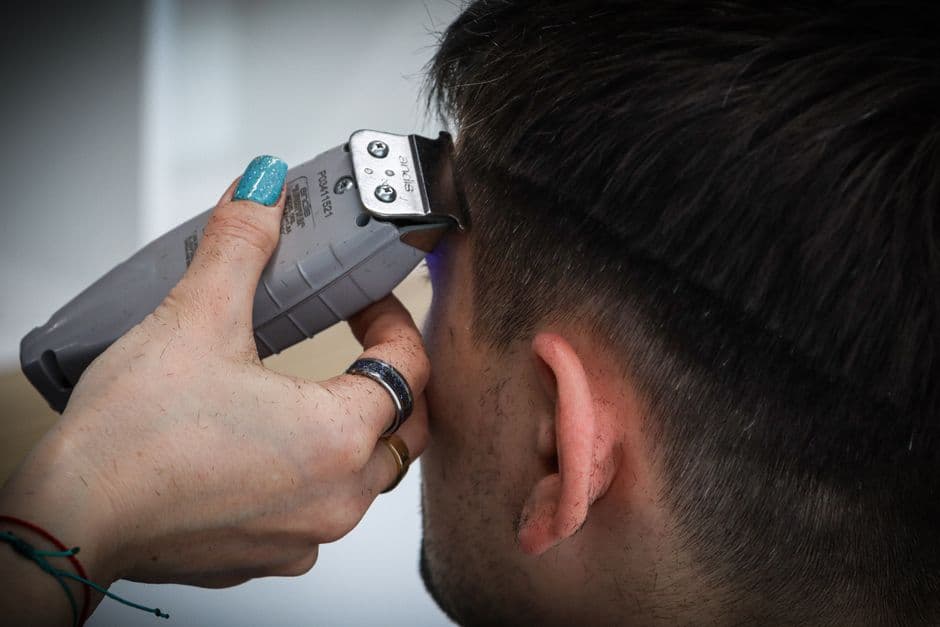
Why this is the one to learn first
A crew cut is three lengths and two blends. Everything difficult about cutting hair - judging length by eye, holding tension, controlling an angle - is done for you by the guard, which is a physical guarantee that you cannot go shorter than you set.
It is also short enough everywhere that a mistake grows out in two weeks rather than two months. That combination is why it is the sensible first haircut to attempt on yourself, and why the general self-cut guide starts from the same place.
The three zones
| Zone | Where | Guard | Approx. length |
|---|---|---|---|
| Top | Crown forward to the hairline | #4 | 12.5 mm |
| Middle | Temple round to the back, upper band | #3 | 9.5 mm |
| Sides and back | Hairline up to the middle zone | #2 | 6 mm |
| Blend zones | The two boundaries | Taper lever | Continuous |
| Edges | Around the ears, the nape | Bare blade | 0 |
The millimeter column is the one to remember. Guard numbers are a widely followed convention rather than a standard, and a #3 on one clipper is not necessarily a #3 on another - the guard guide has the full conversion.
Top first, always
Cut the top before the sides. It is counter-intuitive - the sides feel like the easy warm-up - and doing it the other way means blending the sides upward toward a boundary you have not established yet.
Work against the direction of growth, in overlapping passes from front to back. Overlapping is the habit that matters: each pass should cover about a third of the previous one, because a clipper that misses a strip leaves a visible ridge you will not see until the light changes.
Blending the two boundaries
This is where a crew cut becomes a haircut rather than three buzzes stacked on each other. Set the taper lever between the two guard lengths and work the boundary line with the same wrist motion used in a fade: as the clipper approaches the boundary, rotate the blade away from the scalp so the cut feathers out rather than stopping flat.
The detail that makes it a crew cut
A crew cut is not a uniform length on top. The defining feature is that the top is slightly longer at the front than at the crown, so the profile rises gently toward the forehead.
- Cut the whole top at your chosen guard first, as above.
- Drop one guard size and take a second pass over the crown and the back third of the top only - stopping before you reach the front.
- Blend the junction with the lever, working front to back so the transition is a gradient rather than a step.
It is a subtle difference, it takes ninety seconds, and it is the whole reason the result reads as a deliberate haircut rather than an all-over buzz.
Edges and the nape, last
- Around the ears: bare blade, following the natural hairline. Do not invent a new outline - the one you have is symmetrical and any line you cut will not be.
- The nape: follow the natural growth line rather than squaring it off. Squared napes need redoing every week; a natural one grows out invisibly.
- Sideburns: level with each other, checked against the tops of your ears rather than by eye. Ears are usually more symmetrical than your judgment in a mirror.
Afterwards, and the thing that decides next month
Clean and oil the clipper. A crew cut is a lot of passes through dense short hair, which is exactly the load that dulls a blade, and a dull blade pushes hair instead of cutting it - producing the banding you spent the blend avoiding.
The two-minute maintenance routine is what decides whether next month's cut works, and it matters more than usual here because nobody in the clipper category publishes a blade replacement interval at all.
Every pick, with the working
Each entry shows the published specifications, the axis scores they produce and what you give up. The order is the computed order, not a commercial one, and the arithmetic is open underneath every score.
Our pickThe widest published guard range
Wahl Elite Pro (79602)
Corded, with self-sharpening precision blades Wahl publishes as cutting 40 per cent faster, twelve color-coded guards spanning 1/16 inch to 1 inch, an adjustable taper lever and an eight-foot braided cord. The guard range is the reason to pick it: 1/16 to 1 inch covers a skin-close neckline and a long top from one box.
- Material
- Not published
- Runtime
- Not published
- Charge time
- Not published
- Length settings
- 12
- Waterproof
- Not published
- Made in
- Not published
- Refill
- Proprietary to the maker
- Warranty
- Not published
- Assumed service life
- 1,300 uses
The arithmetic: 260 uses a year x 5 years of assumed service life = 1300 uses.
What it gets right
- Twelve published guards from 1/16 in to 1 in - the widest range in this ledger
- Self-sharpening precision blades with a published cutting-speed claim
- Secure-Fit guides with stainless steel clips, so a guard does not pop mid-stroke
- Eight-foot braided cord, which is the difference between reaching your own neckline and not
Flaws
- Corded only
- Twelve guards is a lot of plastic to store and keep in order
- No published motor rating or warranty
The working behind the 5.6
- How long it lasts: not scored
- Not scored. This is a durable item, not a consumable, so how long it lasts is an assumption about service life rather than something the pack size tells us.
- Ease of switching: 8.5
- Twelve published guards from 1/16 in to 1 in cover every length a head needs from one box (++), secure-fit clips (+), corded with no runtime to manage (+), but no published motor or warranty figure (-).
- Refill economics: 4.0
- Only this maker's refill fits, so the ongoing price is set by the maker rather than by a market. This is where the real cost of ownership hides.
- What the maker publishes: 2.0
- 1 of 5 specifications a buyer would expect are published: settings. Not published: runtimeMin, chargeMin, material, warrantyLabel. 1 / 5 x 10 = 2.0.
Axes with no published input are dropped and the remaining weights re-normalized, so a product is not punished for a category where an axis does not apply. Specifications compiled 3 September 2026 from Wahl Elite Pro 79602 published specifications.
2Fading and blending at home
Wahl 5 Star Magic Clip (8148)
Cord or cordless with a published 90-minute lithium runtime and zero-overlap 2161 blades, plus a taper lever you can work with your thumb mid-stroke. The taper lever is the whole reason this is the fade pick: it changes cutting length continuously rather than in guard-sized jumps, which is what a blend actually needs.
- Material
- Not published
- Runtime
- 90 min
- Charge time
- Not published
- Length settings
- 8
- Waterproof
- Not published
- Made in
- Not published
- Refill
- Proprietary to the maker
- Warranty
- Not published
- Assumed service life
- 1,300 uses
The arithmetic: 260 uses a year x 5 years of assumed service life = 1300 uses.
What it gets right
- Published 90-minute lithium runtime, and it runs corded when flat
- Zero-overlap 2161 blades with a thumb-operated taper lever for continuous length change
- Eight attachment combs, oil and cleaning brush in the box
- Cord-or-cordless, so a dead battery never ends a haircut halfway
Flaws
- A taper lever rewards practice; on a first attempt it is one more thing to get wrong
- Wahl does not publish a motor rating for it, so it cannot be compared numerically to the corded Andis
- No published charge time
The working behind the 5.9
- How long it lasts: not scored
- Not scored. This is a durable item, not a consumable, so how long it lasts is an assumption about service life rather than something the pack size tells us.
- Ease of switching: 8.0
- Cord-or-cordless removes the flat-battery failure entirely (++), 90 minutes published (+), eight combs is a sane number (+), but a taper lever is a skill and a first-time home barber has enough of those already (-).
- Refill economics: 4.0
- Only this maker's refill fits, so the ongoing price is set by the maker rather than by a market. This is where the real cost of ownership hides.
- What the maker publishes: 4.0
- 2 of 5 specifications a buyer would expect are published: runtimeMin, settings. Not published: chargeMin, material, warrantyLabel. 2 / 5 x 10 = 4.0.
Axes with no published input are dropped and the remaining weights re-normalized, so a product is not punished for a category where an axis does not apply. Specifications compiled 3 September 2026 from Wahl 5 Star Magic Clip 8148 published specifications.
3Scissor-over-comb, and everything clippers cannot do
Equinox Razor Edge 6.5 in Hair Shears
6.5 inches overall on 2.55 inch blades, Japanese stainless, 3.5 ounces, with an adjustable tension screw. The tension screw is the specification that matters: shears without one drift loose and start folding hair instead of cutting it, and no amount of steel quality fixes that. This is the tool for the top of a head, where a guard cannot follow the shape.
- Weight
- 99 g
- Length
- 165 mm
- Material
- Japanese stainless steel, hand-sharpened convex edge
- Made in
- Not published
- Refill
- Nothing to refill
- Warranty
- Not published
- Assumed service life
- 2,600 uses
The arithmetic: 260 uses a year x 10 years of assumed service life = 2600 uses.
What it gets right
- Published overall length, blade length and weight, which most shear listings do not give
- Adjustable tension screw, so the pivot can be reset rather than replaced
- Japanese stainless with hand-sharpened convex edges, published
- 3.5 oz: light enough that the wrist is not fighting it on a long cut
Flaws
- Equinox publishes no steel grade or Rockwell hardness - only Japanese stainless
- Shears are a skill: scissor-over-comb is harder than any clipper technique
- Needs oiling and eventual professional sharpening, neither of which has a published interval
The working behind the 6.5
- How long it lasts: not scored
- Not scored. This is a durable item, not a consumable, so how long it lasts is an assumption about service life rather than something the pack size tells us.
- Ease of switching: 5.0
- Published overall length, blade length and weight (+), an adjustable tension screw that keeps them cutting rather than folding (+), but no published steel grade or hardness (-) and scissor technique is the steepest skill in home haircutting (--).
- Refill economics: 8.0
- Nothing to refill. The only future cost is replacing the item itself.
- What the maker publishes: 7.5
- 3 of 4 specifications a buyer would expect are published: weightG, lengthMm, material. Not published: madeIn. 3 / 4 x 10 = 7.5.
Axes with no published input are dropped and the remaining weights re-normalized, so a product is not punished for a category where an axis does not apply. Specifications compiled 3 September 2026 from Equinox Razor Edge shears listed dimensions, weight and tension adjustment.
Prices last verified September 24, 2026. They move constantly; the figure on Amazon when you click is the real one.
Questions people actually ask
What guard numbers make a crew cut?
A common set is a #4 on top, #3 in the middle and #2 at the sides - or everything one step longer for a softer version. Write down the millimeter figures rather than the numbers, because guard numbers are a convention rather than a standard and they do not transfer between brands.
Can I cut a crew cut without a taper lever?
You can get close by using more guards in smaller steps, but the boundaries will be softer rather than blended. The lever is what makes a continuous gradient possible - the fade guide explains why guards alone cannot do it.
Do I need scissors?
Not for a true crew cut, which is short enough everywhere that guards handle it. If you want more length on top than a #4, that becomes scissor work - and that comparison covers where the crossover is.
How do I do the back of my own head?
By feel, with a second mirror only for checking rather than for working. Run the clipper upward in overlapping passes and confirm with your free hand - your palm finds a missed strip far more reliably than a reversed reflection does.
How often does it need redoing?
Every two to three weeks. Hair grows roughly half an inch a month, so at three weeks a #2 has become closer to a #3 and the graduation has flattened out. It is a short-interval haircut, which is exactly why doing it yourself is worth learning.