How to build a lather
Almost every bad lather is one mistake: too much water at the start, which you cannot take back out.
By Sawyer V. · Published · Last updated
We have not tested any of this. Everything below is compiled from published manufacturer specifications, and the arithmetic is printed so you can check it. This page carries affiliate links: if you buy through one we earn a commission at no extra cost to you, and it does not change the order of the picks. Full disclosure.
The short version
Load the brush from the soap first with no added water, then hydrate a few drops at a time. You can always add water; you can never take it out. Start with a pasty, over-concentrated mess on purpose and work water in until it turns glossy and holds a peak that flops slightly at the tip. That is meringue, and it is the target. Whipped-cream airy means you went too far.
| # | Pick | Lasts | Score | Price |
|---|---|---|---|---|
| 1 | Proraso Green shaving soap The safe first soap | ~100 lathers | 7.7/10 | $10.00 - view on Amazon |
| 2 | Yaqi Tuxedo synthetic, 24 mm The default first brush | 1,300 shaves* | 8.1/10 | $19.99 - view on Amazon |
| 3 | Captain's Choice Copper Lather Bowl Ridges that do the work for you | 2,600 shaves* | 8.3/10 | $76.99 - view on Amazon |
Prices last verified September 24, 2026. They move constantly; the figure on Amazon when you click is the real one.
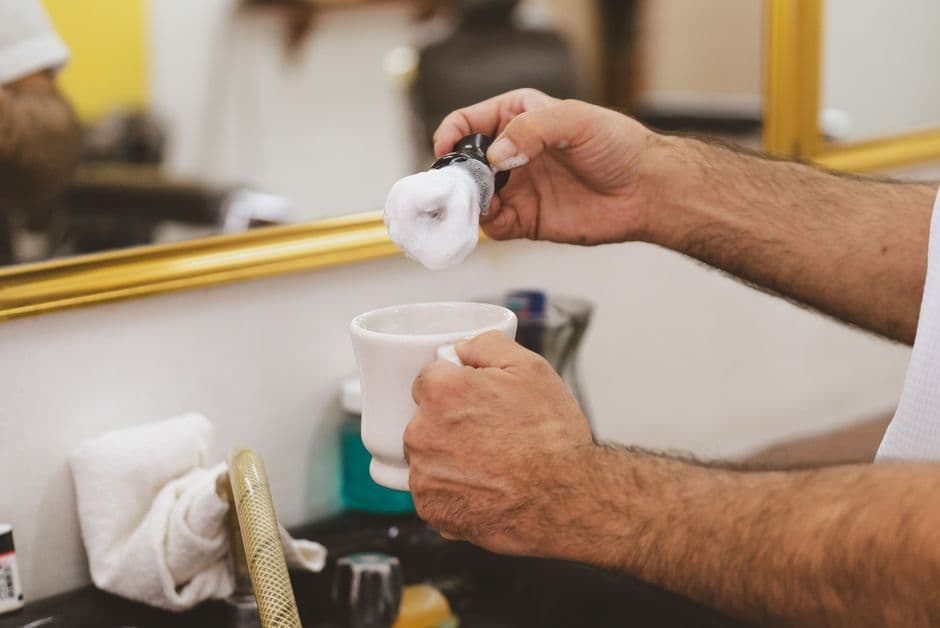
The one principle
You can add water. You cannot remove it. Every technique instruction below follows from that asymmetry. Start too dry on purpose, because a too-dry lather is thirty seconds from being fixed and a too-wet one means loading more soap or starting again.
This is why the standard beginner sequence - wet brush, wet soap, swirl, wonder why it is foam - fails. It puts the irreversible variable in first.
Loading, which is not lathering
The first thirty seconds are a transfer operation. You are moving soap from the puck into the brush, and the brush should come away looking coated and glossy rather than foamy.
- Damp, not dripping. Soak the brush, then shake it out firmly two or three times over the sink. Synthetic knots hold much less water than badger, so they need less shaking - that comparison covers the difference.
- Use some pressure. Not scrubbing, but more than you would think. The brush tips need to work into the surface of the soap.
- Thirty seconds on a hard soap, less on a cream. A croap or cream loads in about ten. A hard triple-milled puck genuinely takes half a minute.
Hydrating, a few drops at a time
Now the lather gets made. What you have in the brush at this point should look like thick paste and behave badly. Good.
- Swirl for ten seconds in the bowl or on your face.
- Add water by dipping only the very tips of the brush - a centimeter of the bristles, no more - or by flicking a few drops in with your fingers.
- Swirl for another ten seconds.
- Repeat until it changes character. It usually takes four or five additions.
The change is quite sudden and unmistakable once you have seen it. The mixture goes from dull and dragging to glossy and slick, and the brush starts to move freely.
The four ways it goes wrong
| What you see | What it is | The fix |
|---|---|---|
| Big visible bubbles, light and airy | Too much water, not enough soap | Load more soap into the same brush |
| Dull, stiff, drags on the skin | Not enough water | A few more drops, ten more seconds |
| Thins out and vanishes on the face | Under-loaded from the start | Load 20 seconds longer next time |
| Grainy or curdled | Hard water reacting with the soap | Try distilled water once to confirm |
Getting it onto the face properly
The last thirty seconds matter more than people expect. Swirl the lather onto the face first, which works it into the beard, then finish with light straight strokes as if you were painting. That final painting motion stands the hairs up away from the skin, which is what gives the blade something to cut.
The layer should be thin enough that you can see skin through it in places. A thick opaque coating looks impressive and mostly gets pushed off by the first stroke - the shaving guide covers what the razor actually needs.
Between passes
Build enough lather for three passes at the start rather than making more each time. That is the argument for a bowl at all, and the argument for a scuttle if your third pass is always cold.
Re-lather fully between passes. Shaving a second pass over the residue of the first is a reliable way to produce the irritation people blame on their razor, and it costs ten seconds to avoid.
Every pick, with the working
Each entry shows the published specifications, the axis scores they produce and what you give up. The order is the computed order, not a commercial one, and the arithmetic is open underneath every score.
Our pickThe safe first soap
Proraso Green shaving soap
150 grams of eucalyptus-and-menthol soap in a bowl, made in Italy, free of parabens, silicones and preservatives. It lathers easily enough that a first attempt with a new brush still produces something usable, which is the only quality that matters in a first soap. The menthol is loud; if you dislike it, buy the white tub instead.
- Net weight
- 150 g
- Fragrance
- Fragranced
- Made in
- Italy
- Refill
- Nothing to refill
- Warranty
- Not applicable
- How long it lasts
- 100 uses
Published key ingredients: Stearic acid, Coconut oil, Glycerin, Menthol, Eucalyptus globulus leaf oil.
The arithmetic: 150 g net weight / 1.5 g per lather (assumed) = about 100 lathers.
What it gets right
- 150 g published net weight in a reusable bowl
- Lathers readily, which forgives a beginner's brush technique
- Published ingredient list; no parabens, silicones or preservatives
- Sold in most places that sell any wet shaving at all
Flaws
- The menthol and eucalyptus is a strong opinion for a product you use every day
- Contains fragrance and geraniol, so not the choice for a genuinely reactive face
The working behind the 7.7
- How long it lasts: 3.8
- 150 g net weight / 1.5 g per lather (assumed) = about 100 lathers. At five shaves a week, that is about 4.6 months. A 12-month supply scores 10 in this category, so 4.6 / 12 x 10 = 3.8.
- Ease of switching: 9.0
- Lathers with very little technique (+), 150 g published net weight in a bowl you can load straight from (+), but a fragranced, mentholated formula is a strong choice to impose on a face you have just started shaving differently (-).
- Refill economics: 8.0
- Nothing to refill. The only future cost is replacing the item itself.
- What the maker publishes: 10.0
- 4 of 4 specifications a buyer would expect are published: netWeightG, madeIn, keyIngredients, fragranceFree. 4 / 4 x 10 = 10.0.
Axes with no published input are dropped and the remaining weights re-normalized, so a product is not punished for a category where an axis does not apply. Specifications compiled 3 September 2026 from Proraso Green shaving soap published specifications.
2The default first brush
Yaqi Tuxedo synthetic, 24 mm
A 24 mm synthetic knot with a published loft in the 55 to 58 mm range, depending on handle. Synthetic fiber needs no breaking in, does not smell wet, dries in an afternoon and costs a fraction of badger. There is no argument for starting anywhere else.
- Material
- Synthetic fiber, resin handle
- Made in
- China
- Refill
- Nothing to refill
- Warranty
- Not published
- Assumed service life
- 1,300 uses
The arithmetic: 260 shaves a year x 5 years of assumed service life = 1300 shaves.
What it gets right
- 24 mm knot with published loft, dense enough to build lather from a hard soap
- No break-in period and no wet-animal smell
- Dries fast, which matters if the brush lives in a bathroom
- Cheap enough that a bad first choice is not a real loss
Flaws
- Loft varies by handle model, so two Yaqis are not identical brushes
- Synthetic fiber holds less water than badger, which some people notice on the third pass
The working behind the 8.1
- How long it lasts: not scored
- Not scored. This is a durable item, not a consumable, so how long it lasts is an assumption about service life rather than something the pack size tells us.
- Ease of switching: 9.0
- No break-in, no odor, fast drying, and a published 24 mm knot in the size range that suits face lathering (+). Loft varies between handle models, so the specification is a range rather than a figure (-).
- Refill economics: 8.0
- Nothing to refill. The only future cost is replacing the item itself.
- What the maker publishes: 6.7
- 2 of 3 specifications a buyer would expect are published: material, madeIn. Not published: lengthMm. 2 / 3 x 10 = 6.7.
Axes with no published input are dropped and the remaining weights re-normalized, so a product is not punished for a category where an axis does not apply. Specifications compiled 3 September 2026 from Yaqi Tuxedo 24 mm published specifications (West Coast Shaving).
3Ridges that do the work for you
Captain's Choice Copper Lather Bowl
Hand-raised copper, roughly 4.5 inches wide and 1.5 inches deep, with ridges pressed into the base and a contoured wall that keeps the brush from knocking out over the edge. The ridges are the specification that matters: they give the brush something to work against, which is most of what a bowl is for.
- Weight
- 170 g
- Material
- Hand-raised copper, ridged base
- Made in
- United States
- Refill
- Nothing to refill
- Warranty
- Not published
- Assumed service life
- 2,600 uses
The arithmetic: 260 uses a year x 10 years of assumed service life = 2600 uses.
What it gets right
- Published ridged base - the one feature that actually speeds lather building
- Published dimensions (approx. 4.5 in wide, 1.5 in deep) and a rolled lip
- Copper, hand-raised rather than pressed, so there is no seam to trap soap
- Roughly six ounces: heavy enough to stay put one-handed
Flaws
- Copper tarnishes and needs occasional polishing to stay bright
- Shallow at 1.5 inches - a big brush will throw lather over the rim
- No heat retention at all, unlike a ceramic scuttle
The working behind the 8.3
- How long it lasts: not scored
- Not scored. This is a durable item, not a consumable, so how long it lasts is an assumption about service life rather than something the pack size tells us.
- Ease of switching: 9.0
- Published ridged base and dimensions (+), no seam to trap soap (+), heavy enough to stay put (+), but it tarnishes (-) and 1.5 in is shallow for a large brush (-).
- Refill economics: 8.0
- Nothing to refill. The only future cost is replacing the item itself.
- What the maker publishes: 7.5
- 3 of 4 specifications a buyer would expect are published: material, madeIn, weightG. Not published: volumeMl. 3 / 4 x 10 = 7.5.
Axes with no published input are dropped and the remaining weights re-normalized, so a product is not punished for a category where an axis does not apply. Specifications compiled 3 September 2026 from Captain's Choice copper lather bowl published dimensions and construction.
Prices last verified September 24, 2026. They move constantly; the figure on Amazon when you click is the real one.
Questions people actually ask
Why is my lather thin and bubbly?
Too much water, almost always added too early. Big visible bubbles mean the mixture is mostly air and water with not enough soap in it. The fix is to load more soap into the same brush - go back to the puck and swirl for another twenty seconds - rather than starting over.
How long should building a lather take?
About 30 seconds loading and 60 to 90 seconds building, so under two minutes once you know what you are doing. If it is taking four minutes you are probably adding water too slowly out of caution, which is a much better failure than the opposite.
Bowl lather or face lather?
Face lathering is faster and exfoliates slightly as you work; bowl lathering gives you more control over the water ratio and is easier to learn on. Start in a bowl, move to the face if you want the time back. The bowl roundup covers what a bowl actually needs to do.
Does hard water ruin lather?
It makes it harder. Calcium and magnesium react with soap to form scum instead of lather, which is why the same soap performs differently in two cities. Distilled water from a supermarket is a cheap test - if your lather is transformed by it, that was the problem.
How much soap should a puck lose per shave?
Very little. We assume 1.5 g per lather in the cost arithmetic, which is why a 150 g puck runs to around a hundred shaves. If your puck is visibly shrinking week to week, you are loading far more than you need.