Is a shaving brush worth it?
Yes, if you use a soap - and the reason is not the one the internet gives. It is a hydration tool, not a massage tool, and that changes which one to buy.
By Sawyer V. · Published · Last updated
We have not tested any of this. Everything below is compiled from published manufacturer specifications, and the arithmetic is printed so you can check it. This page carries affiliate links: if you buy through one we earn a commission at no extra cost to you, and it does not change the order of the picks. Full disclosure.
The short version
Worth it if you use a soap or a brush cream. Not worth it otherwise. A brush is a hydration tool: it carries water into a hard soap and whips it to the right consistency, which is something hands genuinely cannot do. It is not an exfoliator and it does not lift hairs - those two claims are everywhere and neither holds up. If you use a brushless cream, you do not need one.
| # | Pick | Lasts | Score | Price |
|---|---|---|---|---|
| 1 | Yaqi Tuxedo synthetic, 24 mm The default first brush | 1,300 shaves* | 8.1/10 | $19.99 - view on Amazon |
| 2 | Omega 10098 boar Hard soaps and big lather | 1,300 shaves* | 7.8/10 | $14.99 - view on Amazon |
| 3 | Semogue 830 Boar in a smaller knot | 1,300 shaves* | 7.8/10 | $27.01 - view on Amazon |
| 4 | Cremo Original Shave Cream A slick, no-brush cream from a drugstore shelf | ~110 lathers | 7.5/10 | $8.37 - view on Amazon |
Prices last verified September 24, 2026. They move constantly; the figure on Amazon when you click is the real one.
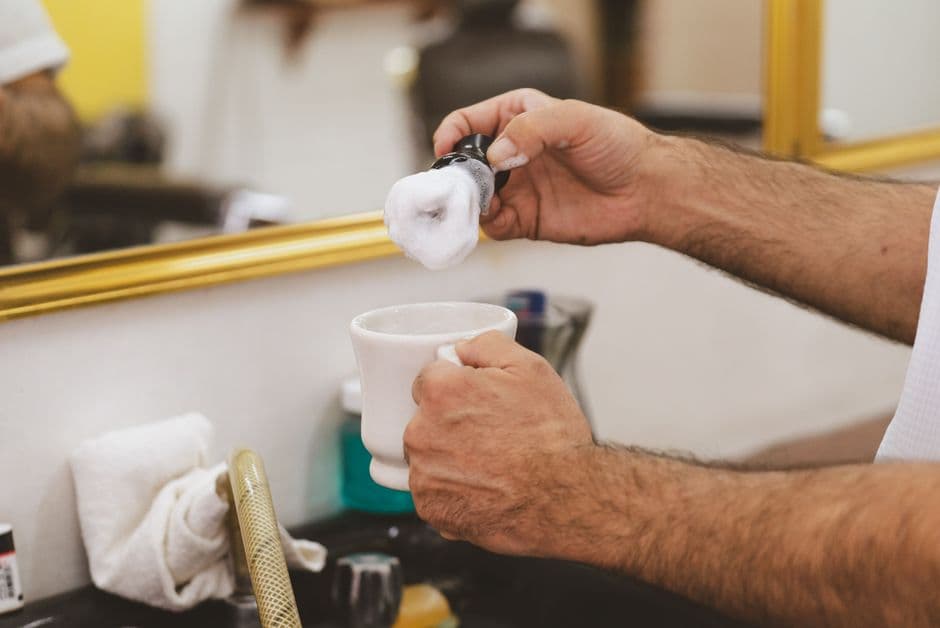
The job it actually does
A lather is three things: soap, water and air, in roughly the right proportions. Get the water wrong and nothing else matters - too little and the lather looks right and collapses in ninety seconds; too much and it is soup.
A brush is the tool for the water. The bristles hold a reservoir of it, release it gradually into the soap as you work, and whip air in at the same time. That is a genuinely mechanical job and hands are bad at it.
Two claims that do not hold up
Both appear in almost every article on this subject, and this site will not repeat them.
- "It exfoliates." Any exfoliation from bristles on skin is incidental and trivially small compared with a product formulated to do it. If exfoliation is what you want, buy an exfoliant - and note that shaving is already a mechanical exfoliation on its own.
- "It lifts the hairs for a closer shave." Plausible-sounding, widely repeated, and nobody publishes evidence for it. The blade is about to sever the hair at the skin line regardless of which direction it was pointing thirty seconds earlier.
Dropping both claims does not weaken the case for a brush. The hydration argument is sufficient on its own, and it is the one that survives.
Which type, and what actually differs
| Type | Water behavior | Break-in | Drying |
|---|---|---|---|
| Synthetic | Releases water readily, whips fast | None | Fast |
| Boar | Holds water well once softened | Several weeks of use | Slower |
| Badger | Holds the most water, softest tips | Minimal | Slowest |
Synthetic is the sensible default for almost everyone starting out: it works from the first use, dries quickly, holds no smell and costs least. Boar rewards patience - the tips split as they soften and it becomes a genuinely different brush after a month.
The badger-versus-synthetic comparison covers the fuller argument, and the brush roundup ranks the field on published knot size and materials - which is genuinely all this category discloses.
Who should buy one
- Anyone using a hard soap puck. Effectively required. This is the clearest case.
- Anyone whose lather keeps collapsing. That is a hydration problem, and a brush is the hydration tool - the lather guide is the other half of the answer.
- Anyone shaving with a safety razor. Three passes needs a lather that holds for three passes, and canned foam does not.
- Anyone who wants the ten minutes to be pleasant. The least measurable reason and one of the most honest ones.
Who genuinely does not need one
- Anyone using a brushless cream. It will not foam and it is not supposed to. A brush makes this worse, not better.
- Anyone shaving in four minutes. Lathering is where the extra time goes, and that is a real constraint rather than a failure of commitment.
- Anyone shaving with an electric. Wet electric shaving wants a thin slick product, not a whipped lather - a bowl lather clogs a foil.
The verdict
Worth it, on the hydration argument alone. If you have moved to a soap and your lather is thin or collapsing, a brush is the missing tool and a synthetic one costs very little.
Not worth it if you use a brushless cream, and not worth it for exfoliation or hair-lifting, because it does neither. Buy it for the lather, or buy a cream that does not need one - both are legitimate answers.
Every pick, with the working
Each entry shows the published specifications, the axis scores they produce and what you give up. The order is the computed order, not a commercial one, and the arithmetic is open underneath every score.
Our pickThe default first brush
Yaqi Tuxedo synthetic, 24 mm
A 24 mm synthetic knot with a published loft in the 55 to 58 mm range, depending on handle. Synthetic fiber needs no breaking in, does not smell wet, dries in an afternoon and costs a fraction of badger. There is no argument for starting anywhere else.
- Material
- Synthetic fiber, resin handle
- Made in
- China
- Refill
- Nothing to refill
- Warranty
- Not published
- Assumed service life
- 1,300 uses
The arithmetic: 260 shaves a year x 5 years of assumed service life = 1300 shaves.
What it gets right
- 24 mm knot with published loft, dense enough to build lather from a hard soap
- No break-in period and no wet-animal smell
- Dries fast, which matters if the brush lives in a bathroom
- Cheap enough that a bad first choice is not a real loss
Flaws
- Loft varies by handle model, so two Yaqis are not identical brushes
- Synthetic fiber holds less water than badger, which some people notice on the third pass
The working behind the 8.1
- How long it lasts: not scored
- Not scored. This is a durable item, not a consumable, so how long it lasts is an assumption about service life rather than something the pack size tells us.
- Ease of switching: 9.0
- No break-in, no odor, fast drying, and a published 24 mm knot in the size range that suits face lathering (+). Loft varies between handle models, so the specification is a range rather than a figure (-).
- Refill economics: 8.0
- Nothing to refill. The only future cost is replacing the item itself.
- What the maker publishes: 6.7
- 2 of 3 specifications a buyer would expect are published: material, madeIn. Not published: lengthMm. 2 / 3 x 10 = 6.7.
Axes with no published input are dropped and the remaining weights re-normalized, so a product is not punished for a category where an axis does not apply. Specifications compiled 3 September 2026 from Yaqi Tuxedo 24 mm published specifications (West Coast Shaving).
2Hard soaps and big lather
Omega 10098 boar
27 mm knot, 65 mm loft, 145 mm tall, handmade in Italy with an ABS handle. Boar bristle splits at the tips as it breaks in, which takes a few weeks of use and then gives you a brush with real backbone for driving lather out of a hard puck. It is also the cheapest genuinely good brush here.
- Weight
- Not published
- Length
- 145 mm
- Material
- Boar bristle, ABS handle
- Made in
- Italy
- Refill
- Nothing to refill
- Warranty
- Not published
- Assumed service life
- 1,300 uses
The arithmetic: 260 shaves a year x 5 years of assumed service life = 1300 shaves.
What it gets right
- Published 27 mm knot and 65 mm loft — a big brush with the backbone hard soaps want
- Handmade in Italy, and priced like an accessory rather than an object
- Improves for the first month or so as the tips split
Flaws
- Needs a break-in period before it is pleasant, which is a strange thing to ask of a first purchase
- Boar smells for the first few uses
- 27 mm is large; on a small face it is more brush than you need
The working behind the 7.8
- How long it lasts: not scored
- Not scored. This is a durable item, not a consumable, so how long it lasts is an assumption about service life rather than something the pack size tells us.
- Ease of switching: 6.5
- Published knot and loft (+), backbone suited to hard soap (+), but a required break-in period and initial odor are two things a first-month wet shaver should not have to interpret (--).
- Refill economics: 8.0
- Nothing to refill. The only future cost is replacing the item itself.
- What the maker publishes: 10.0
- 3 of 3 specifications a buyer would expect are published: lengthMm, material, madeIn. 3 / 3 x 10 = 10.0.
Axes with no published input are dropped and the remaining weights re-normalized, so a product is not punished for a category where an axis does not apply. Specifications compiled 3 September 2026 from Omega 10098 published specifications (Maggard Razors).
3Boar in a smaller knot
Semogue 830
22 mm knot, 55 mm loft, 103 mm tall, 65 grams, acrylic handle, made in Portugal. It is the Omega's argument in a smaller, tidier package: same premium boar behavior, less brush, better suited to a face rather than a bowl.
- Weight
- 65 g
- Length
- 103 mm
- Material
- Premium boar bristle, acrylic handle
- Made in
- Portugal
- Refill
- Nothing to refill
- Warranty
- Not published
- Assumed service life
- 1,300 uses
The arithmetic: 260 shaves a year x 5 years of assumed service life = 1300 shaves.
What it gets right
- Published 22 mm knot and 55 mm loft — a genuinely face-sized brush
- Premium boar, made in Portugal by a family firm that has done nothing else for decades
- 103 mm tall and 65 g; it feels like a tool rather than an ornament
Flaws
- Same break-in period and initial odor as any boar brush
- Smaller knot holds less lather, so a three-pass shave is closer to the limit
The working behind the 7.8
- How long it lasts: not scored
- Not scored. This is a durable item, not a consumable, so how long it lasts is an assumption about service life rather than something the pack size tells us.
- Ease of switching: 6.5
- Published knot, loft, height and weight — the most completely specified brush here (+). Break-in and odor apply as with any boar (--).
- Refill economics: 8.0
- Nothing to refill. The only future cost is replacing the item itself.
- What the maker publishes: 10.0
- 3 of 3 specifications a buyer would expect are published: lengthMm, material, madeIn. 3 / 3 x 10 = 10.0.
Axes with no published input are dropped and the remaining weights re-normalized, so a product is not punished for a category where an axis does not apply. Specifications compiled 3 September 2026 from Semogue 830 published specifications (Maggard Razors).
4A slick, no-brush cream from a drugstore shelf
Cremo Original Shave Cream
Skip this one. Not a brush, and on this page because it is the honest alternative to buying one. A brushless cream lays down a thin slick film by hand - no brush, no bowl, no technique and no learning curve. If the answer to 'is a brush worth it' turns out to be no for you, this is what you buy instead, and it is a genuinely good product rather than a consolation prize.
6 oz with the full ingredient list published - twenty-four items, led by water, sodium cocoyl isethionate and the fatty acids that do the slip. It is designed not to foam: a thin, slick film rather than a lather, which is a genuinely different approach and works well under a cartridge. Fragrance sits ninth on the list, so it is not a sensitive-skin product whatever the shelf says.
- Net weight
- 170 g
- Fragrance
- Fragranced
- Made in
- Not published
- Refill
- Nothing to refill
- Warranty
- Not applicable
- How long it lasts
- 110 uses
Published key ingredients: Water, Sodium cocoyl isethionate, Palmitic acid, Stearic acid, Macadamia seed oil, Allantoin, Aloe barbadensis leaf juice.
The arithmetic: 170 g net weight / 1.5 g per lather (assumed) = about 110 lathers.
What it gets right
- Full 24-item ingredient list published
- 6 oz published, and it uses very little per shave because it is not whipped
- Works with no brush, no bowl and no technique
- Allantoin and aloe both named on the published list
Flaws
- Fragrance is ninth on the published list, ahead of most of the actives
- No lather, which removes the part of wet shaving some people are buying
- No published concentration for any single ingredient
The working behind the 7.5
- How long it lasts: 4.2
- 170 g net weight / 1.5 g per lather (assumed) = about 110 lathers. At five shaves a week, that is about 5.1 months. A 12-month supply scores 10 in this category, so 5.1 / 12 x 10 = 4.2.
- Ease of switching: 9.5
- No brush, no bowl and no technique required, which is the lowest-friction entry to a better shave there is (++), full published list (+), but fragrance ninth on that list rules it out for reactive skin (-).
- Refill economics: 8.0
- Nothing to refill. The only future cost is replacing the item itself.
- What the maker publishes: 7.5
- 3 of 4 specifications a buyer would expect are published: netWeightG, keyIngredients, fragranceFree. Not published: madeIn. 3 / 4 x 10 = 7.5.
Axes with no published input are dropped and the remaining weights re-normalized, so a product is not punished for a category where an axis does not apply. Specifications compiled 3 September 2026 from Cremo Original Shave Cream published ingredient list and size.
Prices last verified September 24, 2026. They move constantly; the figure on Amazon when you click is the real one.
Questions people actually ask
What does a shaving brush actually do?
It carries water into the soap and whips air into the mixture. Lather is soap plus the right amount of water plus air, and a hard puck cannot be hydrated properly by hand - which is what the lather guide is about.
Does a brush exfoliate or lift the hairs?
Those are the two standard claims and neither survives much scrutiny. Any exfoliation is incidental and far less than a product designed for it. Hair lifting is plausible-sounding and nobody publishes evidence for it - and the blade is about to cut the hair regardless of which way it is pointing.
Badger, boar or synthetic?
Synthetic for most people - it dries fast, holds no smell, needs no breaking in and costs least. Boar needs a few weeks of use to soften and then holds water well. The comparison covers the trade properly.
Can I just use my hands?
With a brushless cream, yes - that is what it is designed for. With a hard soap puck, not really: you cannot get enough water into it evenly, and the result is a thin lather that collapses mid-shave.
Do I need a bowl as well?
No. Face lathering works and uses less product. A bowl gives more control while you are learning and is a genuine convenience rather than a requirement - the bowl page covers where a scuttle differs.