Kent 81T beard comb review
Almost every premium claim on this site needs a published figure to stand up. This one needs your thumbnail, because the difference is physical and you can feel it.
By Sawyer V. · Published
We have not tested any of this. Everything below is compiled from published manufacturer specifications, and the arithmetic is printed so you can check it. This page carries affiliate links: if you buy through one we earn a commission at no extra cost to you, and it does not change the order of the picks. Full disclosure.
The short version
Buy it, and check the thing it is sold on yourself. The listing publishes four facts: it is the 81T, it is hand-made, it is saw-cut and polished, and it is made in England. Only one of those matters, and it is the saw-cut. A molded comb has a seam running down every tooth where the two halves of the mold met - a ridge that catches hair and splits it, worst when the hair is wet and weakest. A saw-cut comb is cut from sheet and polished, so there is no seam to begin with. Run a thumbnail along the inside of a tooth and you can feel which one you own. Buy the bigger 20T instead if your beard is past about three inches.
| # | Pick | Lasts | Score | Price |
|---|---|---|---|---|
| 1 | Kent 81T Beard and Mustache Comb Not tearing hair while you tidy | 1,300 shaves* | 9.2/10 | $6.00 - view on Amazon |
Prices last verified November 5, 2026. They move constantly; the figure on Amazon when you click is the real one.
What it is
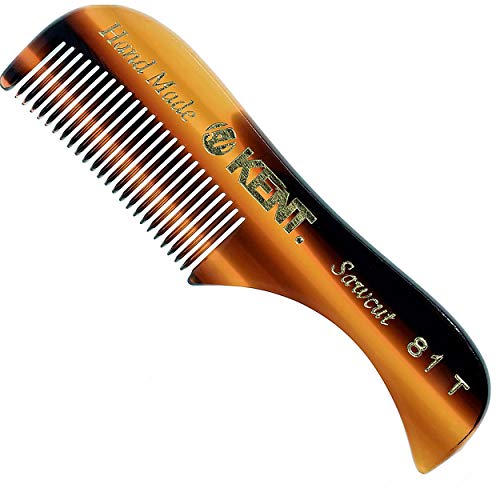
A 73 mm pocket comb for a beard or mustache, cut from cellulose acetate sheet rather than molded, hand-finished, and made in England by a firm that has been making brushes and combs since the eighteenth century. It costs several times what a visually identical drugstore comb costs, and it is the pick on our brush and comb roundup.
| Kent 81T | |
|---|---|
| Model | 81T |
| Construction | Saw-cut and polished, hand-made |
| Material | Cellulose acetate |
| Length | 73 mm, pocket size |
| Made in | England |
| Tooth spacing | Not published |
| Tooth count | Not published |
| Warranty | Not published |
The seam is the entire product
An injection-molded comb is made by forcing hot plastic into a two-part steel mold. Where the two halves meet there is a joint, and that joint prints itself onto the part as a parting line - a thin raised ridge running down the length of every tooth, sometimes with a small flash of excess plastic at the tip.
On most molded objects that ridge is cosmetic and nobody cares. On a comb it sits exactly where the product does its work: the inside face of the tooth, which is the surface in continuous sliding contact with the hair shaft. A ridge with an edge, drawn along a hair hundreds of times a month, is an abrasion tool.
A saw-cut comb never has one. The blank is a flat sheet; the teeth are cut into it and the cut faces are then polished. There were never two halves, so there is no line where they met. That is the whole of the difference, and it is the whole of the reason for the price.
Why it matters on a beard specifically
Scalp hair gets combed when wet and then left alone. Beard hair gets combed wet, combed dry, combed after balm, combed again at lunchtime, and it is coarser and more curved than scalp hair, which means more contact area per stroke.
The damage that produces is not breakage you notice. It is split ends, accumulating slowly along the length. And split ends are the mechanism behind most of what people call beard scratchiness: a split tip is a sharp tip, and a beard full of them feels like wire against a neck and against anybody standing close to it. The softening guide covers the rest of the causes, but the comb is the one most people never think to suspect.
Which reframes the purchase. You are not buying a nicer comb. You are buying out of a slow, invisible source of damage, for about the price of a sandwich, once.
The specification Kent will not give you
Tooth spacing. The listing calls it “fine toothed” and goes no further - no millimeter gap, no tooth count, nothing comparable between models or brands.
On a comb, spacing is the functional specification. It decides whether the comb moves through a dense beard at all, whether it distributes product or just drags it, and whether it will tolerate curl. “Fine” is a relative word doing a measurement's job, and on a site that ranks on published figures it has to be marked as the gap it is.
It matters less here than it would elsewhere, because the saw-cut claim is checkable by hand and the spacing claim is at least visible in the photographs. But it is the reason this is a good product rather than a fully documented one.
Size is the real buying decision
At 73 mm this is deliberately small - an extra-small in Kent's own range - and that cuts both ways.
- Stubble, a mustache, a beard to about two inches: the right size, and small enough that it lives in a pocket. A comb in a drawer gets used twice a week; a comb in a pocket gets used daily.
- A beard past about three inches: too short. You cannot draw it through the full length in one stroke, so you work in sections and the comb stops being quicker than fingers. Buy the larger Kent.
- Head hair: wrong tool entirely - the hair comb page covers that, and the same saw-cut argument applies there.
A comb is not a small brush
Worth settling, because people buy one assuming it replaces the other and then conclude the cheaper of the two was a waste. They do different mechanical jobs.
A comb separates. Rigid teeth at a fixed spacing pass between hairs, pulling tangles apart and putting a part where you want one. It reaches the skin easily, which is why it is the better tool for moving balm or oil down to where it is actually needed rather than leaving it sitting on the outer layer.
A brush lies hair down. Hundreds of flexible bristles contact the outside of the beard at once, pulling sebum from the skin along the length of the hair and training the whole mass to point the same way. It will not detangle anything - a brush meeting a knot simply pushes it along.
The practical sequence on a beard past an inch is comb first to separate and distribute, brush second to settle the shape. Under an inch there is nothing to detangle and nothing to train, and fingers do both jobs adequately. The roundup covers where each becomes worth owning.
This is also why the saw-cut argument applies to combs and not to brushes. A bristle has no mold seam to cut with; a molded tooth does. If you only fix one of the two tools in your kit, the comb is the one where construction changes the outcome.
Using it
- Comb after balm or oil, not before. The comb is what moves product off the outer layer and down to the skin, which is where it is wanted.
- Short strokes, from the ends up. Starting at the root and dragging through a tangle is how hair breaks regardless of what the comb is made of.
- Wash it occasionally. Acetate takes warm soapy water fine; it is wax and sebum buildup between the teeth that makes any comb drag.
- It will not survive being sat on. Cut acetate is rigid rather than springy, which is the trade for holding a polished edge.
Who should buy it
- Anyone with a beard under about three inches who currently uses a molded comb. This is a cheap fix to a problem they probably have not attributed correctly.
- Anyone buying a small gift. It is the reason this comb holds a gift award here: it is inexpensive, it is obviously well made in the hand, and it is useful to anybody with facial hair regardless of their routine.
- Anyone who carries one. Pocket size is the whole point of the 81T.
Who should not
- Anyone with a long beard. Size, not quality, is the problem - buy the bigger one.
- Anyone whose current comb already passes the thumbnail test. You own the thing being recommended.
- Anyone wanting a published spacing figure to compare against another comb. It does not exist.
The verdict
One of the few genuinely justified premiums in grooming, and unusual on this site because the justification is not a published number - it is a manufacturing step whose absence you can feel. Saw-cut against molded is a real, physical, checkable difference, and it happens to sit precisely where a comb touches hair.
It is not perfectly documented: Kent will not tell you the tooth spacing, which is the one figure that would let you compare it with anything else. And it is small, which is a deliberate design decision that rules it out for long beards entirely.
But the test it asks you to trust is one you can run yourself, in two seconds, on the comb you already own. Very few products on this site can say that, and it is worth noticing how rare it is: almost every other premium in grooming asks you to believe a claim about materials or process that you have no way of checking after the money has gone. This one hands you the evidence along with the product.
Every pick, with the working
Each entry shows the published specifications, the axis scores they produce and what you give up. The order is the computed order, not a commercial one, and the arithmetic is open underneath every score.
Our pickNot tearing hair while you tidy
Kent 81T Beard and Mustache Comb
73 mm, sawcut from cellulose acetate and hand-sanded in England. Sawcut matters more than it sounds: a molded comb has a seam along every tooth that catches and splits hair, and a sawcut one does not. On a beard, split ends are most of what scratchiness actually is.
- Length
- 73 mm
- Material
- Sawcut cellulose acetate
- Made in
- England
- Refill
- Nothing to refill
- Warranty
- Not published
- Assumed service life
- 1,300 uses
The arithmetic: 260 shaves a year x 5 years of assumed service life = 1300 shaves.
What it gets right
- Sawcut and hand-sanded, so there is no molding seam to split hair
- 73 mm - pocket-sized, which is the size you will actually carry
- Cellulose acetate rather than injection-molded plastic
- Made in England by a firm that has done nothing else for two centuries
Flaws
- Costs several times an ordinary drugstore comb that looks identical
- 73 mm is too small to be useful on a long beard's full length
- Kent publishes tooth spacing nowhere
The working behind the 9.2
- How long it lasts: not scored
- Not scored. This is a durable item, not a consumable, so how long it lasts is an assumption about service life rather than something the pack size tells us.
- Ease of switching: 9.5
- Sawcut teeth with no molding seam is a real, checkable construction difference that prevents split ends (++), pocket-sized (+), but tooth spacing is unpublished and it costs many times a visually identical drugstore comb (-).
- Refill economics: 8.0
- Nothing to refill. The only future cost is replacing the item itself.
- What the maker publishes: 10.0
- 2 of 2 specifications a buyer would expect are published: material, madeIn. 2 / 2 x 10 = 10.0.
Axes with no published input are dropped and the remaining weights re-normalized, so a product is not punished for a category where an axis does not apply. Specifications compiled 3 September 2026 from Kent handmade sawcut comb published construction.
Prices last verified November 5, 2026. They move constantly; the figure on Amazon when you click is the real one.
If this is not the one
The alternatives named above, in one place. Each links to its own page, where the published specifications and the scoring are set out in full.
Kent 20T Folding Pocket Comb
The same construction in a larger body. If your beard is past about three inches, the 81T is too small to pull through its full length and this is the one to buy.
Kent Beard Brush
A brush does a different job - it distributes oil and lies hair down. A comb detangles and parts. Most beards past an inch eventually want both.
Honest Amish Beard Balm
What to comb through. A comb moves product to the skin that fingers leave on the outer layer, which is most of what makes a balm look like it is working.
Prices last verified November 5, 2026. They move constantly; the figure on Amazon when you click is the real one.
Questions people actually ask
What does saw-cut actually mean?
The comb starts as a flat sheet of cellulose acetate and the teeth are cut into it, then the edges are polished by hand. The alternative is injection molding, where liquid plastic is forced into a two-part mold - fast, cheap, and it leaves a parting line down every tooth where the mold halves met.
Does the seam on a cheap comb really split hair?
A mold seam is a raised ridge with an edge, dragged repeatedly along the length of a hair shaft. Hair is at its weakest when wet, which is exactly when most people comb a beard. It is not a dramatic failure - nothing snaps in your hand - it is cumulative damage that shows up later as split ends, and split ends are most of what beard scratchiness actually is.
How do I tell what my current comb is?
Run a thumbnail slowly down the inside face of one tooth, from base to tip. A molded comb has a faint ridge running the length of it and often a slight flash of plastic at the tip. A saw-cut comb is smooth in both directions. It takes two seconds and it is more reliable than any claim on the packet.
Is 73 mm too small?
For stubble, a mustache or a beard up to roughly two inches, no - and the size is the reason it actually lives in a pocket rather than a drawer. For a long beard it is too short to pull through the full length in one stroke, and the larger Kent is the better buy. Length is the deciding variable, not price.
Is cellulose acetate just plastic?
It is a plastic, yes - the distinction being drawn here is not natural against synthetic, it is cut against molded. Acetate takes a cut edge and a polish well, which is why it is the material saw-cut combs are made from. Anyone buying this expecting a plant-based product rather than a better-finished one has the wrong idea of it.
What does Kent not publish?
Tooth spacing. The listing says “fine toothed” and that is as precise as it gets - no millimeter figure for the gap, and no count. On a comb, spacing is the functional specification, and it is the one number missing.