The best safety razors for thick beards
Coarse, dense growth clogs a mild razor and then you press. The answer is a bigger published blade gap, not a harder hand - and one maker publishes six of them.
By Sawyer V. · Published
We have not tested any of this. Everything below is compiled from published manufacturer specifications, and the arithmetic is printed so you can check it. This page carries affiliate links: if you buy through one we earn a commission at no extra cost to you, and it does not change the order of the picks. Full disclosure.
The short version
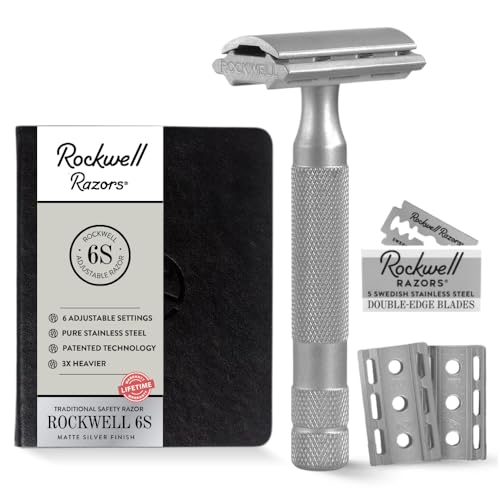
Buy the Rockwell 6S and start on plate R3. Three reversible plates give six published blade gaps from 0.008 to 0.031 inches, so you can find the setting your face tolerates instead of guessing - and dense growth is exactly the case where the right gap is not the one a beginner would pick. Blade gap is the specification that matters here, not weight and not the number of blades. If you want maximum aggression in one fixed razor, the Mühle R41 publishes what it is in the maker's own words.
| # | Pick | Lasts | Score | Price |
|---|---|---|---|---|
| 1 | Rockwell 6S Dialing in your own aggression | 5,200 shaves* | 8.6/10 | $120.00 - view on Amazon |
| 2 | Mühle R41 Wiry growth, for somebody who already shaves well | 5,200 shaves* | 5.8/10 | $48.00 - view on Amazon |
| 3 | Merkur 37C Dense, wiry growth, cut at a slant | 5,200 shaves* | 6.4/10 | $56.00 - view on Amazon |
| 4 | Mühle R89 The mildest of the classic three | 5,200 shaves* | 8.7/10 | $48.00 - view on Amazon |
Prices last verified September 24, 2026. They move constantly; the figure on Amazon when you click is the real one.
What a thick beard actually does to a razor
Dense, coarse growth does not defeat a razor by being hard to cut. It defeats it by filling the head. A mild razor has a small gap between the blade edge and the safety bar, and once that gap packs with hair and lather the blade stops meeting skin properly.
What happens next is the actual problem: you press. Pressure on a double-edge razor is how weepers, razor burn and a sore neck happen, and it is a response to a tool that is not clearing rather than a technique failure.
What this page ranks on
- A published blade gap. A number, in inches or millimeters. Prose like "large blade gap" is a claim, not a specification.
- Whether you can change it. An adjustable razor lets you match the gap to your growth and your skill instead of buying one guess.
- Head geometry. Open comb, closed comb or slant - how the head clears thick lather and long hair.
- Published weight and dimensions. Not because heavy cuts better, but because weight lets you keep pressure off and the figure should be public.
Published figures
| Razor | Blade gap | Head | Weight | Adjustable |
|---|---|---|---|---|
| Rockwell 6S | 0.008 - 0.031 in, six settings | Closed comb | Not published | Yes, 3 reversible plates |
| Mühle R41 | Not published | Open comb | 69.7 g | No |
| Merkur 37C | Not published | Slant, closed | 78 g | No |
| Mühle R89 | Not published | Closed comb | 64 g | No |
The pick: Rockwell 6S
Three reversible plates giving six published blade gaps from 0.008 to 0.031 inches. Nobody else in this category publishes that range, and on a thick beard it turns the whole question into an experiment you can run rather than a purchase you can regret.
Start on R3. If the razor clogs or leaves growth behind after one pass, move to R4 and then R5. If your neck complains before your beard does, drop to R2. Three shaves settles it, and the plates you are not using cost nothing to own.
The honest cons. It is the most expensive option here and the plates are easy to lose. Rockwell publishes gaps but not the razor's weight. And an adjustable razor asks you to make a decision the fixed razors make for you - which is the point, but it is still a decision.
The most aggressive: Mühle R41
Mühle describes the R41 in its own copy as promising "an extremely direct and aggressive shave" and names the buyer as advanced and professional shavers. That is unusually honest marketing, and it is the reason this razor is second rather than first: it is genuinely the right tool for wiry growth and genuinely the wrong first razor.
Published at 69.7 g and 92 mm on Mühle's US store, chrome-plated metal, open comb. The teeth are what matter - they channel thick lather and long hair away from the blade instead of packing it in.
The honest cons. No blade gap figure is published anywhere, on the one razor where you would most want it. Mühle's US and UK stores publish different weights and lengths for the same razor - 69.7 g and 92 mm against 68 g and 94 mm. No warranty term, and no country of manufacture on the product page.
The slant: Merkur 37C
A slant bar twists the blade so it meets hair at an angle rather than square on, which is the same reason a guillotine blade is angled. Merkur publishes 78 g, 81 mm, a brass handle with a die-cast zinc head, and made in Germany.
Merkur also prints that "the large blade gap of the closed head allows good lather flow and resists clogging" - the right idea for this page, and still no number.
The honest cons. No published gap figure, no warranty and no blades in the box. A slant also has a narrower angle window than a straight bar: it rewards a learned hand and punishes a careless one, which is a real cost on a neck.
Before you buy aggression, rule out preparation
A surprising share of "my beard is too thick for this razor" is a preparation problem wearing a hardware costume. Three things fix more of it than a new razor does:
- A longer soak. Hair takes water in slowly, and wet hair cuts far more easily than damp hair. Shave at the end of a shower, not the start.
- A wetter, slicker lather. Thin lather is the most common cause of a clogged head - the lather guide covers hydration, and hard water is the variable nobody mentions.
- A fresh blade. Dense growth blunts blades faster. If you are on shave six of a blade and blaming the razor, change it first - this page covers the interval.
That is why the mild R89 sits at the bottom of this page rather than being left off it: it is the cheap way to test whether density is really your problem.
Using an aggressive razor without paying for it
- No pressure at all. More gap means more blade exposure. Let the weight do it; your hand only steers.
- Shallower angle than you think. Ride the cap, not the bar.
- Two passes, with the grain then across it. Chasing bare skin against the grain on a dense beard is where the neck damage comes from.
- Rinse the head every few strokes. Even a wide gap clogs eventually, and a clogged razor is the thing that makes you press.
The main razor roundup ranks the whole field for everyone else; the adjustable comparison covers why a variable gap is worth the money if your growth is the reason you are here.
Every pick, with the working
Each entry shows the published specifications, the axis scores they produce and what you give up. The order is the computed order, not a commercial one, and the arithmetic is open underneath every score.
Our pickDialing in your own aggression
Rockwell 6S
The 6S is the one razor here that publishes the number everybody else hides. Three reversible plates give six blade gaps from 0.008 to 0.031 inches, so you can start on R1, find the setting your face tolerates, and never wonder whether the razor or your technique is the problem. It is 118 grams of 316L stainless and it ships with five blades.
- Weight
- 118 g
- Length
- 95 mm
- Material
- 316L stainless steel
- Head
- Adjustable, three reversible plates
- Blade gap
- 0.008 in to 0.031 in across R1-R6
- Blades in the box
- 5
- Length settings
- 6
- Made in
- USA
- Refill
- Universal standard
- Warranty
- Not published
- Assumed service life
- 5,200 uses
The arithmetic: 260 shaves a year x 20 years of assumed service life = 5200 shaves.
What it gets right
- Published blade gaps from 0.008 in to 0.031 in across six settings — the only razor in this ledger that discloses them
- 316L stainless, so there is no plating to wear through
- Five blades in the box; usable the day it arrives
- 118 g, the heaviest here, which suits a heavy beard and a light hand
Flaws
- Six settings is six chances to blame the razor instead of your angle in the first month
- Three loose plates are three things to keep track of
- Heaviest and largest of the group at 95 mm overall
The working behind the 8.6
- How long it lasts: not scored
- Not scored. This is a durable item, not a consumable, so how long it lasts is an assumption about service life rather than something the pack size tells us.
- Ease of switching: 7.0
- R1 plate is the mildest published gap in this ledger at 0.008 in (+), blades included (+), but six settings and three loose plates add decisions in exactly the month a new wet shaver has too many (-).
- Refill economics: 10.0
- The refill is a commodity standard that dozens of factories make, so the price is set by competition and no single maker can raise it.
- What the maker publishes: 10.0
- 7 of 7 specifications a buyer would expect are published: weightG, lengthMm, material, madeIn, headType, bladeGapNote, bladesIncluded. 7 / 7 x 10 = 10.0.
Axes with no published input are dropped and the remaining weights re-normalized, so a product is not punished for a category where an axis does not apply. Specifications compiled 3 September 2026 from Rockwell 6S published specifications (Fendrihan).
2Wiry growth, for somebody who already shaves well
Mühle R41
An open comb razor Mühle itself describes as promising an extremely direct and aggressive shave, in chrome-plated metal, published at 69.7 g and 92 mm on its US store. It is the only razor in this ledger whose maker names the buyer that plainly - advanced and professional shavers - and the only one where two official stores publish different weights for the same razor.
- Weight
- 69.7 g
- Length
- 92 mm
- Material
- Chrome-plated metal
- Head
- Open comb
- Made in
- Not published
- Refill
- Universal standard
- Warranty
- Not published
- Assumed service life
- 5,200 uses
The arithmetic: 260 shaves a year x 20 years of assumed service life = 5200 shaves.
What it gets right
- Published weight and length, and an unusually blunt statement of how aggressive it is
- Open comb head clears thick lather and longer growth instead of clogging
- Mühle names the intended user rather than claiming the razor suits everybody
- Chrome-plated metal, published as corrosion-resistant
Flaws
- Mühle's US and UK stores publish different figures for the same razor: 69.7 g / 92 mm against 68 g / 94 mm
- No blade gap figure published anywhere, on the razor where that number matters most
- No warranty term and no country of manufacture on the product page
- Not a first razor, by the maker's own description
The working behind the 5.8
- How long it lasts: not scored
- Not scored. This is a durable item, not a consumable, so how long it lasts is an assumption about service life rather than something the pack size tells us.
- Ease of switching: 3.5
- Published weight, length and an honest aggression statement (+), universal DE blades (+), but the maker directs it at advanced shavers (--), no blade gap is published (-) and two official stores disagree on the weight (-).
- Refill economics: 10.0
- The refill is a commodity standard that dozens of factories make, so the price is set by competition and no single maker can raise it.
- What the maker publishes: 5.7
- 4 of 7 specifications a buyer would expect are published: weightG, lengthMm, material, headType. Not published: madeIn, bladeGapNote, bladesIncluded. 4 / 7 x 10 = 5.7.
Axes with no published input are dropped and the remaining weights re-normalized, so a product is not punished for a category where an axis does not apply. Specifications compiled 3 September 2026 from Mühle R41 published weight, length, material and head type.
3Dense, wiry growth, cut at a slant
Merkur 37C
A two-piece slant bar razor at a published 78 g and 81 mm, with a brass handle, a die-cast zinc head and a bright chrome finish, published as made in Germany. Merkur prints that the large blade gap of the closed head allows good lather flow and resists clogging - and never publishes what that gap measures.
- Weight
- 78 g
- Length
- 81 mm
- Material
- Brass handle, die-cast zinc head, chrome-plated
- Head
- Slant bar, closed
- Made in
- Germany
- Refill
- Universal standard
- Warranty
- Not published
- Assumed service life
- 5,200 uses
The arithmetic: 260 shaves a year x 20 years of assumed service life = 5200 shaves.
What it gets right
- Published 78 g weight and 81 mm length
- Published materials: brass handle, die-cast zinc head, chrome-plated
- Published as made in Germany on the maker's own page
- Slant geometry is aimed at wiry, dense beards and Merkur says so plainly
Flaws
- No blade gap figure published - only the words 'large blade gap'
- No warranty term published
- No blades included, and no count published either way
- A slant is not a first razor; the angle is less forgiving than a straight bar
The working behind the 6.4
- How long it lasts: not scored
- Not scored. This is a durable item, not a consumable, so how long it lasts is an assumption about service life rather than something the pack size tells us.
- Ease of switching: 4.0
- Published weight, dimensions, materials and country (++), universal blades (+), but no blade gap figure (-) and a slant asks you to learn an angle before it rewards you (--).
- Refill economics: 10.0
- The refill is a commodity standard that dozens of factories make, so the price is set by competition and no single maker can raise it.
- What the maker publishes: 7.1
- 5 of 7 specifications a buyer would expect are published: weightG, lengthMm, material, madeIn, headType. Not published: bladeGapNote, bladesIncluded. 5 / 7 x 10 = 7.1.
Axes with no published input are dropped and the remaining weights re-normalized, so a product is not punished for a category where an axis does not apply. Specifications compiled 3 September 2026 from Merkur 37C published weight, dimensions, materials and origin.
4The mildest of the classic three
Mühle R89
Skip this one. On this page as the control rather than as a pick. It is a mild closed comb at a published 64 grams, and if a mild razor is clogging on your beard the honest first question is whether the problem is density or preparation - a longer soak, a wetter lather and a fresh blade solve more 'thick beard' complaints than an aggressive razor does. Buy this if you want to test that theory cheaply before spending on a razor you may have to learn.
The R89 is the lightest of the three classic closed combs at 64 grams and the only one that puts a blade in the box, which matters more than it sounds when the alternative is ordering two things and waiting for both. Mühle publishes a 41 x 94 mm envelope and nothing else, which is the one place it is less forthcoming than Edwin Jagger.
- Weight
- 64 g
- Length
- 94 mm
- Material
- Chrome-plated metal, engraved handle
- Head
- Closed comb
- Blade gap
- Not published
- Blades in the box
- 1
- Made in
- Germany
- Refill
- Universal standard
- Warranty
- Not published
- Assumed service life
- 5,200 uses
The arithmetic: 260 shaves a year x 20 years of assumed service life = 5200 shaves.
What it gets right
- Ships with a blade, so it is a complete first purchase on its own
- 64 g — the lightest of the three classics, which suits a lighter touch
- Closed comb, nothing adjustable, chrome-plated with an engraved handle for grip
- Standard blade fitment
Flaws
- Mühle does not publish a blade gap, so its mildness cannot be compared numerically to anything
- Lightest of the three, which means slightly more of the pressure is yours to supply
- One blade in the box is a sample, not a supply
The working behind the 8.7
- How long it lasts: not scored
- Not scored. This is a durable item, not a consumable, so how long it lasts is an assumption about service life rather than something the pack size tells us.
- Ease of switching: 8.0
- Closed comb (+), no adjustment (+), one blade included so it works on arrival (+), 64 g is the lightest of the classic three, so slightly more pressure is yours to control (-).
- Refill economics: 10.0
- The refill is a commodity standard that dozens of factories make, so the price is set by competition and no single maker can raise it.
- What the maker publishes: 8.6
- 6 of 7 specifications a buyer would expect are published: weightG, lengthMm, material, madeIn, headType, bladesIncluded. Not published: bladeGapNote. 6 / 7 x 10 = 8.6.
Axes with no published input are dropped and the remaining weights re-normalized, so a product is not punished for a category where an axis does not apply. Specifications compiled 3 September 2026 from Mühle R89 listed specifications (Maggard Razors).
Prices last verified September 24, 2026. They move constantly; the figure on Amazon when you click is the real one.
Questions people actually ask
What makes a razor better for a thick beard?
Blade gap - the distance between the blade edge and the safety bar. A wider gap lets more hair reach the blade before the head clogs, which is what a mild razor does on dense growth and what makes people press harder to compensate.
Is an aggressive razor harder to use?
Yes, and honestly so. A wider gap exposes more blade, which is less forgiving of pressure and angle. That is the argument for an adjustable razor: you learn on a small gap and open it up as your technique settles, rather than buying the aggression first.
Open comb or closed comb for coarse hair?
An open comb clears thick lather and long growth better because the teeth channel it away from the blade. That comparison covers the trade in full: more clearance, less support for the skin.
Does a heavier razor shave a thick beard better?
Weight helps you stop pressing, which matters, but it is not the specification doing the cutting. The Henson AL13 is a published 37 grams and shaves perfectly well; gap and angle decide how dense a beard a head can take.
What blade should I use with it?
Start with a sharp, forgiving one and change it more often than you think. The blade roundup covers the field, and the blade-matching guide covers coarse growth specifically. A dull blade on a thick beard is what tugging actually is.
Will this stop the irritation on my neck?
Partly. Fewer passes over the same skin is the single biggest lever on irritation, and a razor that clears growth in one pass gets you there. The rest is preparation and grain direction - the razor burn guide is the other half.