How to clean a safety razor
Five steps across three timescales. The one that matters most is the one nobody does: the threads, where scale stops the head seating flat.
By Sawyer V. · Published
We have not tested any of this. Everything below is compiled from published manufacturer specifications, and the arithmetic is printed so you can check it. This page carries affiliate links: if you buy through one we earn a commission at no extra cost to you, and it does not change the order of the picks. Full disclosure.
The five steps
- Rinse it under a hot tap after every shave, head assembled. Ten seconds of hot water through the head clears most of the soap and stubble. Doing it with the razor still assembled is fine and is what you will actually keep doing.
- Shake it dry and stand it up, blade side down. Water sitting in a two-piece head or in the doors of a butterfly razor is what corrodes it. Standing it blade-down lets the water run out instead of pooling.
- Once a week, take it apart and rinse the pieces separately. Soap scum builds where the cap meets the plate, which is exactly where you cannot see it. Thirty seconds with the parts separated does what a rinse cannot.
- Once a month, scrub the threads and the underside of the cap. An old toothbrush and dish soap. The screw threads collect a paste of soap and hard-water scale that eventually stops the head seating flat, and a head that does not seat flat changes the blade geometry.
- Descale it if your water is hard, with diluted vinegar. Twenty minutes in a one-to-one white vinegar and water solution, then rinse thoroughly and dry. Do this only if you see white scale - it is a fix rather than a routine, and it is not for plated brass on a monthly basis.
| # | Pick | Lasts | Score | Price |
|---|---|---|---|---|
| 1 | Merkur 34C HD One razor, no research | 5,200 shaves* | 8.9/10 | $60.00 - view on Amazon |
| 2 | Double-edge blade sampler Your actual first blade purchase | Not published | 8.9/10 | Check price on Amazon |
| 3 | Parker 99R Changing blades without touching one | 5,200 shaves* | 8.8/10 | $31.77 - view on Amazon |
Prices last verified October 19, 2026. They move constantly; the figure on Amazon when you click is the real one.
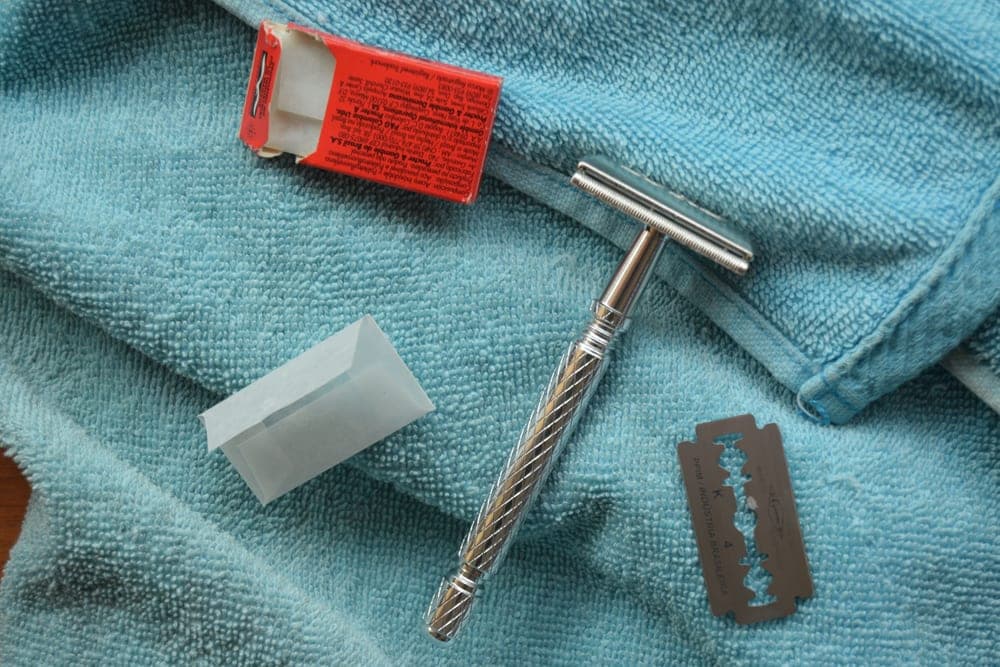
Why bother, when the blade is the part that cuts
Because the razor is the part you are keeping. Our arithmetic assumes a twenty-year service life - 5,200 shaves at five a week - and that assumption only holds for a razor that gets rinsed. It is also the cheapest maintenance in grooming: ten seconds a day, thirty seconds a week.
There is a second reason that is less obvious and more important. Soap and hard-water scale build up on the screw threads and under the cap, and once there is enough of it the head stops seating perfectly flat. A head that does not seat flat changes the blade gap - the exact property that decides how mild the razor is. You will experience that as the razor having become harsher, and you will probably blame the blade.
Daily: ten seconds
Hot tap, water through the head, assembled. Shake it out, stand it blade-down on a shelf or hang it on a stand. That is the whole routine and it removes the soap while it is still soft.
Standing it blade-down matters more on some designs than others. A two-piece like the Merkur has a long screw running the handle; a butterfly like the Parker 99R has doors that trap water in the mechanism. Both benefit from letting gravity empty them rather than leaving them lying in a dish.
Weekly: take it apart
- Unscrew it and separate the pieces. Two on a Merkur, three on a three-piece. On a butterfly, open the doors fully and rinse through them.
- Rinse each piece under hot water, paying attention to where the cap meets the plate - that join is where scum accumulates out of sight.
- Handle the blade by its short edges, or leave it in its wrapper if you are changing it anyway. If it is near five shaves, this is the moment to bin it.
Put used blades in a blade bank or a tin with a slot rather than loose in a bathroom bin. This is the one genuine safety consideration in the entire category and it is about somebody else's hands, not yours.
Monthly: the threads and the cap
An old toothbrush, a drop of dish soap, hot water. Scrub the screw threads on the handle, the corresponding threads in the cap, and the underside of the cap where the blade sits. Rinse and dry.
On a butterfly razor, work the mechanism a few times under running water while you do it - the doors and the cam that drives them are the part that traps soap, and it is the trade-off for never having to touch a bare blade.
If your water is hard
You will see white scale on the head. Twenty minutes in a one-to-one solution of white vinegar and water, then a thorough rinse and a proper dry, removes it.
Do this when you see scale, not on a schedule. Acid exposure is a fix, and repeated monthly acid baths are not something to do to a chrome-plated brass razor. A solid stainless razor like the Rockwell 6S tolerates it better than plated brass does, which is one of several small arguments for stainless over twenty years.
What not to do
- No dishwasher. Dishwasher detergent is aggressive enough to attack chrome plating, and the heat cycle does nothing useful.
- No abrasives. Scouring pads and metal polish on a plated razor remove plating, and once it is gone there is no putting it back.
- No need to sterilize. You are the only person using it. A hot rinse is sufficient and boiling adds nothing.
- Do not store it wet in a closed case. Travel cases are for traveling, not for a razor that has just been used.
The same reasoning, applied to a different tool, is in the electric shaver guide - where the stakes are higher, because a shaver head is a proprietary part with a published replacement interval and a safety razor is three pieces of metal that outlive you.
Every pick, with the working
Each entry shows the published specifications, the axis scores they produce and what you give up. The order is the computed order, not a commercial one, and the arithmetic is open underneath every score.
Our pickOne razor, no research
Merkur 34C HD
Buy this one if you want to stop reading and start shaving. It is 68 grams of chrome-plated brass on a short knurled handle, which is heavy enough that you naturally stop pressing, and the head is a plain closed comb with nothing to set, adjust or get wrong. It has been in production in Solingen for decades, so parts, advice and blades are everywhere.
- Weight
- 68 g
- Length
- 80 mm
- Material
- Chrome-plated brass
- Head
- Closed comb, two-piece
- Blade gap
- Not published
- Blades in the box
- 0
- Made in
- Germany
- Refill
- Universal standard
- Warranty
- Not published
- Assumed service life
- 5,200 uses
The arithmetic: 260 shaves a year x 20 years of assumed service life = 5200 shaves.
What it gets right
- 68 g in a 80 mm body: the weight does the work, which is exactly the habit a cartridge user has to unlearn
- Closed comb with no adjustment, so there is one variable fewer on your first month
- Two-piece construction; the head unscrews as a unit and there is nothing to lose in the sink
- Takes any standard double-edge blade, so the refill is a commodity
Flaws
- The 80 mm handle is short for large hands, and Merkur's own longer handles are a separate purchase
- No blade in the box, so the first order needs a blade pack alongside it
- Chrome over brass will show wear at the edges over years in a way stainless will not
The working behind the 8.9
- How long it lasts: not scored
- Not scored. This is a durable item, not a consumable, so how long it lasts is an assumption about service life rather than something the pack size tells us.
- Ease of switching: 8.5
- Closed comb (+), no adjustment to set (+), 68 g published weight in the range where the razor's own mass supplies the pressure (+), no blade included so the first order is two items (-).
- Refill economics: 10.0
- The refill is a commodity standard that dozens of factories make, so the price is set by competition and no single maker can raise it.
- What the maker publishes: 8.6
- 6 of 7 specifications a buyer would expect are published: weightG, lengthMm, material, madeIn, headType, bladesIncluded. Not published: bladeGapNote. 6 / 7 x 10 = 8.6.
Axes with no published input are dropped and the remaining weights re-normalized, so a product is not punished for a category where an axis does not apply. Specifications compiled 3 September 2026 from Merkur 34C HD listed specifications (Fendrihan).
2Your actual first blade purchase
Double-edge blade sampler
This is the one thing on the site we will tell you to buy before you have read the rest of it. Blades are the cheapest variable in shaving and the one that changes the result most, and no amount of reading will tell you which edge suits your face. A sampler settles it in about six weeks for the price of a sandwich.
- Material
- Varies by seller
- Blades per pack
- Not published
- Made in
- Varies by seller
- Refill
- Universal standard
- Warranty
- Not applicable
- How long it lasts
- Not published
What it gets right
- Answers the only question in wet shaving that genuinely cannot be answered by reading
- Costs less than a single pack of cartridges
- Ends the beginner's habit of blaming the razor for a blade problem
Flaws
- Contents vary between sellers, so what you get is not a fixed specification
- You will end up with a few blades you never use again
The working behind the 8.9
- How long it lasts: not scored
- Not scored. This is a durable item, not a consumable, so how long it lasts is an assumption about service life rather than something the pack size tells us.
- Ease of switching: 9.5
- Removes the single largest unknown of the first two months (++). Contents are not a published specification, so the yield figure cannot be computed (-).
- Refill economics: 10.0
- The refill is a commodity standard that dozens of factories make, so the price is set by competition and no single maker can raise it.
- What the maker publishes: 6.7
- 2 of 3 specifications a buyer would expect are published: material, madeIn. Not published: unitsPerPack. 2 / 3 x 10 = 6.7.
Axes with no published input are dropped and the remaining weights re-normalized, so a product is not punished for a category where an axis does not apply. Specifications compiled 3 September 2026 from Double-edge blade range (West Coast Shaving).
3Changing blades without touching one
Parker 99R
The 99R is a twist-to-open butterfly: the doors open, the old blade drops out, the new one drops in, the doors close. If the part of this that worries you is handling a bare double-edge blade, that mechanism is the answer, and at 100 grams over a 114 mm brass handle it has the heft to go with it.
- Weight
- 100 g
- Length
- 114 mm
- Material
- Brass handle, nickel head
- Head
- Butterfly twist-to-open, straight bar
- Blade gap
- Not published
- Blades in the box
- Not published
- Made in
- India
- Refill
- Universal standard
- Warranty
- Not published
- Assumed service life
- 5,200 uses
The arithmetic: 260 shaves a year x 20 years of assumed service life = 5200 shaves.
What it gets right
- Butterfly twist-to-open head — you never pick up a loose blade
- 100 g over a 114 mm handle, the longest grip in this ledger
- Brass handle with a nickel head; standard blade fitment
- Parker has built this model in India since the 1970s, so it is not a novelty
Flaws
- A butterfly mechanism is more moving parts than a two-piece, and more to eventually loosen
- Parker does not publish a blade gap
- The doors trap soap; it needs rinsing more thoroughly than a three-piece
The working behind the 8.8
- How long it lasts: not scored
- Not scored. This is a durable item, not a consumable, so how long it lasts is an assumption about service life rather than something the pack size tells us.
- Ease of switching: 9.0
- Butterfly head removes the single step new wet shavers most dislike, handling a bare blade (++), 100 g (+), 114 mm handle (+), more moving parts to eventually wear (-).
- Refill economics: 10.0
- The refill is a commodity standard that dozens of factories make, so the price is set by competition and no single maker can raise it.
- What the maker publishes: 7.1
- 5 of 7 specifications a buyer would expect are published: weightG, lengthMm, material, madeIn, headType. Not published: bladeGapNote, bladesIncluded. 5 / 7 x 10 = 7.1.
Axes with no published input are dropped and the remaining weights re-normalized, so a product is not punished for a category where an axis does not apply. Specifications compiled 3 September 2026 from Parker 99R listed specifications (Maggard Razors).
Prices last verified October 19, 2026. They move constantly; the figure on Amazon when you click is the real one.
Questions people actually ask
How often should I clean a safety razor?
Rinse after every shave, strip and rinse the pieces weekly, scrub the threads monthly. The daily rinse is ten seconds and does most of the work; the monthly scrub is the one that prevents the problem you cannot see.
Do I need to dry my razor after every shave?
Shake it out and stand it blade-down so water runs rather than pools. Towel-drying a chrome-plated razor every day is not necessary and will not hurt. Leaving it lying in a puddle in a soap dish is what shortens its life.
Can I put a safety razor in boiling water or a dishwasher?
No to both. A dishwasher's detergent is aggressive enough to strip chrome plating, and boiling adds nothing that a hot tap does not. There is also no sterilization case to make - you are the only person using it.
How do I get white scale off a razor?
Twenty minutes in one-to-one white vinegar and water, then rinse thoroughly and dry. Only when you can see scale, not as a routine - repeated acid exposure is not something to do monthly to plated brass.
Should I take the blade out to clean it?
For the weekly strip, yes - and handle it by the short edges or through its wrapper. If the blade is near the end of its five shaves, that is the moment to bin it rather than refit it. Keep a blade bank rather than putting loose blades in a bathroom bin.