The best adjustable safety razors
The whole promise of an adjustable is that you can dial in the aggression your face tolerates. That promise only means something if the maker tells you what you are dialing between.
By Sawyer V. · Published
We have not tested any of this. Everything below is compiled from published manufacturer specifications, and the arithmetic is printed so you can check it. This page carries affiliate links: if you buy through one we earn a commission at no extra cost to you, and it does not change the order of the picks. Full disclosure.
The short version
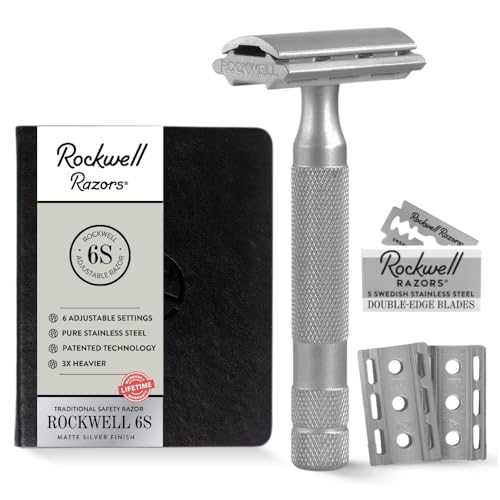
Buy the Rockwell 6S. It is the only adjustable here that publishes what you are adjusting between: six blade gaps from 0.008 to 0.031 inches across three reversible plates, in 118 g of 316L stainless, with five blades in the box. You can find the setting that works, write it down, and return to it exactly. If you specifically want a dial you can turn mid-shave, the Parker Variant is the cheapest honest way to get one - 110 g of brass with a published 1-5 dial, and no published gap behind any of the five numbers.
| # | Pick | Lasts | Score | Price |
|---|---|---|---|---|
| 1 | Rockwell 6S Dialing in your own aggression | 5,200 shaves* | 8.6/10 | $120.00 - view on Amazon |
| 2 | Parker Variant A dial you can turn mid-shave | 5,200 shaves* | 8.1/10 | $63.59 - view on Amazon |
| 3 | Merkur Progress 510 A long handle and Solingen build | 5,200 shaves* | 8.2/10 | $85.00 - view on Amazon |
| 4 | Merkur Futur 700 The heaviest adjustable here | 5,200 shaves* | 7.8/10 | $75.00 - view on Amazon |
Prices last verified October 19, 2026. They move constantly; the figure on Amazon when you click is the real one.
The promise, and the thing that breaks it
An adjustable safety razor sells one idea: faces differ, so the razor should move rather than you. Start mild, work up, stop where your skin stops complaining, and you have a razor set to you rather than to an average.
It is a good idea. It depends entirely on one thing that most of this category quietly skips: the maker telling you what the settings are.
A blade gap is the distance between the blade edge and the safety bar. It is measurable, it is the figure that predicts aggression better than any adjective, and of the four razors on this page exactly one publishes it. Rockwell prints six gaps in inches. Parker prints a dial numbered one to five and no gaps. Merkur, on its own product pages for both the Progress and the Futur, prints neither a gap nor how many positions the dial has.
What to look for
- A published blade gap, per setting. The only figure in this category that means anything across brands. Its absence is not a small omission.
- How the adjustment is made. A dial changes mid-shave; plates mean taking the razor apart. That is a real convenience difference and it is the trade you are making against disclosure.
- Weight, published. Something in the 100 to 130 g range so the razor supplies its own pressure. This matters more on an adjustable, because pressing is how people turn a mild setting into an aggressive one by accident.
- What the head is actually made of. “Brass handle” and “zinc head” is a common combination, and the head is the part that matters.
- Blades in the box. Trivial, and it decides whether you can shave the day it arrives.
Published figures
| Razor | Adjustment | Published blade gap | Weight | Length | Head material |
|---|---|---|---|---|---|
| Rockwell 6S | Three reversible plates, six positions | 0.008 in to 0.031 in, published per plate | 118 g | 95 mm | 316L stainless |
| Parker Variant | Dial at the base, 1-5 | Not published | 110 g | 102 mm (4 in) | Brass frame, electroplated |
| Merkur Progress 510 | Dial, position count not published | Not published | 103 g | 104 mm | Die-cast zinc head, brass handle |
| Merkur Futur 700 (the skip) | Rotating handle, position count not published | Not published | 129 g | 108 mm | Die-cast zinc |
The pick: Rockwell 6S
Three plates, each reversible, giving six settings - and Rockwell publishes a gap for every one of them, from 0.008 inches on R1 to 0.031 inches on R6. That is the mildest published gap in this ledger at one end and a genuinely aggressive one at the other, and you know which is which before you buy.
The practical value is that it turns shaving into something you can debug. Shave on R2 for a week; if your neck is irritated, the question is no longer “is it the razor or me”, because the razor is a known quantity. Move to R1 and you have changed one measurable thing. No dial razor on this page lets you do that.
It is 118 g of 316L stainless, so there is no plating to wear through, and it ships with five blades - you can shave the day it arrives.
The honest cons. Changing the setting means taking the razor apart, so it is a between-shaves decision rather than a mid-shave one - if your cheeks and neck want different settings, this is the wrong tool. Three loose plates are three things to lose in a bathroom drawer. At 95 mm it is the shortest handle here, which a large hand notices. And it costs more than any of the dials.
If you are weighing it against a mild fixed razor rather than against other adjustables, that head-to-head is here.
If you want a dial: Parker Variant
The case for a dial is real and this page should not pretend otherwise. Necks are more sensitive than cheeks on most faces, and a razor you can soften for the last pass without putting it down is doing something a plate razor cannot.
The Parker is the cheapest way to get that without buying something flimsy. Maggard publishes 110 g on a four-inch body, a genuine brass frame rather than zinc, two-piece construction so the blade seats against the head, and a dial at the base running 1 to 5. At its price that is a lot of razor.
The honest cons. Parker publishes no blade gap for any of the five positions, so the numbers are relative to themselves - a 3 tells you it is milder than a 4 and nothing else. No country of manufacture is published. The finish is electroplated rather than solid metal, which makes it a wear item in a wet environment. And five positions is five chances to blame the razor for something your angle is doing.
The Solingen option: Merkur Progress 510
The reason to pick this over the Futur is the handle. At 104 mm with a long, slim grip it suits a large hand and the awkward angle under a jaw, and Merkur publishes 103 g, the dimensions, the materials and the city it is made in.
It is a two-piece razor, so the blade seats against the head rather than by eye, and it has been in production long enough that parts and secondhand advice are everywhere.
The honest cons. Merkur publishes neither a blade gap nor a number of dial positions for it on its own product page - the mechanism is described and the arithmetic is withheld. The head is die-cast zinc on a brass handle, which puts the cheaper metal in the part that does the work. Chrome over zinc is a wear item. And it is the most expensive dial here, which is hard to justify when the Parker publishes more about itself for less.
The honest question first
Most people asking about adjustables should buy a mild fixed razor instead, and it is worth saying plainly before anybody spends ninety dollars on a dial.
- In your first month, an adjustable adds a variable you cannot interpret. If a shave goes badly you now have five candidates - blade, angle, pressure, lather, setting - and no way to isolate one.
- Most faces settle on one setting and never move it. Which means what you bought was the search, not the range - and a fixed razor at roughly the right gap would have been the same shave for less money.
- An adjustable is genuinely right in two cases. You share the razor with somebody whose face is different from yours, or your neck and cheeks need different settings and you want to change mid-shave.
The full comparison is here, and the main roundup is where to go if the answer turns out to be a fixed razor.
How to actually use one
- Start on the mildest setting and stay there a week. Not two shaves. Long enough that your technique stops being the biggest variable.
- Change one thing at a time. Either the setting or the blade, never both. A blade sampler plus an adjustable is two experiments running at once - pick the blade first, then move the razor.
- Write the setting down. This is the only step people skip and it is the one that makes an adjustable worth owning. On the Rockwell you can record a published gap; on a dial you can at least record the number.
- Go up, not down, to fix a poor shave. Counter-intuitively, most irritation at a mild setting is pressure - if you are pressing to compensate for a mild gap, a slightly wider gap and a lighter hand is the fix.
- Stop when it is comfortable, not when it is closest. The aggressive end of every one of these razors exists; it does not follow that you should get there. The razor burn page covers what you are risking.
And if you have gone through all six Rockwell plates or all five Parker positions and nothing is comfortable, the problem is almost certainly not the gap - technique and the blade account for more of a bad shave than any setting on any of these razors.
Every pick, with the working
Each entry shows the published specifications, the axis scores they produce and what you give up. The order is the computed order, not a commercial one, and the arithmetic is open underneath every score.
Our pickDialing in your own aggression
Rockwell 6S
The 6S is the one razor here that publishes the number everybody else hides. Three reversible plates give six blade gaps from 0.008 to 0.031 inches, so you can start on R1, find the setting your face tolerates, and never wonder whether the razor or your technique is the problem. It is 118 grams of 316L stainless and it ships with five blades.
- Weight
- 118 g
- Length
- 95 mm
- Material
- 316L stainless steel
- Head
- Adjustable, three reversible plates
- Blade gap
- 0.008 in to 0.031 in across R1-R6
- Blades in the box
- 5
- Length settings
- 6
- Made in
- USA
- Refill
- Universal standard
- Warranty
- Not published
- Assumed service life
- 5,200 uses
The arithmetic: 260 shaves a year x 20 years of assumed service life = 5200 shaves.
What it gets right
- Published blade gaps from 0.008 in to 0.031 in across six settings — the only razor in this ledger that discloses them
- 316L stainless, so there is no plating to wear through
- Five blades in the box; usable the day it arrives
- 118 g, the heaviest here, which suits a heavy beard and a light hand
Flaws
- Six settings is six chances to blame the razor instead of your angle in the first month
- Three loose plates are three things to keep track of
- Heaviest and largest of the group at 95 mm overall
The working behind the 8.6
- How long it lasts: not scored
- Not scored. This is a durable item, not a consumable, so how long it lasts is an assumption about service life rather than something the pack size tells us.
- Ease of switching: 7.0
- R1 plate is the mildest published gap in this ledger at 0.008 in (+), blades included (+), but six settings and three loose plates add decisions in exactly the month a new wet shaver has too many (-).
- Refill economics: 10.0
- The refill is a commodity standard that dozens of factories make, so the price is set by competition and no single maker can raise it.
- What the maker publishes: 10.0
- 7 of 7 specifications a buyer would expect are published: weightG, lengthMm, material, madeIn, headType, bladeGapNote, bladesIncluded. 7 / 7 x 10 = 10.0.
Axes with no published input are dropped and the remaining weights re-normalized, so a product is not punished for a category where an axis does not apply. Specifications compiled 3 September 2026 from Rockwell 6S published specifications (Fendrihan).
2A dial you can turn mid-shave
Parker Variant
110 grams of electroplated brass on a four-inch body, with a numbered dial at the base that runs from 1 to 5 - so unlike every plate-based adjustable you can change the setting with the razor still in your hand. What Parker does not publish is what any of those five positions is in millimeters, which is the whole trade this category asks you to make.
- Weight
- 110 g
- Length
- 102 mm
- Material
- Brass frame, electroplated finish
- Head
- Adjustable dial 1-5, two-piece closed comb
- Blade gap
- Parker publishes a 1-5 dial and no blade gap figure for any position
- Blades in the box
- Not published
- Length settings
- 5
- Made in
- Not published
- Refill
- Universal standard
- Warranty
- Not published
- Assumed service life
- 5,200 uses
The arithmetic: 260 shaves a year x 20 years of assumed service life = 5200 shaves.
What it gets right
- Published 1-5 dial at the base of the handle, changeable mid-shave without disassembly
- 110 g on a 4-inch body - heavy enough to stop you pressing
- Genuine brass frame rather than zinc, at the lowest price of the adjustables here
- Two-piece construction, so blade alignment is set by the head rather than by you
Flaws
- Parker publishes no blade gap for any of the five settings
- No country of manufacture published
- Electroplated rather than solid stainless, so the finish is a wear item
- Five positions is five chances to blame the razor instead of your angle
The working behind the 8.1
- How long it lasts: not scored
- Not scored. This is a durable item, not a consumable, so how long it lasts is an assumption about service life rather than something the pack size tells us.
- Ease of switching: 7.5
- A numbered dial you can turn mid-shave is the easiest adjustment mechanism to learn on (+), 110 g supplies its own pressure (+), brass frame at the lowest price here (+), but no published gap for any setting means the numbers are relative to themselves and nothing else (-).
- Refill economics: 10.0
- The refill is a commodity standard that dozens of factories make, so the price is set by competition and no single maker can raise it.
- What the maker publishes: 7.1
- 5 of 7 specifications a buyer would expect are published: weightG, lengthMm, material, headType, bladeGapNote. Not published: madeIn, bladesIncluded. 5 / 7 x 10 = 7.1.
Axes with no published input are dropped and the remaining weights re-normalized, so a product is not punished for a category where an axis does not apply. Specifications compiled 3 September 2026 from Parker Variant published weight, length, material and dial range (Maggard Razors).
3A long handle and Solingen build
Merkur Progress 510
103 grams and 104 millimeters, two-piece, with a brass handle, a die-cast zinc head and a bright chrome finish, made in Solingen. The long handle is the reason to pick it over the Futur - it suits a large hand and an awkward neck angle. Merkur publishes the mechanism and withholds the arithmetic: no gap figure, and no position count on its own product page.
- Weight
- 103 g
- Length
- 104 mm
- Material
- Brass handle, die-cast zinc head, bright chrome-plated
- Head
- Adjustable dial, two-piece closed comb
- Blade gap
- Merkur publishes no blade gap and no dial position count
- Blades in the box
- Not published
- Length settings
- Not published
- Made in
- Germany (Solingen)
- Refill
- Universal standard
- Warranty
- Not published
- Assumed service life
- 5,200 uses
The arithmetic: 260 shaves a year x 20 years of assumed service life = 5200 shaves.
What it gets right
- Published 103 g and 104 mm, on the longest handle of the adjustables here
- Brass handle rather than zinc, and made in Solingen - both published
- Two-piece, so the blade seats against the head rather than by eye
- Decades-old production run, which means parts and advice are everywhere
Flaws
- Merkur publishes neither a blade gap nor a number of dial positions for it
- A die-cast zinc head on a brass handle - the cheaper metal is in the part that matters
- The most expensive dial-adjustable in this ledger
- Chrome plating over zinc is a wear item in a wet environment
The working behind the 8.2
- How long it lasts: not scored
- Not scored. This is a durable item, not a consumable, so how long it lasts is an assumption about service life rather than something the pack size tells us.
- Ease of switching: 7.0
- Published weight, dimensions, materials and city of manufacture (+), the longest handle here (+), two-piece loading (+), but Merkur publishes neither a gap nor a position count, so you are adjusting against an unlabeled scale (--).
- Refill economics: 10.0
- The refill is a commodity standard that dozens of factories make, so the price is set by competition and no single maker can raise it.
- What the maker publishes: 8.6
- 6 of 7 specifications a buyer would expect are published: weightG, lengthMm, material, madeIn, headType, bladeGapNote. Not published: bladesIncluded. 6 / 7 x 10 = 8.6.
Axes with no published input are dropped and the remaining weights re-normalized, so a product is not punished for a category where an axis does not apply. Specifications compiled 3 September 2026 from Merkur Progress 510 published weight, dimensions, materials and origin.
4The heaviest adjustable here
Merkur Futur 700
Skip this one. A well-made razor and the wrong first adjustable. At a published 129 grams with a 50 mm wide head it is the largest and heaviest thing in this ledger, which is a lot of razor to be learning an unlabeled scale on - and Merkur publishes no blade gap for any position and no count of how many positions there are. The Duo Clip head is genuinely quick to rinse. Buy it third, when you already know what setting your face wants and want something that feels like a tool.
129 grams, 108 millimeters, die-cast zinc under a matt chrome finish, with a snap-on Duo Clip head and a handle you rotate to change the gap. It is the heaviest razor in this ledger and the most modern-looking, and it asks the most of your technique: Merkur publishes no gap figure for any position, so the only feedback you get is your own face.
- Weight
- 129 g
- Length
- 108 mm
- Material
- Die-cast zinc, galvanized, matt chrome-plated
- Head
- Adjustable rotating handle, Duo Clip snap-on head
- Blade gap
- Merkur publishes no blade gap per setting and no position count
- Blades in the box
- Not published
- Length settings
- Not published
- Made in
- Germany
- Refill
- Universal standard
- Warranty
- Not published
- Assumed service life
- 5,200 uses
The arithmetic: 260 shaves a year x 20 years of assumed service life = 5200 shaves.
What it gets right
- Published 129 g - the heaviest razor in this ledger, and all of that weight does the work
- Gap changes by rotating the handle, so it adjusts mid-shave
- Duo Clip head snaps off, which makes rinsing and blade changes quick
- Made in Germany, published
Flaws
- Merkur publishes no blade gap per setting and no position count
- Die-cast zinc throughout rather than brass or stainless
- 129 g and a 50 mm wide head is a lot of razor for a first adjustable
- The snap-on head divides opinion - it is quick, and it is one more thing to seat correctly
The working behind the 7.8
- How long it lasts: not scored
- Not scored. This is a durable item, not a consumable, so how long it lasts is an assumption about service life rather than something the pack size tells us.
- Ease of switching: 6.0
- 129 g means the razor supplies all the pressure you need (+), rotating-handle adjustment works mid-shave (+), snap-on head is quick to rinse (+), but no published gap, no position count, and the heaviest and widest head here make it the least forgiving first adjustable (--).
- Refill economics: 10.0
- The refill is a commodity standard that dozens of factories make, so the price is set by competition and no single maker can raise it.
- What the maker publishes: 8.6
- 6 of 7 specifications a buyer would expect are published: weightG, lengthMm, material, madeIn, headType, bladeGapNote. Not published: bladesIncluded. 6 / 7 x 10 = 8.6.
Axes with no published input are dropped and the remaining weights re-normalized, so a product is not punished for a category where an axis does not apply. Specifications compiled 3 September 2026 from Merkur Futur 700 published weight, dimensions, materials and origin.
Prices last verified October 19, 2026. They move constantly; the figure on Amazon when you click is the real one.
Questions people actually ask
Should my first safety razor be adjustable?
Usually not. An adjustable adds a variable in the month when you already have too many - blade brand, angle, pressure, lather. That comparison makes the case properly, and it comes down on the side of a mild fixed razor first.
What is a blade gap?
The distance between the blade edge and the safety bar. A wider gap exposes more blade and cuts more aggressively; a narrower one is milder and more forgiving. It is the single figure that predicts how a razor behaves, and almost nobody prints it.
Dial or plates?
Dials change mid-shave, which is genuinely useful if your neck and cheeks want different settings. Plates mean disassembling the razor, but every plate here has a published millimeter-scale gap behind it. Convenience against disclosure - that is the whole choice.
What setting should I start on?
The mildest one, for at least a week, with a blade you already know. Then move one step and hold it for several shaves. The technique guide covers the things that matter more than the setting does.
Do the dial numbers mean the same thing between brands?
No, and this is the trap. A “3” on a Parker is not a “3” on a Merkur, because neither publishes what either position is in millimeters. The numbers are relative to themselves and to nothing else.
Is an adjustable better for a coarse beard?
It is useful for finding out what a coarse beard needs, which is not the same thing. If you already know you want more blade, that roundup picks on published gap without asking you to experiment.