The best straight razors for beginners
Almost everyone who quits straight shaving quits because of maintenance, not the shave. Start with the version that has none, and buy the honed steel later if you still want it.
By Sawyer V. · Published
We have not tested any of this. Everything below is compiled from published manufacturer specifications, and the arithmetic is printed so you can check it. This page carries affiliate links: if you buy through one we earn a commission at no extra cost to you, and it does not change the order of the picks. Full disclosure.
The short version
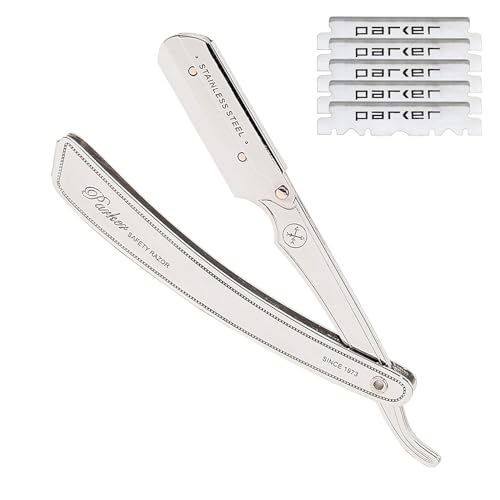
Start with the Parker SRX. It is an all-stainless shavette that takes a snapped standard double-edge blade, so the consumable is the same commodity blade the rest of this site runs on - and there is nothing to strop and nothing to hone. If you want the professional version, the Feather Artist Club SS publishes its blade exposure at 1.25 mm, which is the figure that actually predicts how forgiving a straight-style razor is.
| # | Pick | Lasts | Score | Price |
|---|---|---|---|---|
| 1 | Parker SRX Trying the shavette hold cheaply | 5,200 shaves* | 6.8/10 | $27.95 - view on Amazon |
| 2 | Feather Artist Club SS Straight-razor geometry, no honing | 5,200 shaves* | 4.7/10 | $93.00 - view on Amazon |
| 3 | Dovo Best Quality 5/8 The traditional razor, honed and ready | 5,200 shaves* | 5.5/10 | Check price on Amazon |
| 4 | Illinois #361 Leather Razor Strop The longest published stropping surface | 2,600 shaves* | 8.1/10 | Check price on Amazon |
Prices last verified October 19, 2026. They move constantly; the figure on Amazon when you click is the real one.
Why the first one should take blades
The shave a straight razor gives is not the hard part. The hard parts are the angle, the neck, and - the one that ends most attempts - the maintenance.
A honed straight razor needs stropping before every shave and honing a few times a year. Both are learnable, and neither is what somebody curious about the format wants to discover after spending real money. A shavette removes all of it: the blade is a consumable, the edge is always fresh, and the only skill left is the one you came to learn.
What to look for in a first one
- A replaceable blade. No stropping, no honing, no expensive edge to ruin while you learn.
- A published blade exposure. How far the blade sits proud of the guard is what decides forgiveness - and almost nobody publishes it.
- A commodity consumable, ideally. A razor that takes standard double-edge blades costs cents per shave to feed.
- Enough weight to feel planted. Too light and the razor skates; too heavy and your wrist tires halfway down a cheek.
- A grippy handle. You will be holding it wet, at an angle, for ten minutes.
Published figures
| Razor | Type | Blade | Published exposure | Upkeep |
|---|---|---|---|---|
| Parker SRX | Shavette | Half a standard DE blade | Not published | None |
| Feather Artist Club SS | Shavette | Feather Artist Club (proprietary) | 1.25 mm | None |
| Dovo Best Quality (the skip) | Straight razor | Permanent edge, 1.2210 steel at ~61 HRC | Not applicable | Strop before every shave, hone a few times a year |
| Illinois #361 | Strop | - | - | Only needed with a real straight razor |
The pick: Parker SRX
An all-stainless shavette with a clip mechanism that takes a standard double-edge blade snapped in half. At roughly 65 g it has enough weight to sit steady without tiring your hand, and the stainless body survives being dropped on a tiled floor, which a first straight razor eventually is.
The consumable is the reason it wins. Any double-edge blade fits, which means a hundred blades cost less than a single professional honing - and if you decide the format is not for you, you have spent very little finding out.
The honest cons. Parker publishes no blade exposure, so forgiveness is unknown until you use it. Snapping blades in half is a small fiddly ritual with sharp objects. And a shavette will never have the character of honed steel, which for some people is the entire point of the exercise.
The professional shavette: Feather Artist Club SS
SUS317 stainless holding a replaceable Feather blade, with a published 1.25 mm blade exposure - the only exposure figure published by anybody on this page, and the number that actually predicts how much the razor will let you get away with.
It is the shavette barbers use, and the rigidity of the blade makes it feel closer to a real straight razor than the Parker does.
The honest cons. The blades are proprietary Artist Club blades, so the running cost is several times a snapped DE blade. It is also several times the Parker's price - a lot to spend on finding out whether you enjoy the angle.
The honest progression
- Weeks one to four: cheeks only, with a shavette. Finish the rest of your face with whatever you normally use. Nobody does a full straight shave in week one.
- Then the jaw, then the upper lip. The neck comes last, and it is where almost everyone nicks themselves.
- Only then consider honed steel. If you are still enjoying it after a couple of months, a Dovo and a strop are the next purchase - and stropping is a skill in itself.
And if the honest answer is that you want a closer shave rather than a hobby, the straight-versus-safety comparison makes the case that a double-edge razor gets you most of the way with a fraction of the learning curve.
Every pick, with the working
Each entry shows the published specifications, the axis scores they produce and what you give up. The order is the computed order, not a commercial one, and the arithmetic is open underneath every score.
Our pickTrying the shavette hold cheaply
Parker SRX
An all-stainless shavette with a clip mechanism that takes a snapped double-edge blade rather than a proprietary one, which means the consumable is the same commodity blade the rest of this site runs on. At roughly 65 g it is heavy for a shavette, and Parker includes five blades so the first order is one item.
- Weight
- 65 g
- Length
- 133 mm
- Material
- Stainless steel handle and blade arm
- Head
- Clip-type shavette, takes half a double-edge blade
- Blades in the box
- 5
- Made in
- Not published
- Refill
- Universal standard
- Warranty
- Not published
- Assumed service life
- 5,200 uses
The arithmetic: 260 shaves a year x 20 years of assumed service life = 5200 shaves.
What it gets right
- Takes half a standard double-edge blade, so the refill is a universal commodity
- All-stainless handle and blade arm, not the aluminum used on cheaper barber razors
- Five blades in the box, so it works on arrival
- The cheapest honest way to find out whether you like the straight-razor hold
Flaws
- Parker publishes weight and length and essentially nothing else - no blade exposure, no angle
- Snapping double-edge blades in half is a fiddly step before every few shaves
- Retailer-listed weights vary between 1.9 and 2.3 oz depending on finish, which is a disclosure problem in itself
The working behind the 6.8
- How long it lasts: not scored
- Not scored. This is a durable item, not a consumable, so how long it lasts is an assumption about service life rather than something the pack size tells us.
- Ease of switching: 4.0
- Universal half-DE consumable rather than a proprietary blade (++), five blades included (+), all-stainless build (+), but nothing published beyond weight and length (-) and a bare edge held freehand (--).
- Refill economics: 10.0
- The refill is a commodity standard that dozens of factories make, so the price is set by competition and no single maker can raise it.
- What the maker publishes: 8.3
- 5 of 6 specifications a buyer would expect are published: weightG, lengthMm, material, headType, bladesIncluded. Not published: madeIn. 5 / 6 x 10 = 8.3.
Axes with no published input are dropped and the remaining weights re-normalized, so a product is not punished for a category where an axis does not apply. Specifications compiled 3 September 2026 from Parker SRX listed weight, length and material.
2Straight-razor geometry, no honing
Feather Artist Club SS
A shavette rather than a straight razor: a SUS317 stainless body on a super resin handle, holding a replaceable Feather blade, so you get the straight-razor hold and angle with none of the stropping or honing. Its listings publish the blade exposure - 1.25 mm - which is the number that actually predicts how forgiving it is, and which almost nothing else in shaving states at all.
- Weight
- 43 g
- Material
- SUS317 stainless steel, super resin handle
- Head
- Replaceable-blade shavette, 1.25 mm blade exposure
- Blades in the box
- 0
- Made in
- Japan
- Refill
- Proprietary to the maker
- Warranty
- Not published
- Assumed service life
- 5,200 uses
The arithmetic: 260 shaves a year x 20 years of assumed service life = 5200 shaves.
What it gets right
- A published blade exposure of 1.25 mm, a figure essentially nobody else in shaving states
- Replaceable blades: no strop, no hone, no rust management
- SUS317 stainless body that dismantles for cleaning, which is why barbers use it
- Published 43 g body in SUS317 stainless that dismantles fully for cleaning
Flaws
- Feather Artist Club blades are proprietary - only Feather's own blade fits
- Sharper and less forgiving than a honed straight razor, because the blade is a fresh factory edge every time
- Still a bare edge held at an angle you set: the technique risk of a straight razor without the technique reward
The working behind the 4.7
- How long it lasts: not scored
- Not scored. This is a durable item, not a consumable, so how long it lasts is an assumption about service life rather than something the pack size tells us.
- Ease of switching: 3.0
- No stropping, honing or rust management (++), published blade exposure so the aggression is knowable before you buy (+), but a proprietary blade only Feather makes (-) and a fresh factory edge held freehand, which is less forgiving than a honed straight razor (--).
- Refill economics: 4.0
- Only this maker's refill fits, so the ongoing price is set by the maker rather than by a market. This is where the real cost of ownership hides.
- What the maker publishes: 8.3
- 5 of 6 specifications a buyer would expect are published: weightG, material, madeIn, headType, bladesIncluded. Not published: lengthMm. 5 / 6 x 10 = 8.3.
Axes with no published input are dropped and the remaining weights re-normalized, so a product is not punished for a category where an axis does not apply. Specifications compiled 3 September 2026 from Feather Artist Club SS published body and handle material, weight and compatible blades.
3The traditional razor, honed and ready
Dovo Best Quality 5/8
Skip this one. A genuinely lovely razor and the wrong first one. Dovo publishes 1.2210 silver steel hardened to roughly 61 HRC and ships it factory honed - which means the edge is perfect on day one and entirely your responsibility afterwards. Stropping before every shave, honing a few times a year, and a nick in that edge is an expensive fix. Buy it second, once a shavette has told you whether you actually enjoy the angle.
A real straight razor from Solingen: 1.2210 silver steel hardened to roughly 61 HRC, full hollow ground, factory honed. Dovo publishes the steel grade and the hardness, which almost nobody in this category does, and that pair of numbers is the whole reason to buy this rather than a cheaper blade. It also commits you to a strop, and eventually to honing.
- Weight
- 42 g
- Length
- 159 mm
- Material
- 1.2210 silver steel, approx. 61 HRC, PMMA scales
- Head
- Full hollow ground, round point, 5/8 in blade
- Blades in the box
- 0
- Made in
- Germany
- Refill
- Nothing to refill
- Warranty
- Not published
- Assumed service life
- 5,200 uses
The arithmetic: 260 shaves a year x 20 years of assumed service life = 5200 shaves.
What it gets right
- Published steel: 1.2210 silver steel at approximately 61 HRC, a hardness figure you can actually compare
- Full hollow grind, which is the grind that gives the audible feedback beginners use to judge angle
- Factory honed, so the first shave does not depend on your honing ability
- 42 g in a 159 mm body: light enough that the blade angle does the work rather than the mass
Flaws
- Carbon steel rusts if you leave it wet, every time, without exception
- Needs a strop before every shave and a hone every few months - two more purchases and a skill
- PMMA scales rather than horn or wood at this price point
- The steepest learning curve of any shaving tool on this site
The working behind the 5.5
- How long it lasts: not scored
- Not scored. This is a durable item, not a consumable, so how long it lasts is an assumption about service life rather than something the pack size tells us.
- Ease of switching: 1.5
- Published steel grade and hardness (+), factory honed so the first shave works (+), but carbon steel that rusts unattended (--), a mandatory strop and eventual honing (--), and a months-long angle-and-pressure learning curve with a bare blade (--).
- Refill economics: 8.0
- Nothing to refill. The only future cost is replacing the item itself.
- What the maker publishes: 10.0
- 6 of 6 specifications a buyer would expect are published: weightG, lengthMm, material, madeIn, headType, bladesIncluded. 6 / 6 x 10 = 10.0.
Axes with no published input are dropped and the remaining weights re-normalized, so a product is not punished for a category where an axis does not apply. Specifications compiled 3 September 2026 from Dovo Best Quality 5/8 published steel, hardness and dimensions.
4The longest published stropping surface
Illinois #361 Leather Razor Strop
The same 2.5 inch width and 24 inch overall length, but with a 22 inch stropping surface against the #827's 16 - six more inches of working leather, which is fewer strokes for the same result and more room for error on the return. Also two belts, also a hanging clip, also published as made in the USA. Illinois describes it as smooth leather without naming the type, which is the one place it discloses less.
- Length
- 610 mm
- Material
- Smooth leather with linen belt
- Made in
- USA
- Refill
- Nothing to refill
- Warranty
- Not published
- Assumed service life
- 2,600 uses
The arithmetic: 260 uses a year x 10 years of assumed service life = 2600 uses.
What it gets right
- 22 in published stropping surface - the longest here, and six inches more than the #827
- Two independent belts published, linen and leather
- Published 2.5 in width and 24 in overall length
- Published as made in the USA
Flaws
- Leather type is described only as 'smooth leather', not named as the #827's is
- A longer strop needs more clearance, which is a real constraint in a small bathroom
- Same break-in period as any new leather
- No published hardness, draw or thickness figure - nobody in this category publishes those
The working behind the 8.1
- How long it lasts: not scored
- Not scored. This is a durable item, not a consumable, so how long it lasts is an assumption about service life rather than something the pack size tells us.
- Ease of switching: 7.0
- The longest published stropping surface here, so fewer strokes per session (+), two belts and published dimensions (+), but the leather type is not named (-) and it needs more clearance than the shorter one (-).
- Refill economics: 8.0
- Nothing to refill. The only future cost is replacing the item itself.
- What the maker publishes: 10.0
- 3 of 3 specifications a buyer would expect are published: lengthMm, material, madeIn. 3 / 3 x 10 = 10.0.
Axes with no published input are dropped and the remaining weights re-normalized, so a product is not punished for a category where an axis does not apply. Specifications compiled 3 September 2026 from Illinois #361 published dimensions and construction.
Prices last verified October 19, 2026. They move constantly; the figure on Amazon when you click is the real one.
Questions people actually ask
What is the difference between a shavette and a straight razor?
A straight razor has a permanent honed edge you maintain. A shavette holds a replaceable blade in the same shape and at the same angle. The shave is very similar; the ownership is completely different.
Is a shavette more dangerous?
Slightly, and it is worth knowing why: a fresh disposable blade is sharper than most home- maintained straight edges, and it has no forgiveness at the wrong angle. It is also the cheapest way to find out whether you like the technique.
Do I need a strop on day one?
Only with a real straight razor - a shavette never needs one. If you go straight to honed steel, budget for a strop at the same time and read the stropping guide before the first shave.
How long does it take to learn?
Expect several weeks of doing your cheeks with it and the rest with your usual razor. The angle - roughly 30 degrees, spine off the face - is the whole skill, and the neck is the last part anyone gets comfortable with.
Which blades does a shavette take?
The Parker takes a standard double-edge blade snapped in half, so any blade from the blade roundup works. The Feather takes its own Artist Club blades, which are a proprietary consumable.
Is a straight razor cheaper over time?
A real straight razor is the cheapest possible shave in consumables - almost none - and the most expensive in time and equipment. A shavette is cheap on both counts but keeps buying blades. The calculator does the arithmetic with your prices.
Sources
- Parker SRX listed weight, length and material
- Feather Artist Club SS published body and handle material, weight and compatible blades
- Feather Artist Club SS published 1.25 mm blade exposure (The English Shaving Company)
- Dovo Best Quality 5/8 published steel, hardness and dimensions
- Illinois #361 published dimensions and construction