How to shave with a shavette
A shavette is sharper than a honed straight razor, because the edge is factory-fresh every time. That cuts both ways, literally.
By Sawyer V. · Published
We have not tested any of this. Everything below is compiled from published manufacturer specifications, and the arithmetic is printed so you can check it. This page carries affiliate links: if you buy through one we earn a commission at no extra cost to you, and it does not change the order of the picks. Full disclosure.
The short version
Two spine-widths of angle, skin pulled genuinely tight, short strokes, cheeks first. A shavette holds a factory-fresh blade, so it is sharper than most honed straight razors and much less forgiving of a bad angle. For the first month use it on the cheeks only and finish the neck, chin and upper lip with a safety razor. That is not a compromise - it is how you end the month with the same number of scars you started with.
| # | Pick | Lasts | Score | Price |
|---|---|---|---|---|
| 1 | Feather Artist Club SS Straight-razor geometry, no honing | 5,200 shaves* | 4.2/10 | $155.95 - view on Amazon |
| 2 | Parker SRX Trying the shavette hold cheaply | 5,200 shaves* | 6.8/10 | $27.95 - view on Amazon |
| 3 | Osma Alum Block 75 g Closing weepers and telling you what your technique did | Not published | 7.5/10 | $14.50 - view on Amazon |
Prices last verified September 24, 2026. They move constantly; the figure on Amazon when you click is the real one.
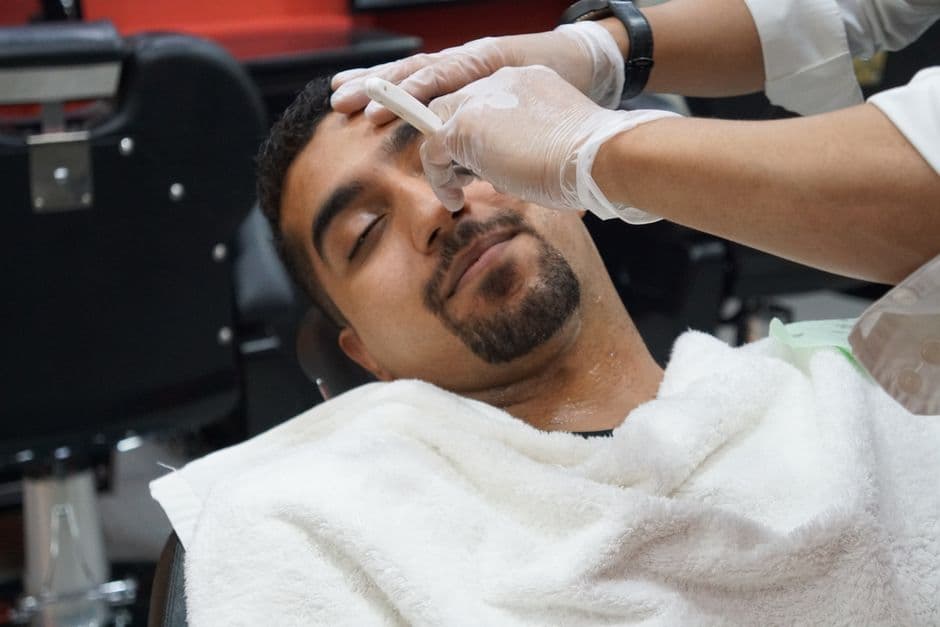
Why a shavette is sharper than a straight razor
This surprises people and it changes how you should approach the first month. A honed straight razor has an edge somebody put on a stone; a shavette holds a blade that came off an industrial grinder yesterday. Feather publishes a blade thickness of 0.31 mm and a blade exposure of 1.25 mm on the Artist Club SS, and that combination is unforgivingly sharp.
Which is good for the shave and bad for the learning curve. The technique below exists to keep those two facts from meeting on your neck in week one.
The grip, which nobody explains properly
Three fingers along the top of the shank, thumb underneath, little finger resting on the tang - the small tab behind the pivot. That little finger is not decorative: it is the counterweight that lets you rotate the blade with tiny wrist movements rather than whole-arm ones.
Hold it like a pen or a fist and you will steer with your elbow, which is why beginners describe the razor as “wandering”. It is not the razor.
The order to work in
Not the order you would use with a safety razor. A shavette is a long straight edge, so it wants flat, visible, stretchable surfaces first.
| Area | When | Why |
|---|---|---|
| Cheeks, downward | Week one | Flat, visible, easy to stretch |
| Sideburns and jawline | Week two | Still flat, but the grain starts turning |
| Under the jaw | Week three | Curved; needs the head tilted back |
| Neck | Month two | Grain changes direction; highest ingrown risk |
| Chin | Month two | Compound curve, nothing to rest against |
| Under the nose | Month two | Short strokes in a small space with a long blade |
Finishing the “later” areas with a safety razor in the meantime is completely normal and is what most people do while they learn. Nobody is watching which tool did which part of your face.
The stroke itself
- Short. Two or three centimeters, not one long sweep. Short strokes let you correct the angle continuously.
- Straight, never sideways. Any lateral movement while the edge is on skin is a slice. If you need to change direction, lift off first.
- No pressure at all. The blade's own weight plus the angle does the cutting. Pressing is what turns a weeper into a cut.
- Rinse every few strokes. Under the tap, edge trailing. Never wipe the edge on a towel.
Afterwards, and what the sting tells you
Cool rinse, then an alum block over the whole face. Alum is astringent and hemostatic, so it closes the weepers - but the genuinely useful part is diagnostic. The amount it stings, and exactly where, is a map of where you pressed or got the angle wrong.
A shave with good technique gives a mild cool tingle. A stinging stripe along one jawline tells you which hand was steeper. The alum block page covers that feedback loop, and it is the fastest way to improve at this.
Follow the alum with a balm, because alum is drying and a guardless razor has just taken a layer off - the aftershave roundup covers the alcohol-free options, which are the right ones here.
Every pick, with the working
Each entry shows the published specifications, the axis scores they produce and what you give up. The order is the computed order, not a commercial one, and the arithmetic is open underneath every score.
Our pickStraight-razor geometry, no honing
Feather Artist Club SS
A shavette rather than a straight razor: SUS317 stainless steel holding a replaceable Feather blade, so you get the straight-razor hold and angle with none of the stropping or honing. Feather publishes the blade dimensions and, unusually, the blade exposure - 1.25 mm - which is the number that actually predicts how forgiving it is.
- Material
- SUS317 stainless steel, synthetic resin handle
- Head
- Replaceable-blade shavette, 1.25 mm blade exposure
- Blades in the box
- 0
- Made in
- Japan
- Refill
- Proprietary to the maker
- Warranty
- Not published
- Assumed service life
- 5,200 uses
The arithmetic: 260 shaves a year x 20 years of assumed service life = 5200 shaves.
What it gets right
- Published blade exposure of 1.25 mm, a figure essentially nobody else in shaving publishes
- Replaceable blades: no strop, no hone, no rust management
- SUS317 stainless body that dismantles for cleaning, which is why barbers use it
- Blade dimensions published to a hundredth of a millimeter (50 x 8.2 x 0.31 mm)
Flaws
- Feather Artist Club blades are proprietary - only Feather's own blade fits
- Sharper and less forgiving than a honed straight razor, because the blade is a fresh factory edge every time
- Still a bare edge held at an angle you set: the technique risk of a straight razor without the technique reward
The working behind the 4.2
- How long it lasts: not scored
- Not scored. This is a durable item, not a consumable, so how long it lasts is an assumption about service life rather than something the pack size tells us.
- Ease of switching: 3.0
- No stropping, honing or rust management (++), published blade exposure so the aggression is knowable before you buy (+), but a proprietary blade only Feather makes (-) and a fresh factory edge held freehand, which is less forgiving than a honed straight razor (--).
- Refill economics: 4.0
- Only this maker's refill fits, so the ongoing price is set by the maker rather than by a market. This is where the real cost of ownership hides.
- What the maker publishes: 6.7
- 4 of 6 specifications a buyer would expect are published: material, madeIn, headType, bladesIncluded. Not published: weightG, lengthMm. 4 / 6 x 10 = 6.7.
Axes with no published input are dropped and the remaining weights re-normalized, so a product is not punished for a category where an axis does not apply. Specifications compiled 3 September 2026 from Feather Artist Club SS published material, blade size and exposure.
2Trying the shavette hold cheaply
Parker SRX
An all-stainless shavette with a clip mechanism that takes a snapped double-edge blade rather than a proprietary one, which means the consumable is the same commodity blade the rest of this site runs on. At roughly 65 g it is heavy for a shavette, and Parker includes five blades so the first order is one item.
- Weight
- 65 g
- Length
- 133 mm
- Material
- Stainless steel handle and blade arm
- Head
- Clip-type shavette, takes half a double-edge blade
- Blades in the box
- 5
- Made in
- Not published
- Refill
- Universal standard
- Warranty
- Not published
- Assumed service life
- 5,200 uses
The arithmetic: 260 shaves a year x 20 years of assumed service life = 5200 shaves.
What it gets right
- Takes half a standard double-edge blade, so the refill is a universal commodity
- All-stainless handle and blade arm, not the aluminum used on cheaper barber razors
- Five blades in the box, so it works on arrival
- The cheapest honest way to find out whether you like the straight-razor hold
Flaws
- Parker publishes weight and length and essentially nothing else - no blade exposure, no angle
- Snapping double-edge blades in half is a fiddly step before every few shaves
- Retailer-listed weights vary between 1.9 and 2.3 oz depending on finish, which is a disclosure problem in itself
The working behind the 6.8
- How long it lasts: not scored
- Not scored. This is a durable item, not a consumable, so how long it lasts is an assumption about service life rather than something the pack size tells us.
- Ease of switching: 4.0
- Universal half-DE consumable rather than a proprietary blade (++), five blades included (+), all-stainless build (+), but nothing published beyond weight and length (-) and a bare edge held freehand (--).
- Refill economics: 10.0
- The refill is a commodity standard that dozens of factories make, so the price is set by competition and no single maker can raise it.
- What the maker publishes: 8.3
- 5 of 6 specifications a buyer would expect are published: weightG, lengthMm, material, headType, bladesIncluded. Not published: madeIn. 5 / 6 x 10 = 8.3.
Axes with no published input are dropped and the remaining weights re-normalized, so a product is not punished for a category where an axis does not apply. Specifications compiled 3 September 2026 from Parker SRX listed weight, length and material.
3Closing weepers and telling you what your technique did
Osma Alum Block 75 g
A 75 gram brick of 100 per cent potassium alum, wetted and wiped over the face after the shave. It is astringent and hemostatic, so it closes the pinprick weepers a new safety razor user produces. Its real value is diagnostic: the amount it stings is a direct readout of how much you pressed, and no other product on this site gives feedback that immediate.
- Net weight
- 75 g
- Fragrance
- Fragrance-free
- Made in
- France
- Refill
- Nothing to refill
- Warranty
- Not applicable
- How long it lasts
- Not published
Published key ingredients: Potassium alum (100%).
What it gets right
- One published ingredient: 100 per cent potassium alum. There is nothing else in it
- Osma publishes the block dimensions (58 x 37 mm) and the weight
- Stings in proportion to the irritation you caused, which is the fastest technique feedback available
- Osma publishes an approximate one-year service life under normal use
Flaws
- It stings, and on a bad shave it stings a lot
- Drying: it needs a balm or moisturizer after it, so it is never the last step
- Must be dried and stored dry or the block dissolves at the edges
The working behind the 7.5
- How long it lasts: not scored
- Not scored. This is a durable item, not a consumable, so how long it lasts is an assumption about service life rather than something the pack size tells us.
- Ease of switching: 7.0
- A single published ingredient with no formulation to evaluate (++), published weight, dimensions and service life (+), immediate technique feedback (+), but it stings (-) and it is drying enough to require a second product after it (-).
- Refill economics: 8.0
- Nothing to refill. The only future cost is replacing the item itself.
- What the maker publishes: 8.0
- 4 of 5 specifications a buyer would expect are published: netWeightG, keyIngredients, fragranceFree, madeIn. Not published: volumeMl. 4 / 5 x 10 = 8.0.
Axes with no published input are dropped and the remaining weights re-normalized, so a product is not punished for a category where an axis does not apply. Specifications compiled 3 September 2026 from Osma Alum Block published composition, weight and dimensions.
Prices last verified September 24, 2026. They move constantly; the figure on Amazon when you click is the real one.
Questions people actually ask
Is a shavette harder than a straight razor?
To shave with, slightly - because a replaceable blade is sharper and thinner than a honed straight edge, so it punishes a wrong angle faster. To own, far easier: no stropping, no honing, no rust. The roundup covers the difference properly.
What angle do you hold a shavette at?
About 30 degrees, which is easiest to find as two spine-widths off the skin: rest the spine flat, then lift until the gap is twice the spine's thickness. Every other instruction on this page is downstream of getting that consistent.
How many shaves does a shavette blade last?
Fewer than you would expect - most people change it every two or three shaves, and many change it every time. The blade is the cheapest part of the process and a dulling edge on a guardless razor is exactly the wrong place to economize.
Can you go against the grain with a shavette?
Eventually, on the cheeks, once your angle is reliable. Not in the first month and not on the neck at all - against-the-grain on a neck is the standard route to ingrown hairs with any blade, and a shavette cuts closer than most.
Will I cut myself?
You will get weepers - pinprick nicks - in the first weeks, and an alum block closes them. Serious cuts come from three things: loose skin, too steep an angle, and moving the razor sideways. Avoid all three and the risk is far lower than the internet suggests.