The best razors for head shaving
You are shaving a curved surface you cannot see, by feel, with your weaker hand for half of it. That changes which razor is the right one, and it is not the aggressive one.
By Sawyer V. · Published
We have not tested any of this. Everything below is compiled from published manufacturer specifications, and the arithmetic is printed so you can check it. This page carries affiliate links: if you buy through one we earn a commission at no extra cost to you, and it does not change the order of the picks. Full disclosure.
The short version
Buy the Rockwell 6S. It is the only razor here that publishes its blade gap - 0.008 to 0.031 inches across six swappable base plates - so you can start mild on a scalp, learn the shape of your own head, and dial up only if you decide to. Buy the Henson AL13 Medium if you would rather never think about it: at 37 g it is the lightest here and machined to as tight as 12.7 micrometers, which makes it very hard to cut yourself with. And do not take a shavette to your head, whatever a video showed you.
| # | Pick | Lasts | Score | Price |
|---|---|---|---|---|
| 1 | Rockwell 6S Dialing in your own aggression | 5,200 shaves* | 8.6/10 | $120.00 - view on Amazon |
| 2 | Henson AL13 Medium The lightest touch, machined to spec | 5,200 shaves* | 8.5/10 | $14.95 - view on Amazon |
| 3 | Merkur 34C HD One razor, no research | 5,200 shaves* | 8.9/10 | $60.00 - view on Amazon |
| 4 | Parker 99R Changing blades without touching one | 5,200 shaves* | 8.8/10 | $31.77 - view on Amazon |
| 5 | Feather Artist Club SS Straight-razor geometry, no honing | 5,200 shaves* | 4.2/10 | $155.95 - view on Amazon |
Prices last verified September 24, 2026. They move constantly; the figure on Amazon when you click is the real one.
A head is a different job from a face
Everything that makes a face shave manageable is missing on a scalp. You cannot see the surface. It curves in two directions at once. The growth swirls, and the nape frequently grows upward. And roughly half the work is done with your non-dominant hand, at an angle you cannot check in a mirror.
So the ranking here is not the same as the general safety razor roundup. Mildness moves to the top, closeness drops down the list, and the handle matters more than it does anywhere else - because you are holding it overhead with wet, soapy hands.
What this page ranks on
- Published blade gap or exposure. The only real measure of how aggressive a razor is. Almost nobody publishes it, which is why the one maker that does wins this page.
- Weight. Enough mass that the razor cuts under its own weight - you should never press on a scalp - but not so much that a fifteen-minute overhead job becomes tiring. Roughly 60 to 120 g is the working band.
- Handle grip and length. Held wet, overhead, at angles you cannot see. A knurled handle is not a style choice here.
- How the blade is changed. A scalp gets through blades faster than a face does, so a fiddly three-piece disassembly is a real friction cost.
The four, side by side
| Razor | Weight | Published gap / exposure | Blade change | Made in |
|---|---|---|---|---|
| Rockwell 6S | 118 g | 0.008-0.031 in across R1-R6 | Three-piece | USA |
| Henson AL13 Medium | 37 g | Machined to 12.7 µm; exposure fixed by model | Three-piece | Canada |
| Merkur 34C HD | 68 g | Not published | Three-piece | Germany |
| Parker 99R | 100 g | Not published | Butterfly (TTO) | India |
The pick: Rockwell 6S
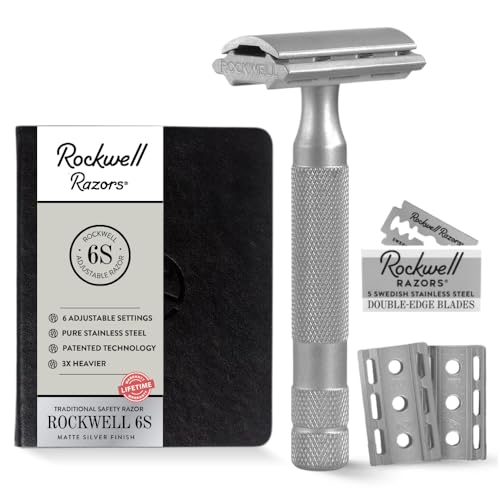
The 6S ships with six base plates, R1 through R6, and Rockwell publishes the blade gap for each: 0.008 inches at R1 up to 0.031 inches at R6. That is the only published aggression scale in this ledger and it is precisely what a head shaver needs.
The reason is practical rather than technical. Nobody knows how their own scalp will take a blade until they have tried, and a scalp is an unforgiving place to find out. Starting at R2 or R3 and moving up over a month is a way of learning your own head without paying for the lesson in nicks - and it is one purchase rather than two razors.
At 118 g it is also the heaviest razor in this ledger, which on a head is an advantage: the weight does the work so your hand does not have to press.
The honest cons. Six plates is six small parts to store, and the one you want is never the one on the razor. It is a three-piece design, so blade changes mean fully dismantling it with wet hands. And 118 g is genuinely heavy if you have shoulder or elbow trouble - the overhead position is the constraint, not the razor. The full review is here.
The most forgiving: Henson AL13 Medium
At 37 g the Henson is the lightest razor in this ledger by a wide margin, and it is machined in Ontario to a published tolerance of as tight as 12.7 micrometers with blade exposure fixed by model rather than adjustable.
The design intent is the whole argument for it on a head: the blade barely protrudes, so the razor is very difficult to cut yourself with even at a wrong angle - and a wrong angle is what happens when you cannot see the surface. It rewards multiple light passes rather than one confident one, which is the correct technique on a scalp anyway.
The honest cons. Being that mild means more passes for the same closeness, and on three times the area of a face that adds real time. The light weight cuts both ways - you will be tempted to press, which is the one thing you must not do. And there is no adjustment: if it turns out to be too mild for your growth, the fix is a different razor.
The classic: Merkur 34C HD
Sixty-eight grams with a short, heavily knurled handle, made in Germany. The short handle is the reason it is on this page: it puts your hand closer to the head of the razor, and control over a curved surface you cannot see comes from proximity rather than leverage.
It is the default recommendation for a first safety razor for good reason, and a head shave is one of the jobs it does without complaint.
The honest cons. Merkur publishes no blade gap, so its mildness is inferred from reputation rather than a figure - which is exactly the disclosure gap this site exists to point at. The short handle that helps on a scalp is less comfortable for large hands. And it is a three-piece, so blade changes are fiddly. The review covers it in full.
The easiest to reload: Parker 99R
A hundred grams with a butterfly twist-to-open head, so changing a blade is a twist of the handle rather than dismantling three parts over a sink. On a head, where blades dull faster because the area is larger, that stops being a convenience and starts being the reason you actually change the blade on time.
The honest cons. No published blade gap, same as the Merkur. Butterfly mechanisms have more moving parts than a three-piece and are the part that eventually fails. And at 100 g with a long handle it is the least maneuverable of the four around the back of a skull.
The one to keep away from your head
The Feather Artist Club SS is a genuinely excellent razor and the only tool in this ledger with a published exposure figure - 1.25 mm. That figure is the reason it is the named skip here.
A shavette holds a rigid, highly exposed blade at whatever angle your hand sets, with no guard bar doing any of the thinking. On a face, in practiced hands, in a mirror, that is control. On a scalp - curved, unseen, half of it left-handed - it is the fastest route to a cut deep enough to ruin the morning. If you want to learn one, learn it on a face.
Three things that matter as much as the razor
- Clipper down first. A blade on hair over about 2 mm pulls and clogs. This is not optional and it is the step most first attempts skip.
- Map the growth, including the nape. It swirls, and the back of the neck frequently grows upward. Work in quarters and take the second pass across the grain rather than against it.
- Sunscreen from the next morning. A freshly shaved scalp has had its top layer taken off and has no hair over it. This is the least optional part of the whole routine - the sunscreen roundup covers what to use.
And a lather that holds. A scalp shave takes longer than a face shave, so a lather that collapses in ninety seconds is a real problem - a soap rather than a canned foam is the fix, and building it properly is free.
Every pick, with the working
Each entry shows the published specifications, the axis scores they produce and what you give up. The order is the computed order, not a commercial one, and the arithmetic is open underneath every score.
Our pickDialing in your own aggression
Rockwell 6S
The 6S is the one razor here that publishes the number everybody else hides. Three reversible plates give six blade gaps from 0.008 to 0.031 inches, so you can start on R1, find the setting your face tolerates, and never wonder whether the razor or your technique is the problem. It is 118 grams of 316L stainless and it ships with five blades.
- Weight
- 118 g
- Length
- 95 mm
- Material
- 316L stainless steel
- Head
- Adjustable, three reversible plates
- Blade gap
- 0.008 in to 0.031 in across R1-R6
- Blades in the box
- 5
- Length settings
- 6
- Made in
- USA
- Refill
- Universal standard
- Warranty
- Not published
- Assumed service life
- 5,200 uses
The arithmetic: 260 shaves a year x 20 years of assumed service life = 5200 shaves.
What it gets right
- Published blade gaps from 0.008 in to 0.031 in across six settings — the only razor in this ledger that discloses them
- 316L stainless, so there is no plating to wear through
- Five blades in the box; usable the day it arrives
- 118 g, the heaviest here, which suits a heavy beard and a light hand
Flaws
- Six settings is six chances to blame the razor instead of your angle in the first month
- Three loose plates are three things to keep track of
- Heaviest and largest of the group at 95 mm overall
The working behind the 8.6
- How long it lasts: not scored
- Not scored. This is a durable item, not a consumable, so how long it lasts is an assumption about service life rather than something the pack size tells us.
- Ease of switching: 7.0
- R1 plate is the mildest published gap in this ledger at 0.008 in (+), blades included (+), but six settings and three loose plates add decisions in exactly the month a new wet shaver has too many (-).
- Refill economics: 10.0
- The refill is a commodity standard that dozens of factories make, so the price is set by competition and no single maker can raise it.
- What the maker publishes: 10.0
- 7 of 7 specifications a buyer would expect are published: weightG, lengthMm, material, madeIn, headType, bladeGapNote, bladesIncluded. 7 / 7 x 10 = 10.0.
Axes with no published input are dropped and the remaining weights re-normalized, so a product is not punished for a category where an axis does not apply. Specifications compiled 3 September 2026 from Rockwell 6S published specifications (Fendrihan).
2The lightest touch, machined to spec
Henson AL13 Medium
Henson's argument is that razor burn is an engineering problem, and it publishes the tolerances to back it: blade angle fixed at 30 degrees, machined to as tight as 12.7 micrometers at an aerospace facility in Ontario. At 37 grams it is by far the lightest razor here, which inverts the usual advice — you cannot let this one do the work, you have to let it float.
- Weight
- 37 g
- Length
- Not published
- Material
- Aircraft aluminum, Type II anodized
- Head
- Fixed exposure, 30-degree blade angle
- Blade gap
- Machined to as tight as 12.7 micrometers; exposure fixed by model
- Blades in the box
- 5
- Made in
- Canada (Ontario)
- Refill
- Universal standard
- Warranty
- Not published
- Assumed service life
- 5,200 uses
The arithmetic: 260 shaves a year x 20 years of assumed service life = 5200 shaves.
What it gets right
- Published machining tolerance of 12.7 micrometers and a fixed 30-degree blade angle, which nobody else in this ledger discloses
- 37 g aluminum body with a Type II anodized finish; nothing to chip or peel
- Five blades in the box
- Sold in Mild, Medium and Aggressive so the choice is made once, at purchase, rather than every morning
Flaws
- 37 g is very light, which removes the weight cue a cartridge user relies on
- The exposure level is fixed at purchase; changing your mind means another razor
- Aluminum will not feel like the heirloom object a stainless razor does
The working behind the 8.5
- How long it lasts: not scored
- Not scored. This is a durable item, not a consumable, so how long it lasts is an assumption about service life rather than something the pack size tells us.
- Ease of switching: 7.5
- Fixed geometry with a published 30-degree blade angle removes the angle guesswork (+), blades included (+), but 37 g is the lightest here and the razor's own mass supplies almost none of the pressure (-).
- Refill economics: 10.0
- The refill is a commodity standard that dozens of factories make, so the price is set by competition and no single maker can raise it.
- What the maker publishes: 8.6
- 6 of 7 specifications a buyer would expect are published: weightG, material, madeIn, headType, bladeGapNote, bladesIncluded. Not published: lengthMm. 6 / 7 x 10 = 8.6.
Axes with no published input are dropped and the remaining weights re-normalized, so a product is not punished for a category where an axis does not apply. Specifications compiled 3 September 2026 from Henson AL13 published specifications.
3One razor, no research
Merkur 34C HD
Buy this one if you want to stop reading and start shaving. It is 68 grams of chrome-plated brass on a short knurled handle, which is heavy enough that you naturally stop pressing, and the head is a plain closed comb with nothing to set, adjust or get wrong. It has been in production in Solingen for decades, so parts, advice and blades are everywhere.
- Weight
- 68 g
- Length
- 80 mm
- Material
- Chrome-plated brass
- Head
- Closed comb, two-piece
- Blade gap
- Not published
- Blades in the box
- 0
- Made in
- Germany
- Refill
- Universal standard
- Warranty
- Not published
- Assumed service life
- 5,200 uses
The arithmetic: 260 shaves a year x 20 years of assumed service life = 5200 shaves.
What it gets right
- 68 g in a 80 mm body: the weight does the work, which is exactly the habit a cartridge user has to unlearn
- Closed comb with no adjustment, so there is one variable fewer on your first month
- Two-piece construction; the head unscrews as a unit and there is nothing to lose in the sink
- Takes any standard double-edge blade, so the refill is a commodity
Flaws
- The 80 mm handle is short for large hands, and Merkur's own longer handles are a separate purchase
- No blade in the box, so the first order needs a blade pack alongside it
- Chrome over brass will show wear at the edges over years in a way stainless will not
The working behind the 8.9
- How long it lasts: not scored
- Not scored. This is a durable item, not a consumable, so how long it lasts is an assumption about service life rather than something the pack size tells us.
- Ease of switching: 8.5
- Closed comb (+), no adjustment to set (+), 68 g published weight in the range where the razor's own mass supplies the pressure (+), no blade included so the first order is two items (-).
- Refill economics: 10.0
- The refill is a commodity standard that dozens of factories make, so the price is set by competition and no single maker can raise it.
- What the maker publishes: 8.6
- 6 of 7 specifications a buyer would expect are published: weightG, lengthMm, material, madeIn, headType, bladesIncluded. Not published: bladeGapNote. 6 / 7 x 10 = 8.6.
Axes with no published input are dropped and the remaining weights re-normalized, so a product is not punished for a category where an axis does not apply. Specifications compiled 3 September 2026 from Merkur 34C HD listed specifications (Fendrihan).
4Changing blades without touching one
Parker 99R
The 99R is a twist-to-open butterfly: the doors open, the old blade drops out, the new one drops in, the doors close. If the part of this that worries you is handling a bare double-edge blade, that mechanism is the answer, and at 100 grams over a 114 mm brass handle it has the heft to go with it.
- Weight
- 100 g
- Length
- 114 mm
- Material
- Brass handle, nickel head
- Head
- Butterfly twist-to-open, straight bar
- Blade gap
- Not published
- Blades in the box
- Not published
- Made in
- India
- Refill
- Universal standard
- Warranty
- Not published
- Assumed service life
- 5,200 uses
The arithmetic: 260 shaves a year x 20 years of assumed service life = 5200 shaves.
What it gets right
- Butterfly twist-to-open head — you never pick up a loose blade
- 100 g over a 114 mm handle, the longest grip in this ledger
- Brass handle with a nickel head; standard blade fitment
- Parker has built this model in India since the 1970s, so it is not a novelty
Flaws
- A butterfly mechanism is more moving parts than a two-piece, and more to eventually loosen
- Parker does not publish a blade gap
- The doors trap soap; it needs rinsing more thoroughly than a three-piece
The working behind the 8.8
- How long it lasts: not scored
- Not scored. This is a durable item, not a consumable, so how long it lasts is an assumption about service life rather than something the pack size tells us.
- Ease of switching: 9.0
- Butterfly head removes the single step new wet shavers most dislike, handling a bare blade (++), 100 g (+), 114 mm handle (+), more moving parts to eventually wear (-).
- Refill economics: 10.0
- The refill is a commodity standard that dozens of factories make, so the price is set by competition and no single maker can raise it.
- What the maker publishes: 7.1
- 5 of 7 specifications a buyer would expect are published: weightG, lengthMm, material, madeIn, headType. Not published: bladeGapNote, bladesIncluded. 5 / 7 x 10 = 7.1.
Axes with no published input are dropped and the remaining weights re-normalized, so a product is not punished for a category where an axis does not apply. Specifications compiled 3 September 2026 from Parker 99R listed specifications (Maggard Razors).
5Straight-razor geometry, no honing
Feather Artist Club SS
Skip this one. Feather publishes a 1.25 mm blade exposure on the Artist Club SS, which is essentially the only published aggression figure anywhere in shaving - and it is exactly why this is the wrong tool for a scalp. A shavette gives you a rigid, highly exposed blade at a hand-set angle on a curved surface you cannot see, using your weaker hand for half the job. It is a superb face razor in practiced hands. On a head it is the fastest way to a cut that bleeds for twenty minutes.
A shavette rather than a straight razor: SUS317 stainless steel holding a replaceable Feather blade, so you get the straight-razor hold and angle with none of the stropping or honing. Feather publishes the blade dimensions and, unusually, the blade exposure - 1.25 mm - which is the number that actually predicts how forgiving it is.
- Material
- SUS317 stainless steel, synthetic resin handle
- Head
- Replaceable-blade shavette, 1.25 mm blade exposure
- Blades in the box
- 0
- Made in
- Japan
- Refill
- Proprietary to the maker
- Warranty
- Not published
- Assumed service life
- 5,200 uses
The arithmetic: 260 shaves a year x 20 years of assumed service life = 5200 shaves.
What it gets right
- Published blade exposure of 1.25 mm, a figure essentially nobody else in shaving publishes
- Replaceable blades: no strop, no hone, no rust management
- SUS317 stainless body that dismantles for cleaning, which is why barbers use it
- Blade dimensions published to a hundredth of a millimeter (50 x 8.2 x 0.31 mm)
Flaws
- Feather Artist Club blades are proprietary - only Feather's own blade fits
- Sharper and less forgiving than a honed straight razor, because the blade is a fresh factory edge every time
- Still a bare edge held at an angle you set: the technique risk of a straight razor without the technique reward
The working behind the 4.2
- How long it lasts: not scored
- Not scored. This is a durable item, not a consumable, so how long it lasts is an assumption about service life rather than something the pack size tells us.
- Ease of switching: 3.0
- No stropping, honing or rust management (++), published blade exposure so the aggression is knowable before you buy (+), but a proprietary blade only Feather makes (-) and a fresh factory edge held freehand, which is less forgiving than a honed straight razor (--).
- Refill economics: 4.0
- Only this maker's refill fits, so the ongoing price is set by the maker rather than by a market. This is where the real cost of ownership hides.
- What the maker publishes: 6.7
- 4 of 6 specifications a buyer would expect are published: material, madeIn, headType, bladesIncluded. Not published: weightG, lengthMm. 4 / 6 x 10 = 6.7.
Axes with no published input are dropped and the remaining weights re-normalized, so a product is not punished for a category where an axis does not apply. Specifications compiled 3 September 2026 from Feather Artist Club SS published material, blade size and exposure.
Prices last verified September 24, 2026. They move constantly; the figure on Amazon when you click is the real one.
Questions people actually ask
What makes a razor good for head shaving specifically?
Mildness first, because you are working blind on a curved surface. Then weight - enough that the razor does the work, not so much that it is tiring overhead. Then a handle you can hold securely with wet, soapy hands from awkward angles. Closeness is fourth, and most people rank it first.
Should I use a safety razor or an electric head shaver?
A manual razor gets genuinely closer; an electric is far faster and much harder to cut yourself with. If you shave your head daily, the speed usually wins - and the electric head shavers are here. This page is for the closer, slower option.
Is a head shave the same as a face shave?
No, and treating it like one is the usual mistake. The growth directions swirl, the nape often grows upward, you cannot see most of what you are doing, and half of it is done with your weaker hand. The full method is here and it is worth reading before the first attempt.
How many blades will a head shave use?
A scalp is roughly three times the area of a face, so blades dull faster in calendar terms - expect to change more often than a face shaver would. That is an argument for a cheap, consistent blade rather than a boutique one; the blade roundup covers what to buy and the cost page works out what it actually comes to.
Do I need a different razor for my head than my face?
Not necessarily - a mild razor does both. But if your face razor is an aggressive one you have grown used to, buying a second mild razor for your head is a smaller cost than the alternative. An adjustable solves this with one purchase, which is part of why the Rockwell wins here.